


























0
Views
0
Downloads

0.0
0
Save
0 Likes
Share
Exploring Atomic Theory: Key Experiments and Models
0 Views
0 Downloads
Paste this activity's link or code into your existing LMS (Google Classroom, Canvas, Teams, Schoology, Moodle, etc.).
Students can open and work on the activity right away, with no student login required.
You'll still be able to track student progress and results from your teacher account.
Information
Description
What It Is:
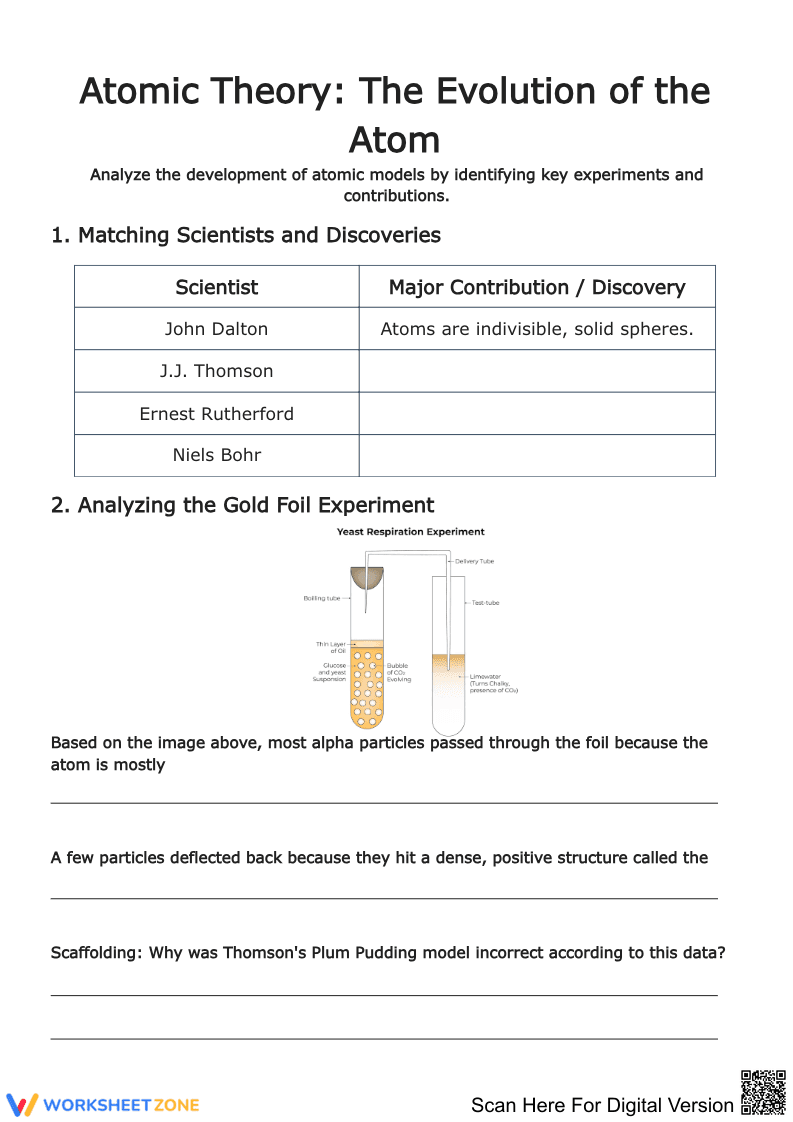
This worksheet for Grade 11 students guides them through the historical evolution of atomic theory. Students will match scientists to their major discoveries, analyze the Gold Foil Experiment, and discuss how scientific understanding of the atom has developed over time. The activities include identifying key experiments, the atomic model changes, and the reasoning behind them.
Why Use It:
This worksheet helps students understand the progression of atomic theory, supporting their grasp of key scientific concepts and the pivotal experiments that shaped our current understanding of atomic structure.
How to Use It:
• Complete the matching section for the key scientists and their contributions.
• Analyze the Gold Foil Experiment to understand how Rutherford’s results refuted Thomson’s Plum Pudding model.
• Answer critical thinking questions regarding the experiment and model revisions.
Grade Suitability:
Best suited for Grade 11 students.
• Students studying atomic theory in chemistry or physics.
Target Users:
Grade 11 students and educators, especially those teaching atomic theory, atomic structure, and the historical development of the atomic model.
This worksheet for Grade 11 students guides them through the historical evolution of atomic theory. Students will match scientists to their major discoveries, analyze the Gold Foil Experiment, and discuss how scientific understanding of the atom has developed over time. The activities include identifying key experiments, the atomic model changes, and the reasoning behind them.
Why Use It:
This worksheet helps students understand the progression of atomic theory, supporting their grasp of key scientific concepts and the pivotal experiments that shaped our current understanding of atomic structure.
How to Use It:
• Complete the matching section for the key scientists and their contributions.
• Analyze the Gold Foil Experiment to understand how Rutherford’s results refuted Thomson’s Plum Pudding model.
• Answer critical thinking questions regarding the experiment and model revisions.
Grade Suitability:
Best suited for Grade 11 students.
• Students studying atomic theory in chemistry or physics.
Target Users:
Grade 11 students and educators, especially those teaching atomic theory, atomic structure, and the historical development of the atomic model.


