


























Views
Downloads



Grade 6 Area of Composite Figures — Essential Math Worksheet
Paste this activity's link or code into your existing LMS (Google Classroom, Canvas, Teams, Schoology, Moodle, etc.).
Students can open and work on the activity right away, with no student login required.
You'll still be able to track student progress and results from your teacher account.
This comprehensive 3-page geometry packet helps students master the calculation of area for composite rectilinear figures. By breaking complex polygons into smaller rectangles, learners develop a deep conceptual understanding of additive area. This resource transitions students from guided decomposition to independent problem-solving and real-world applications.
At a Glance
- Grade: 6 · Subject: Math
- Standard:
CCSS.MATH.CONTENT.6.G.A.1— Find area of polygons by composing into rectangles or decomposing into triangles and other shapes- Skill Focus: Area of composite figures
- Format: 3 pages · 8 problems · Answer key included · PDF
- Best For: Geometry unit practice and formative assessment
- Time: 30–45 minutes
What's Inside
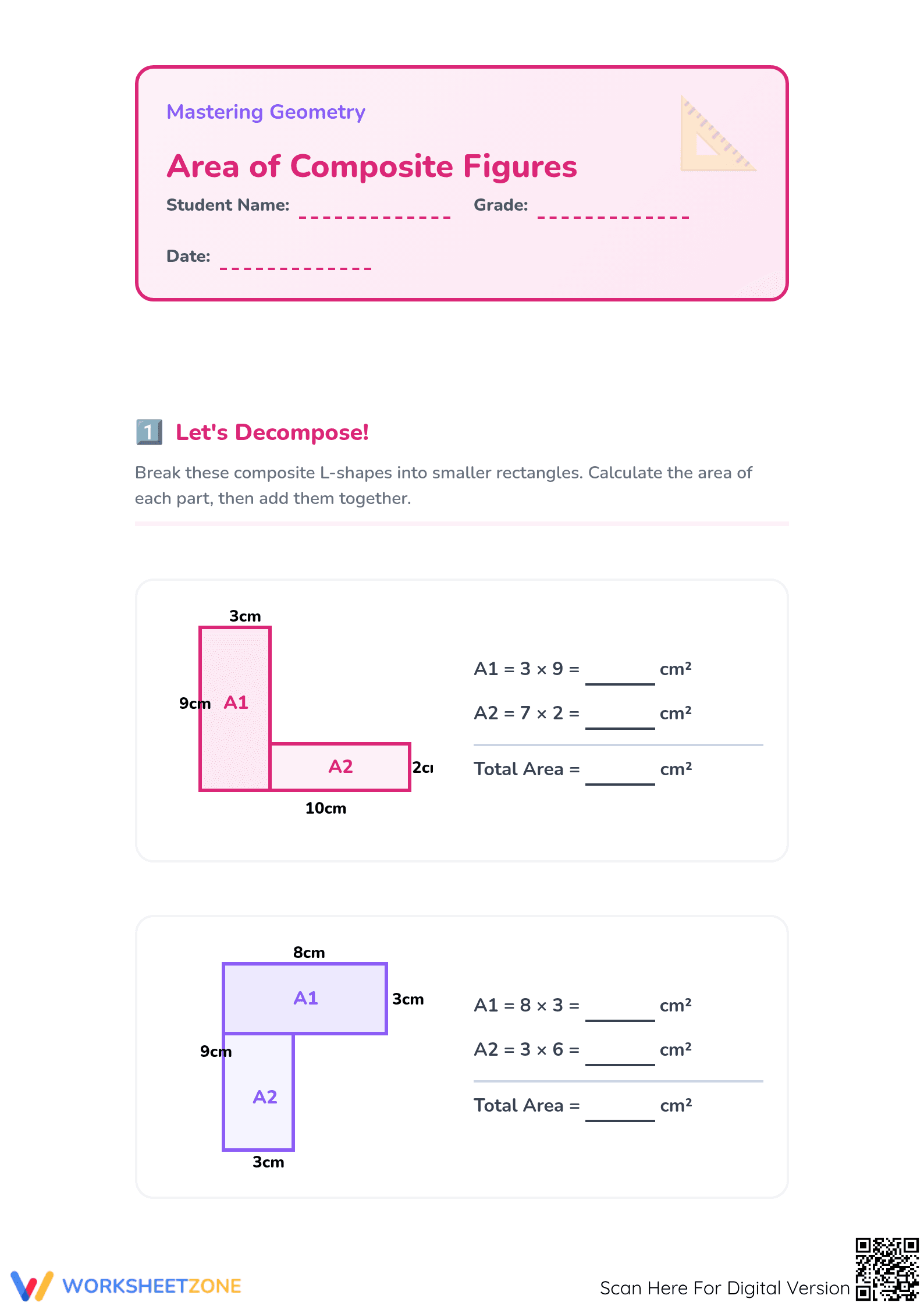
This 3-page worksheet contains 8 tasks divided into four phases. Page one introduces "Let's Decompose!", where students split L-shaped figures into rectangles. Page two challenges students with complex shapes requiring independent decomposition. The final page features a "Missing Dimension Challenge" table and three "Real World Geometry" word problems involving garden designs, pools, and carpeting. A full answer key is included to facilitate quick feedback and self-correction during the lesson.
Zero-Prep Workflow
This resource is designed for immediate classroom implementation with a total teacher preparation time of under 2 minutes. Simply print the PDF and distribute it; the instructions are self-explanatory and include examples to facilitate independent work. Reviewing results is efficient using the included answer key, which can be displayed on a whiteboard for student self-correction or used for quick grading. This structure makes it an ideal choice for emergency sub plans or last-minute geometry enrichment.
Standards Alignment
The primary standard addressed is `CCSS.MATH.CONTENT.6.G.A.1`, which requires students to find the area of polygons by decomposing them into rectangles. This worksheet focuses specifically on the decomposition of rectilinear figures into non-overlapping parts. This standard code can be copied directly into lesson plans, IEP goals, or district curriculum mapping tools to ensure instructional compliance.
How to Use It
Utilize this worksheet as primary practice during your geometry unit after students have mastered finding the area of individual rectangles. It serves as an excellent mid-unit formative assessment; observe how students choose to decompose the figures on page two to identify those who may need additional scaffolding. Most students will complete the entire packet in 30 to 45 minutes, making it suitable for a single class period or homework.
Who It's For
This packet is tailored for Grade 6 students, though it remains relevant for Grade 4 and 5 learners ready for extension work. It is particularly effective for students who benefit from visual models and structured workspaces. Pair this resource with a physical geometry anchor chart or a short video demonstration on additive area to provide a multi-modal learning experience.
Effective geometry instruction relies on the gradual release of responsibility, a framework supported by Fisher & Frey (2014) that moves students from scaffolded tasks to independent application. This worksheet applies these principles to `CCSS.MATH.CONTENT.6.G.A.1` by first providing a visual structure for decomposing composite figures before requiring independent solutions. Research indicates that students engaging with multiple representations—including geometric models and real-world word problems—show higher retention and better transfer of spatial skills. By integrating calculation tasks with "Missing Dimension" challenges, this resource ensures learners understand the underlying logic of additive area. This approach aligns with NAEP recommendations for increasing rigor in middle school mathematics through integrated problem-solving scenarios. The inclusion of three distinct pages allows for flexible pacing, ensuring all students reach mastery of area concepts at their own speed.


