


























Views
Downloads

Essential Grade 8 Exponents Practice | Powers & Bases
Paste this activity's link or code into your existing LMS (Google Classroom, Canvas, Teams, Schoology, Moodle, etc.).
Students can open and work on the activity right away, with no student login required.
You'll still be able to track student progress and results from your teacher account.
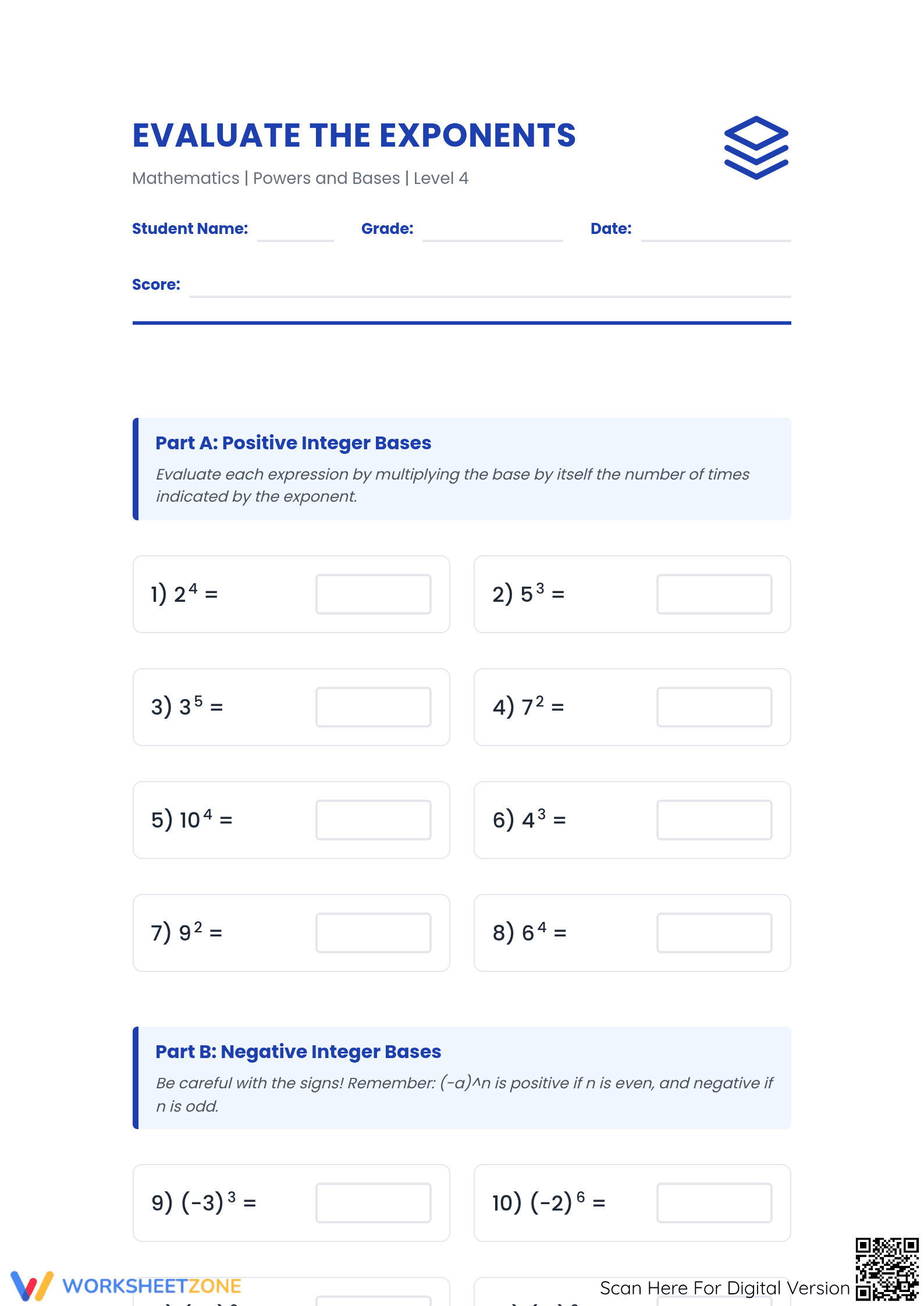
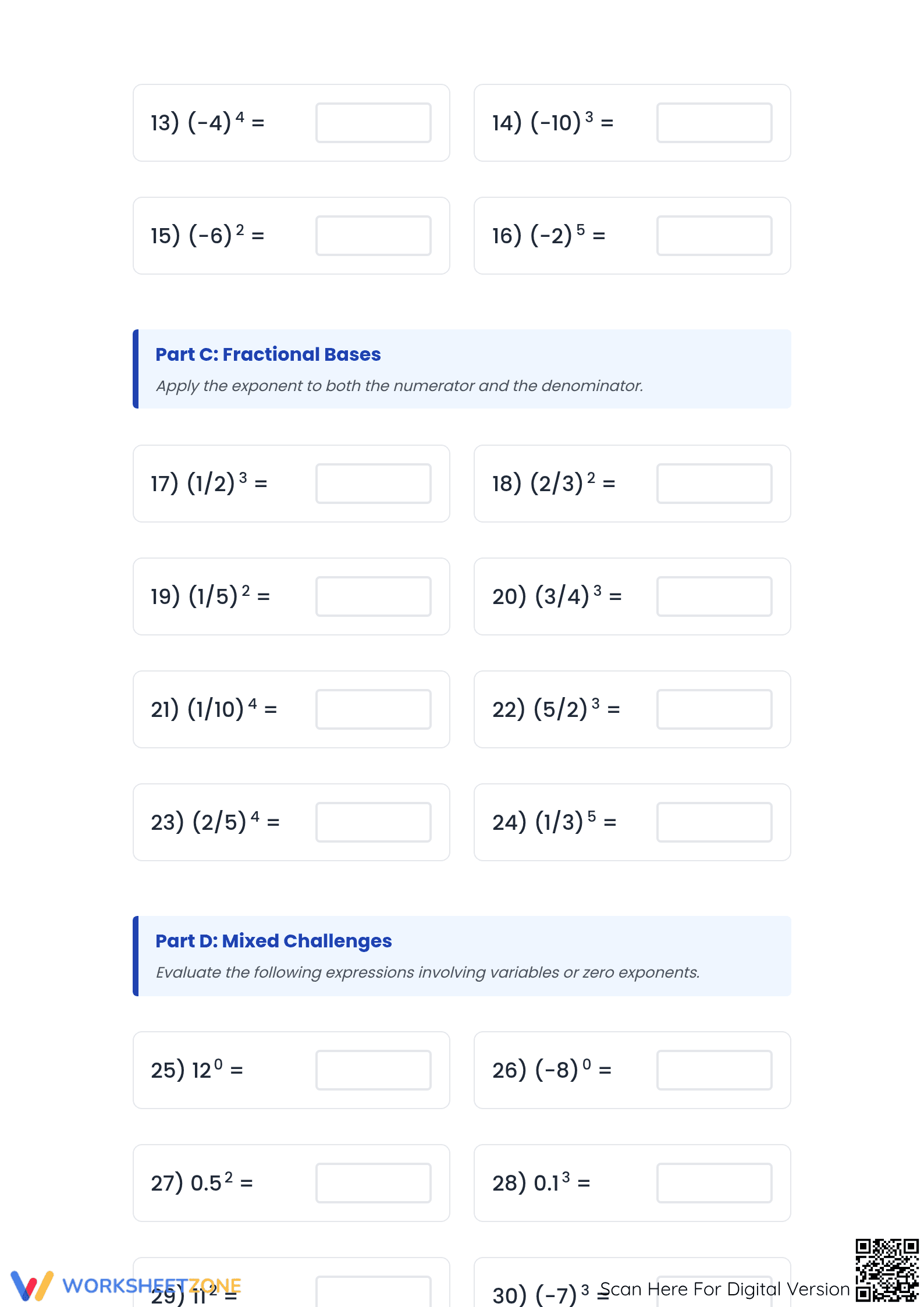
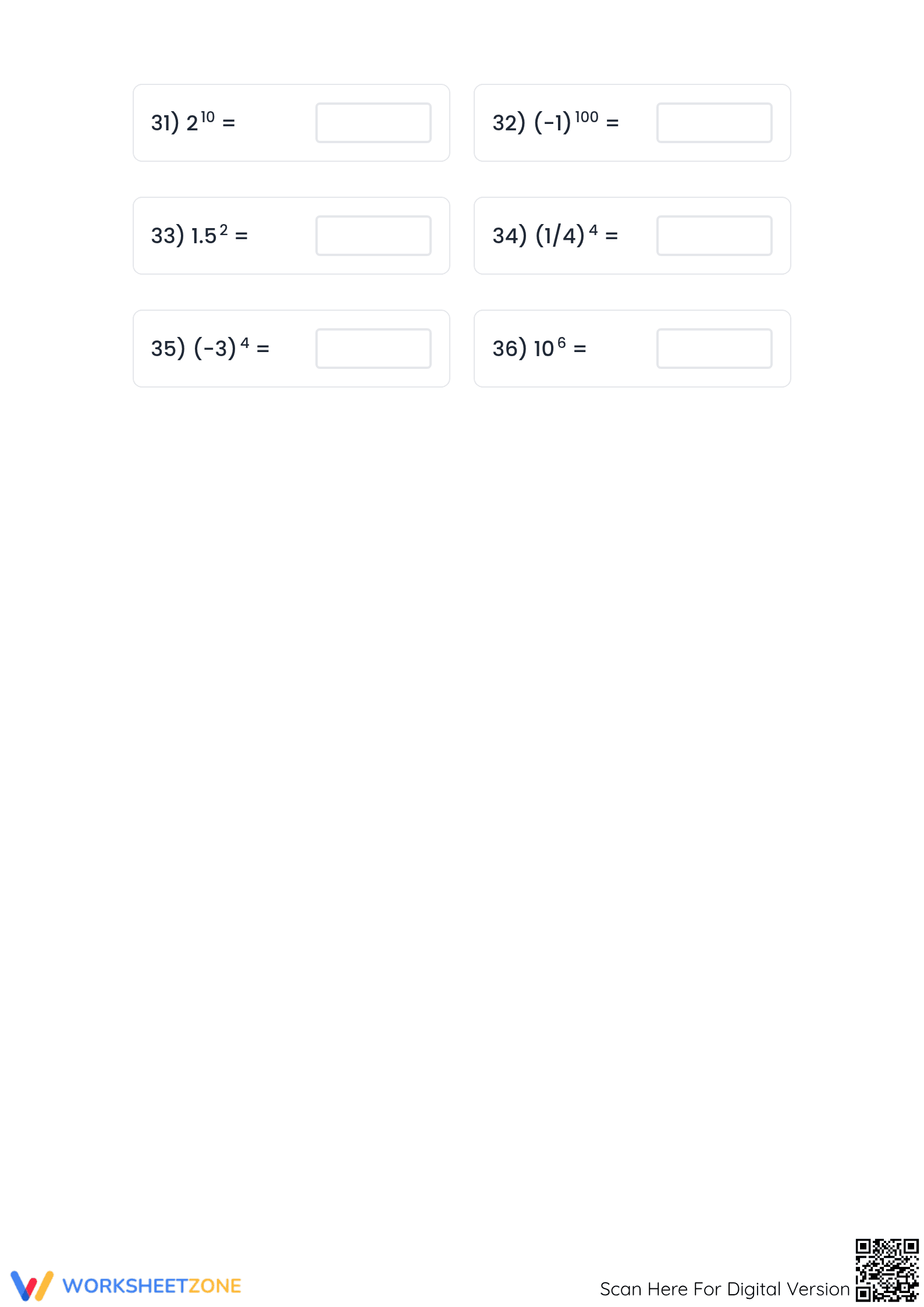
This comprehensive Math worksheet provides students with extensive practice in evaluating exponents across a wide variety of base types. Designed for middle school learners, it guides them through calculations involving positive integers, negative integers, fractional bases, and decimal bases. By completing these 36 problems, students develop the computational fluency required for advanced algebraic concepts.
At a Glance
- Grade: 6–8 · Subject: Math
- Standard:
8.EE.A.1— Apply properties of integer exponents to generate equivalent numerical expressions- Skill Focus: Evaluating Exponents (Positive, Negative, Fractions)
- Format: 3 pages · 36 problems · Answer key included · PDF
- Best For: Independent practice and fluency building
- Time: 25–40 minutes
What's Inside
The worksheet is organized into four distinct parts across three pages, providing a clear and logical progression. It features 36 total problems, a dedicated section for negative integer bases, and a challenging mixed section that includes zero exponents. A full answer key is included, allowing for quick grading or student self-correction during independent study sessions.
Skill Progression
The practice set follows a strategic skill progression to ensure mastery. It begins with Guided Practice focusing on eight positive integer bases to build initial confidence. This is followed by Supported Practice, where students navigate sixteen problems involving negative and fractional bases, requiring careful attention to signs and denominators. Finally, the Independent Practice section presents twelve mixed challenges, including zero exponents and decimals, reinforcing the gradual-release model of instruction.
Standards Alignment
This resource is specifically aligned to the primary standard CCSS.MATH.CONTENT.8.EE.A.1: "Know and apply the properties of integer exponents to generate equivalent numerical expressions." It also supports foundational skills for Grade 6 and 7 expressions and equations. The standard code can be copied directly into lesson plans, IEP goals, or district curriculum mapping tools.
How to Use It
Teachers can effectively use this worksheet as a high-quality homework assignment or a mid-unit formative assessment. For an instructional tip, observe how students handle negative bases in Part B; if they struggle with the sign rules, provide a quick anchor chart refresher. Most students will complete the entire 36-problem set within 25 to 40 minutes.
Who It's For
This worksheet is ideal for Grade 6, 7, and 8 students working on powers and bases. It is particularly useful for differentiation, as the categorical sections allow teachers to assign specific parts based on individual student needs. It pairs naturally with direct instruction on exponent rules or a classroom anchor chart on fractional powers.
According to research by Fisher & Frey (2014) on the gradual release of responsibility, structured practice that transitions from simple integer bases to complex fractional and negative bases is essential for mathematical fluency. This Grade 8 exponents worksheet is designed to facilitate this transition, providing students with 36 targeted problems that build proficiency in evaluating numerical expressions. By isolating different base types—positive, negative, and fractional—the resource allows students to focus on the specific rules governing each category before tackling mixed challenges. The inclusion of zero exponents and decimal bases further pushes students toward the mastery levels required by the CCSS.MATH.CONTENT.8.EE.A.1 standard. Such comprehensive practice helps solidify the mental models needed for higher-level algebra. This worksheet serves as a reliable tool for classroom instruction, ensuring students develop the accuracy and speed necessary for successful performance on standardized assessments and in advanced mathematics courses.


