


























Views
Downloads

Essential Mastery: Evaluate the Exponents 3 Worksheet
Paste this activity's link or code into your existing LMS (Google Classroom, Canvas, Teams, Schoology, Moodle, etc.).
Students can open and work on the activity right away, with no student login required.
You'll still be able to track student progress and results from your teacher account.
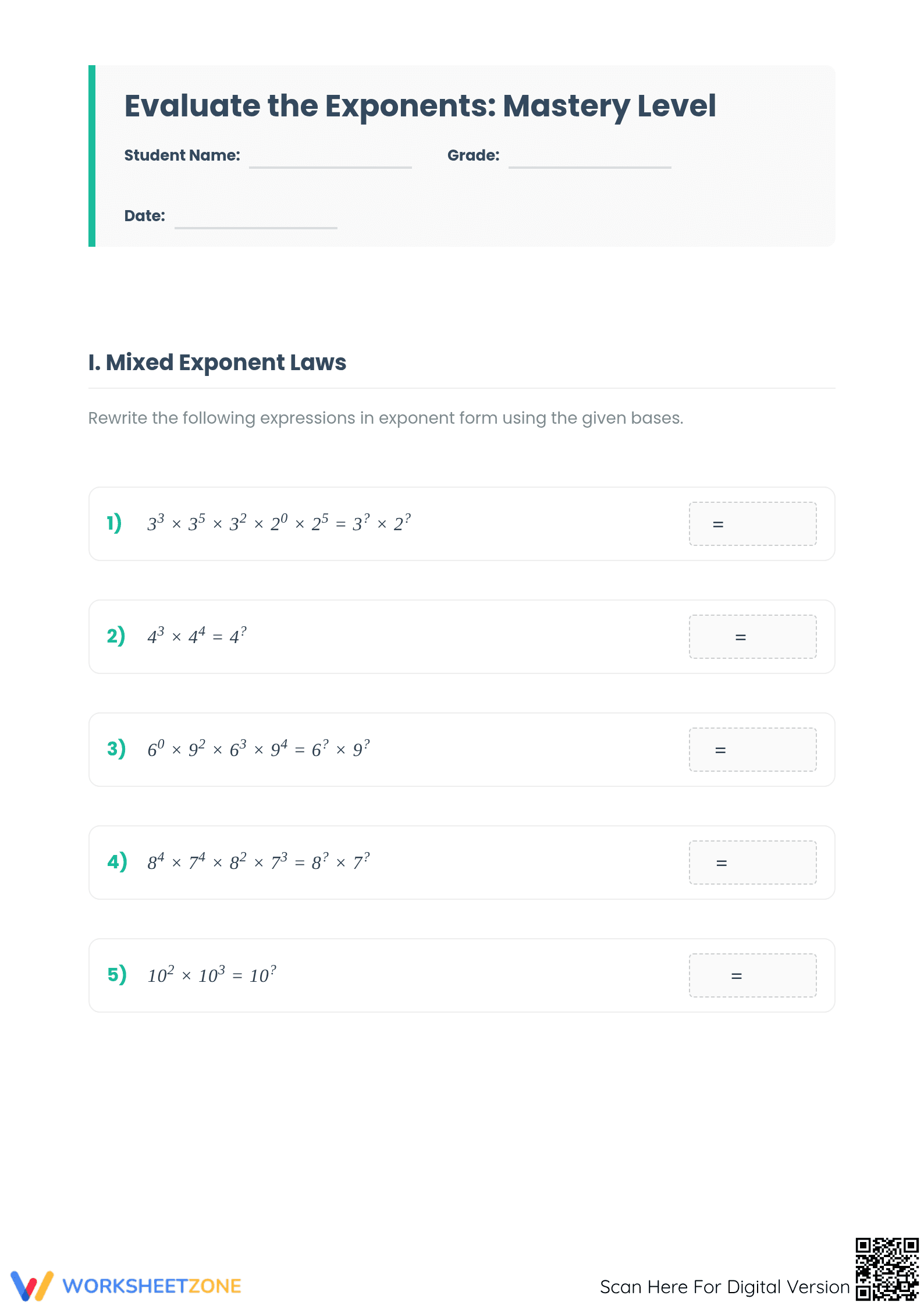
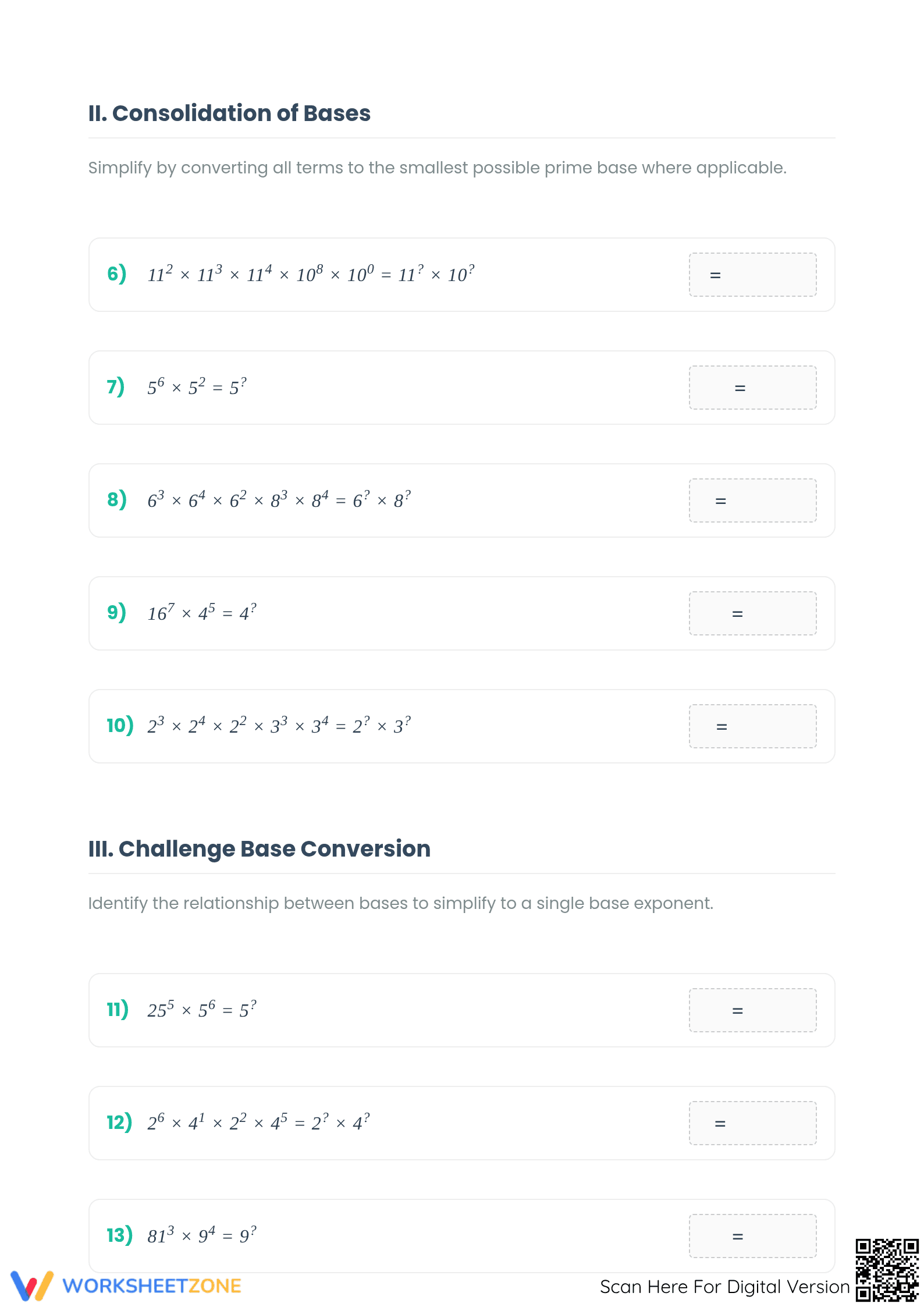
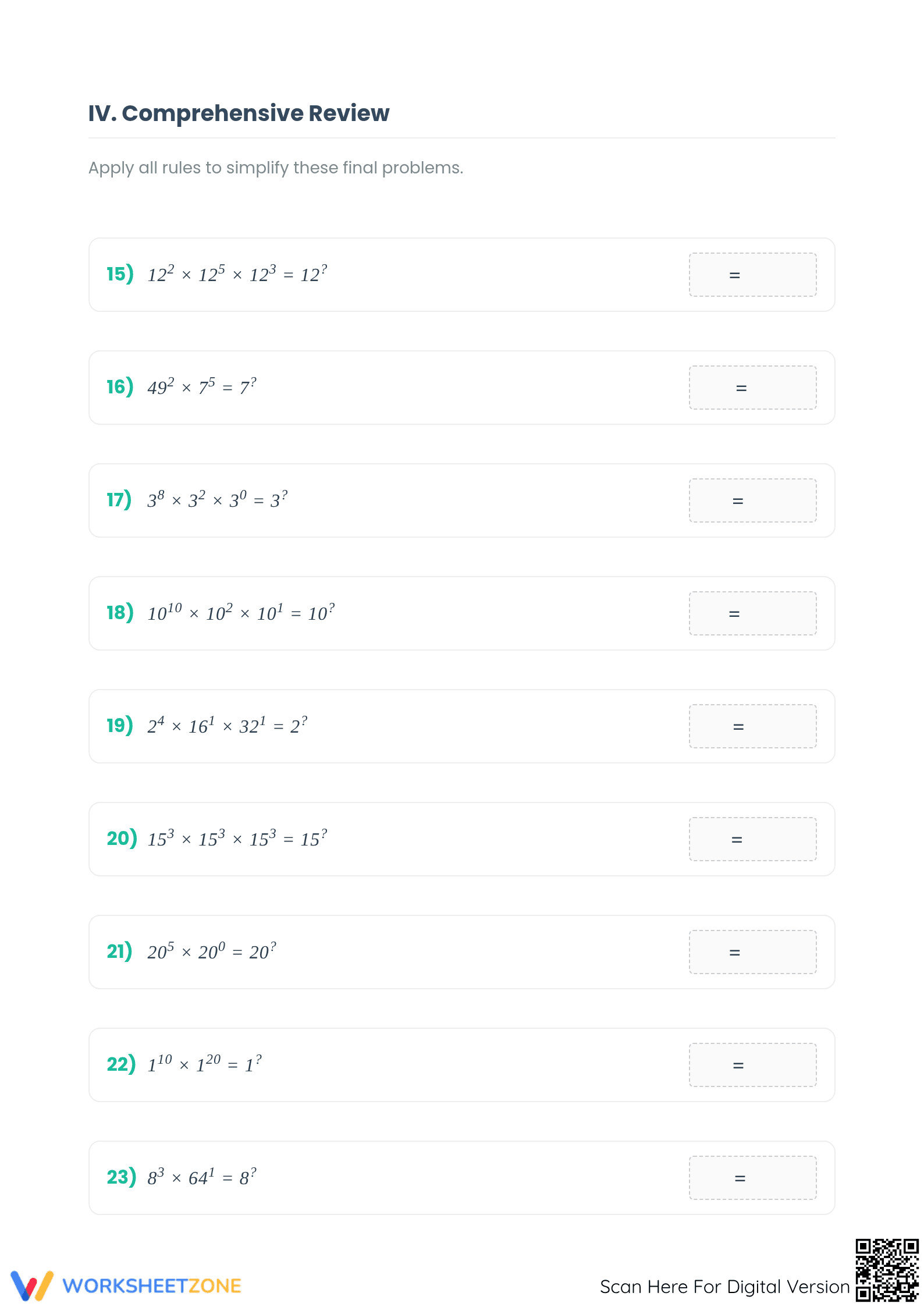
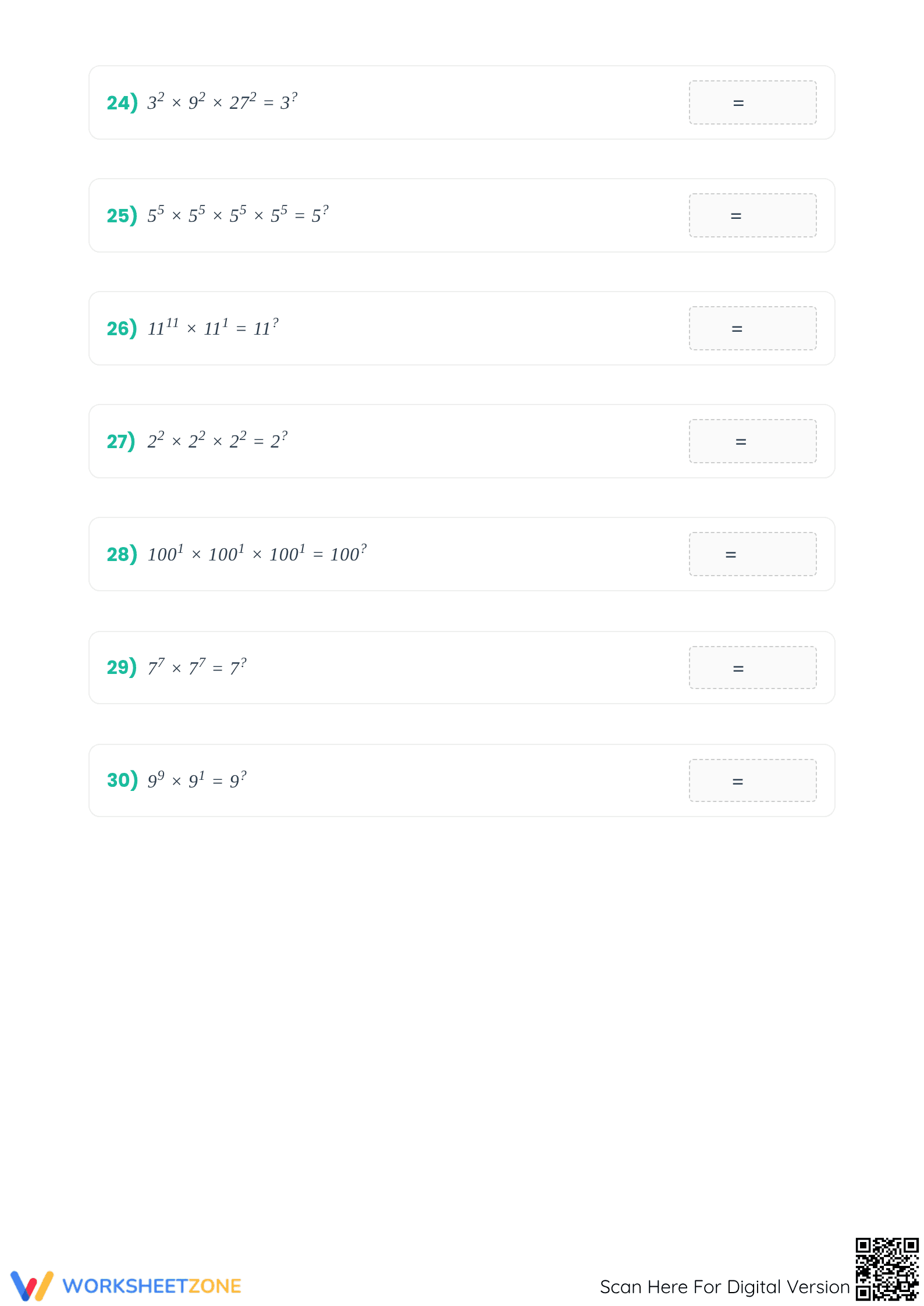
This comprehensive math worksheet empowers students to achieve mastery in evaluating exponents through 29 structured problems. By progressing from core exponent laws to complex base conversions, learners develop the procedural fluency needed for algebraic success. This resource ensures students can confidently manipulate expressions involving power rules and prime base consolidations.
At a Glance
- Grade: 8 · Subject: Math
- Standard:
CCSS.MATH.CONTENT.8.EE.A.1— Apply properties of integer exponents to generate equivalent numerical expressions- Skill Focus: Exponent Rules & Base Conversion
- Format: 4 pages · 29 problems · Answer key included · PDF
- Best For: Mastery assessment or intensive skill practice
- Time: 45–60 minutes
What's Inside
This 4-page collection features four sections designed to build expertise. Section I focuses on mixed exponent laws with same bases. Section II introduces the consolidation of bases into prime forms. Section III provides challenge problems requiring base identification to simplify expressions. Finally, the Comprehensive Review applies all rules across sixteen diverse problems. A full answer key is provided for immediate grading or self-correction.
Mastery Evidence
The worksheet structure maps directly to standard `8.EE.A.1` proficiency levels. Section I assesses the "Approaching" tier through core law application. Sections II and III target the "Meeting" tier, requiring higher-order thinking to transform bases into prime numbers. The final review serves as "Exceeding" evidence, demonstrating the ability to synthesize multiple rules in a single expression. Results from these 29 items can be recorded as evidence of mastery in progress reports. Scores can be entered directly into gradebooks or IEP progress notes for performance tracking.
Standards Alignment
The primary focus is `CCSS.MATH.CONTENT.8.EE.A.1`: "Know and apply the properties of integer exponents to generate equivalent numerical expressions." This resource also supports `6.EE.A.1` through complex multi-step simplifications. Both standard codes can be copied directly into lesson plans, IEP goals, or district curriculum mapping tools.
How to Use It
Use this resource as a summative assessment to verify student readiness for scientific notation or algebraic functions. Alternatively, assign specific sections for targeted intervention during small-group instruction. Teachers should observe student work in Section III to identify misconceptions regarding base relationships. Expected completion time for the full 29-problem set is approximately 50 minutes.
Who It's For
This worksheet is ideal for Grade 8 students working toward standard mastery and Grade 9 learners needing algebraic review. Scaffolding makes it accessible for diverse students, while challenge sections provide extension for advanced learners. Pair this with a digital calculator for self-checking or an exponent rules anchor chart for additional support during the initial review phase.
According to Fisher & Frey (2014), the gradual release of responsibility model is essential for developing mathematical mastery, particularly when dealing with the abstract rules of exponent manipulation. This worksheet embodies that principle by transitioning students from guided law application in Section I to independent synthesis in the final review. By solving 29 diverse problems, students engage in high-repetition practice that moves procedural knowledge into long-term memory. Research indicates that standard CCSS.MATH.CONTENT.8.EE.A.1 serves as a critical bridge between arithmetic operations and the complex functions encountered in secondary mathematics. This resource provides the rigorous alignment necessary for high-stakes assessment preparation while maintaining clear instructional scaffolding. The inclusion of base consolidation tasks ensures that learners are not merely memorizing rules but are developing a deep conceptual understanding of numerical structures. This evidence-based approach aligns with current best practices for middle school mathematics instruction and standard-based grading systems.


