


























Views
Downloads

Evaluate Exponents Worksheet | Grade 6 Essential
Paste this activity's link or code into your existing LMS (Google Classroom, Canvas, Teams, Schoology, Moodle, etc.).
Students can open and work on the activity right away, with no student login required.
You'll still be able to track student progress and results from your teacher account.
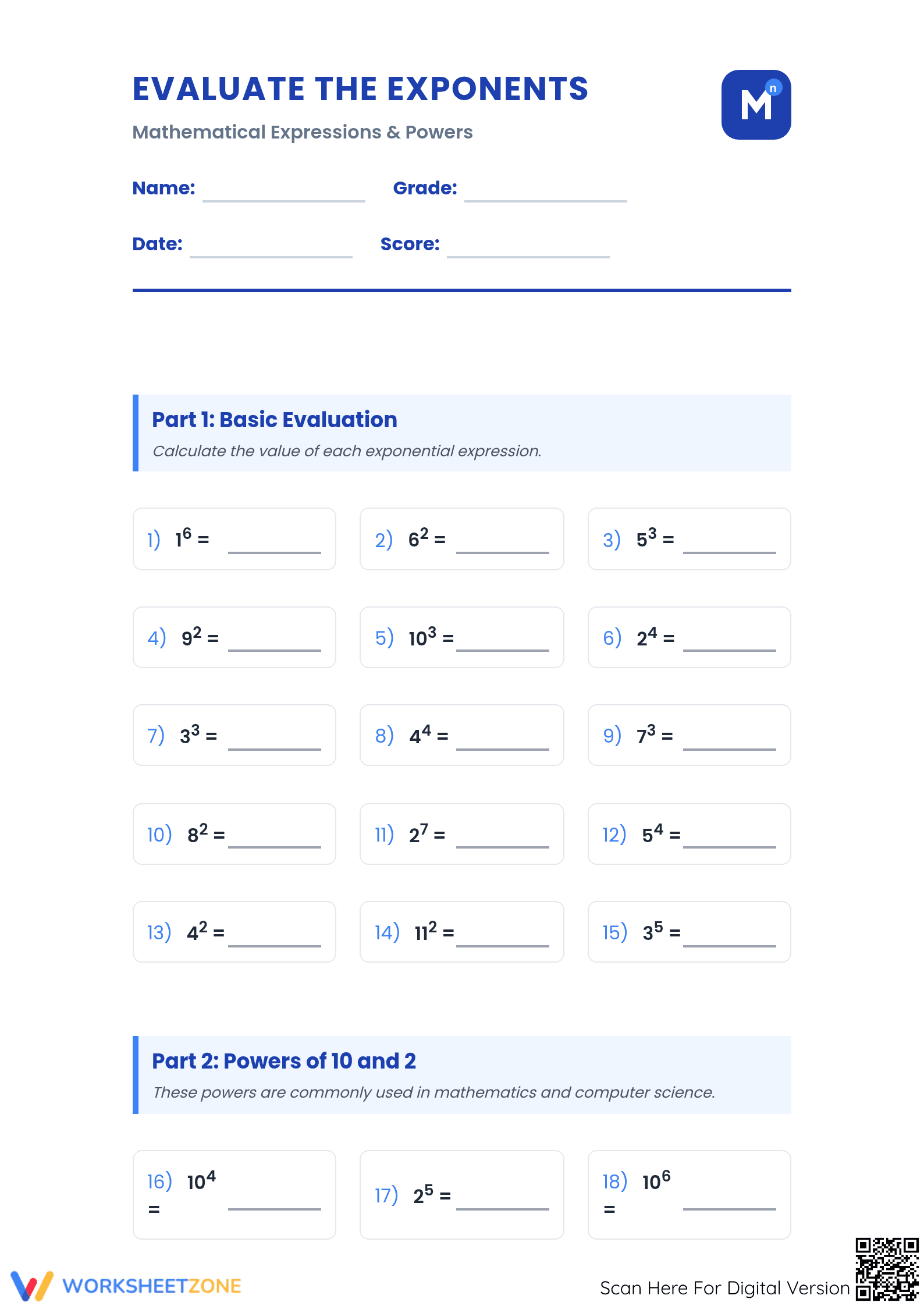
Students master the fundamentals of powers and bases with this comprehensive 3-page practice set. By calculating basic values and applying exponents to complex expressions and real-world scenarios, learners build the numerical fluency required for middle school algebra. This resource ensures students can confidently evaluate numerical expressions involving whole-number exponents across diverse mathematical contexts.
At a Glance
- Grade: 6 · Subject: Math
- Standard:
CCSS.MATH.CONTENT.6.EE.A.1— Write and evaluate numerical expressions involving whole-number exponents- Skill Focus: Exponential Evaluation
- Format: 3 pages · 38 problems · Answer key included · PDF
- Best For: Classroom practice and sub plans
- Time: 35–45 minutes
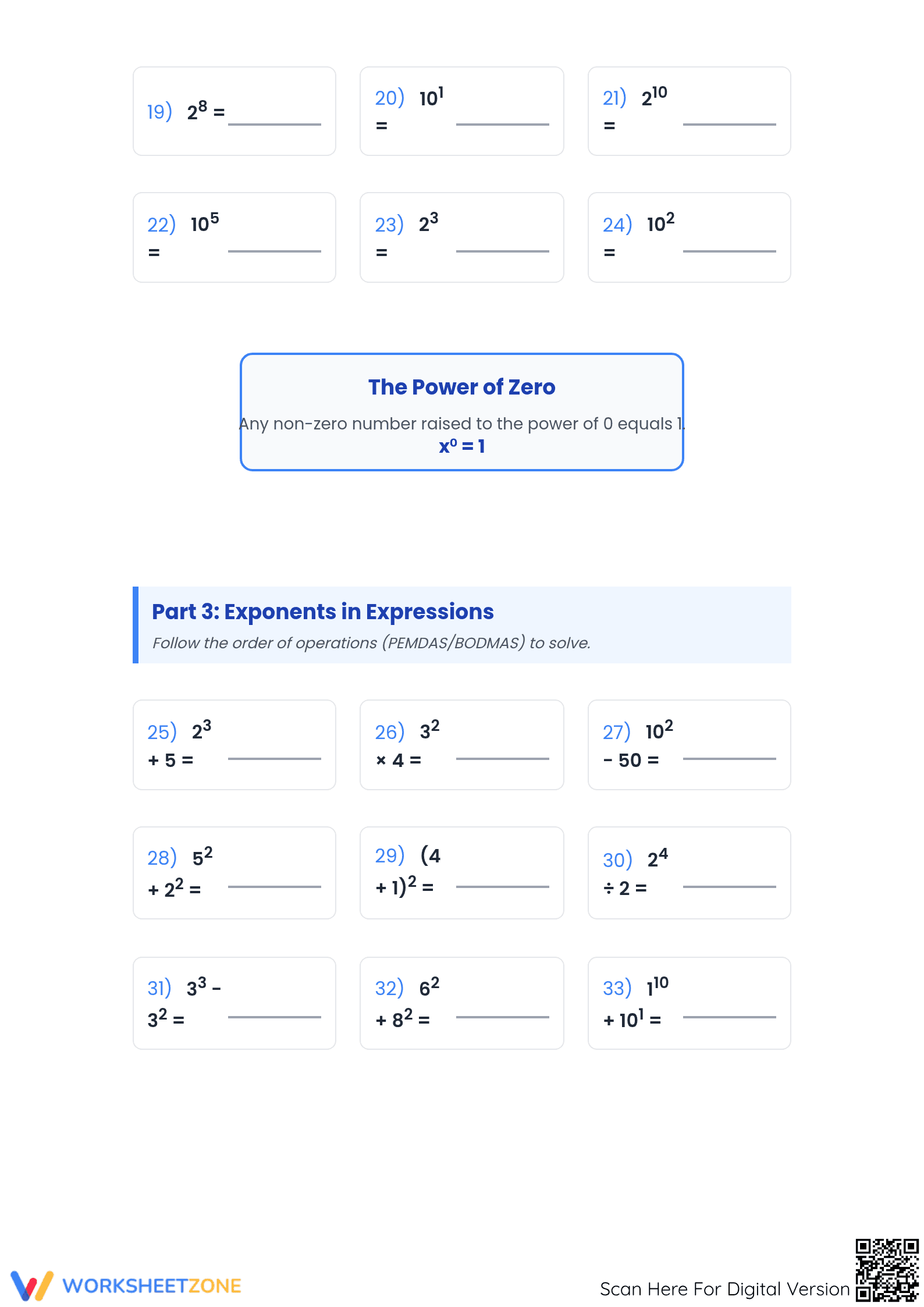
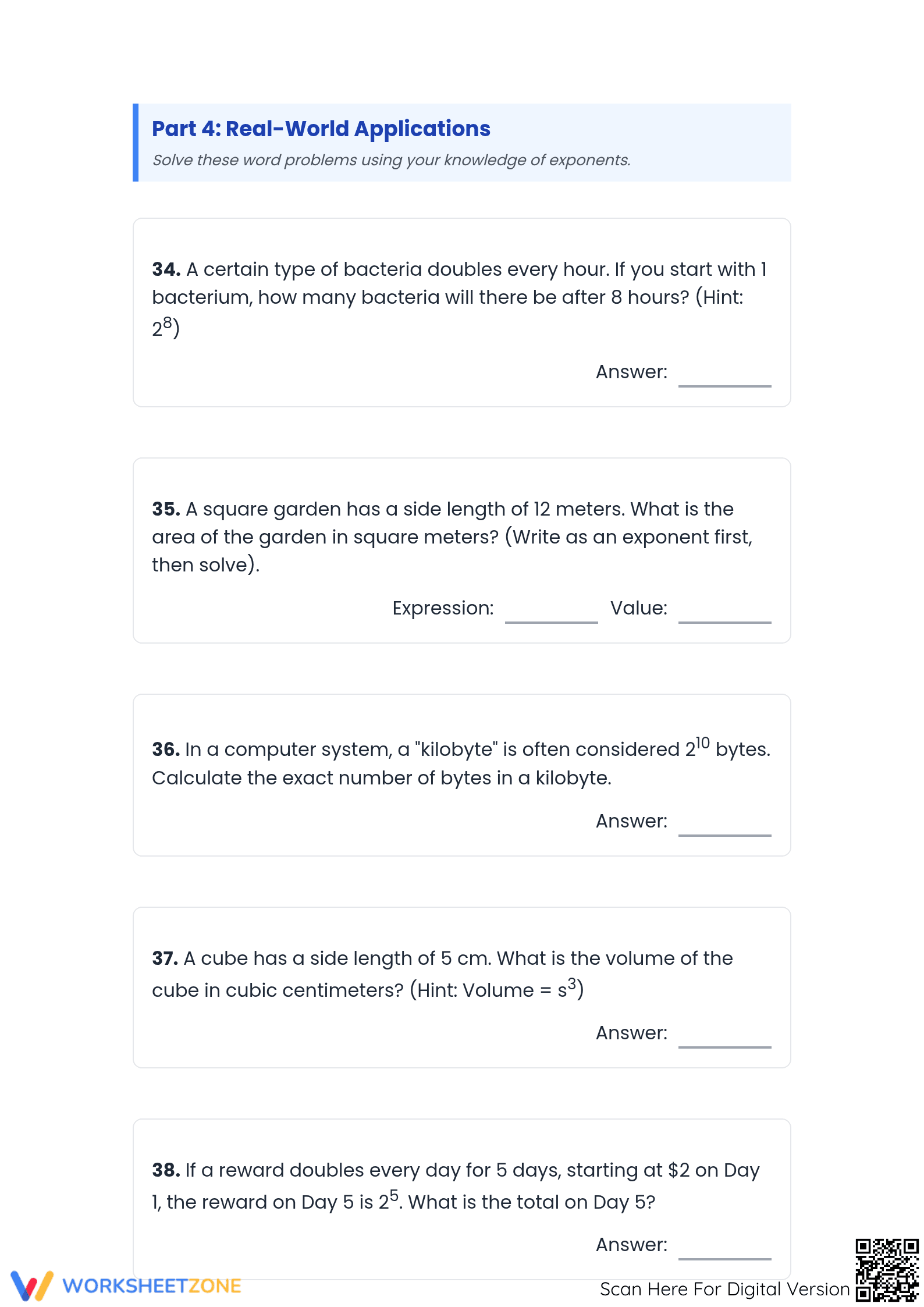
This packet features 38 distinct problems organized into four logical sections. It includes basic exponent evaluation, focused practice with powers of 10 and 2, order of operations (PEMDAS) integration, and real-world word problems involving bacteria growth and volume. A complete answer key is provided for immediate feedback and grading efficiency.
This zero-prep workflow saves valuable instructional time. Simply print the three-page PDF and distribute it to students in under two minutes. Because the tasks progress from simple calculations to complex applications, it functions perfectly as an independent sub plan or a comprehensive homework assignment that requires no teacher-led setup or additional materials.
Standards Alignment
Aligned to CCSS.MATH.CONTENT.6.EE.A.1, students write and evaluate numerical expressions involving whole-number exponents. The worksheet also supports foundational work for 8.EE.A.1 by exploring base-10 and base-2 patterns. Both standard codes can be copied directly into lesson plans, IEP goals, or district curriculum mapping tools.
How to Use It
Assign Part 1 and 2 during direct instruction to verify basic fluency with bases and exponents. Use Parts 3 and 4 as a formative assessment during the following class period to observe how students apply these skills to the order of operations and word problems. Most students will complete the full set in 35–45 minutes, making it an ideal anchor activity.
Who It's For
Designed for Grade 6–8 students, this resource supports general education learners and provides excellent reinforcement for those requiring extra practice with numeric expressions. It pairs naturally with an exponent anchor chart or a "Laws of Exponents" introductory passage to provide a balanced mix of theory and practice.
Research conducted by Fisher & Frey (2014) emphasizes the importance of a gradual release of responsibility when introducing abstract mathematical concepts like exponential notation. This worksheet mirrors that pedagogical shift by moving students from basic calculation (calculating squares and cubes) to complex application (applying exponents to real-world biology and geometry problems). By isolating the standard CCSS.MATH.CONTENT.6.EE.A.1, which requires students to evaluate numerical expressions involving whole-number exponents, the resource ensures targeted practice that avoids cognitive overload. The inclusion of base-10 and base-2 sections specifically addresses common misconceptions regarding magnitude and place value, providing the repetitive exposure necessary for long-term retention. As students navigate the transition from arithmetic to algebraic thinking, having a structured environment to practice evaluating powers ensures they develop the procedural fluency needed for higher-level functions. This comprehensive approach aligns with current best practices in mathematics instruction for middle grade learners.


