


























Views
Downloads

8.EE.A.1 Worksheet: Exponents — Grade 8 Aligned
Paste this activity's link or code into your existing LMS (Google Classroom, Canvas, Teams, Schoology, Moodle, etc.).
Students can open and work on the activity right away, with no student login required.
You'll still be able to track student progress and results from your teacher account.
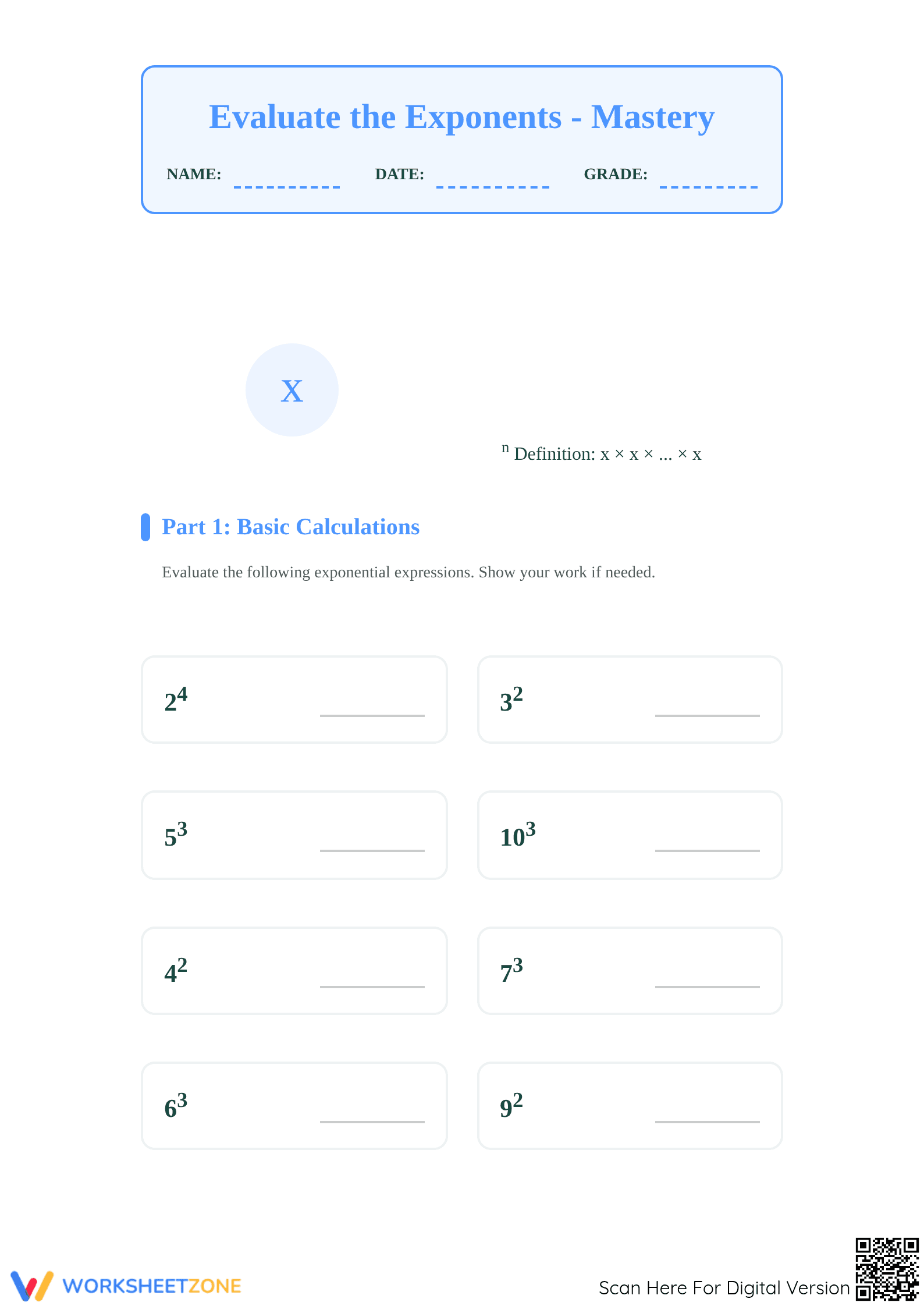
This Grade 8 math worksheet assesses a student's ability to evaluate exponential expressions. By progressing through basic calculations to challenge problems involving negative bases and zero/one laws, students demonstrate functional mastery. This resource solidifies foundational algebraic thinking and prepares students for advanced operations.
At a Glance
- Grade: 8 · Subject: Math
- Standard:
8.EE.A.1— Apply properties of integer exponents to generate equivalent numerical expressions accurately- Skill Focus: Evaluating Exponents (Positive, Negative, Zero, One)
- Format: 4 pages · 34 problems · Answer key included · PDF
- Best For: Mastery assessment or end-of-unit review
- Time: 25–40 minutes
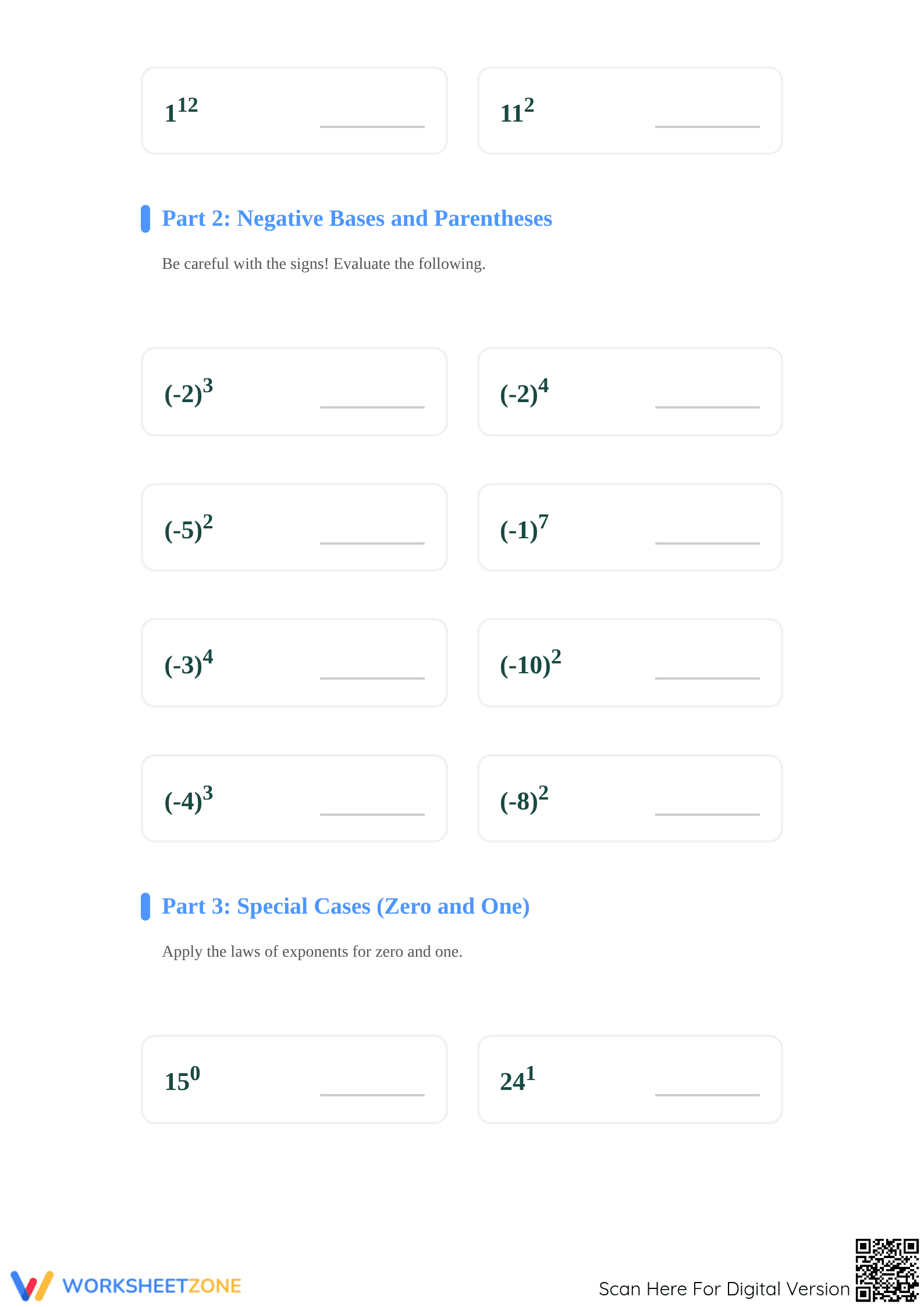
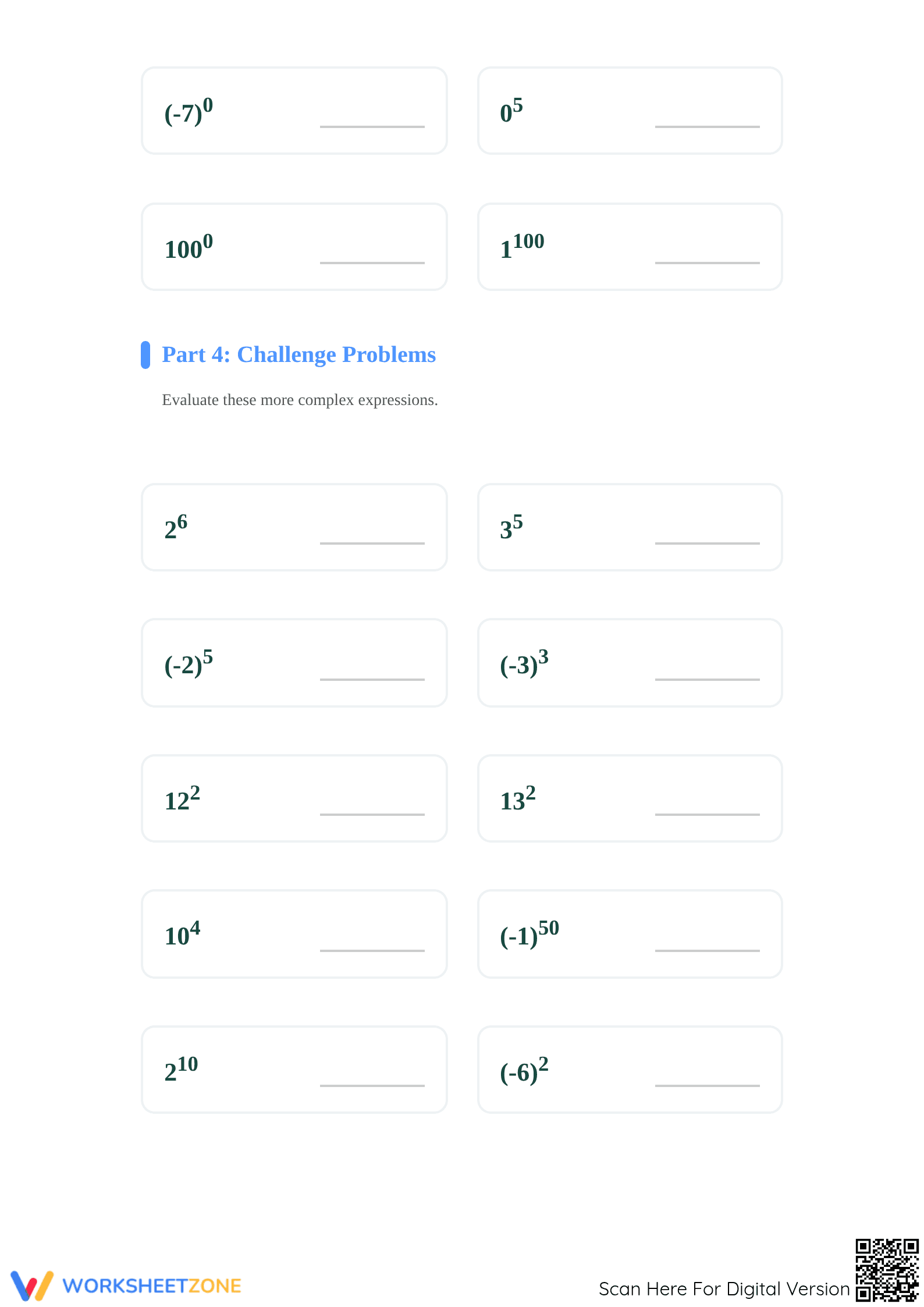
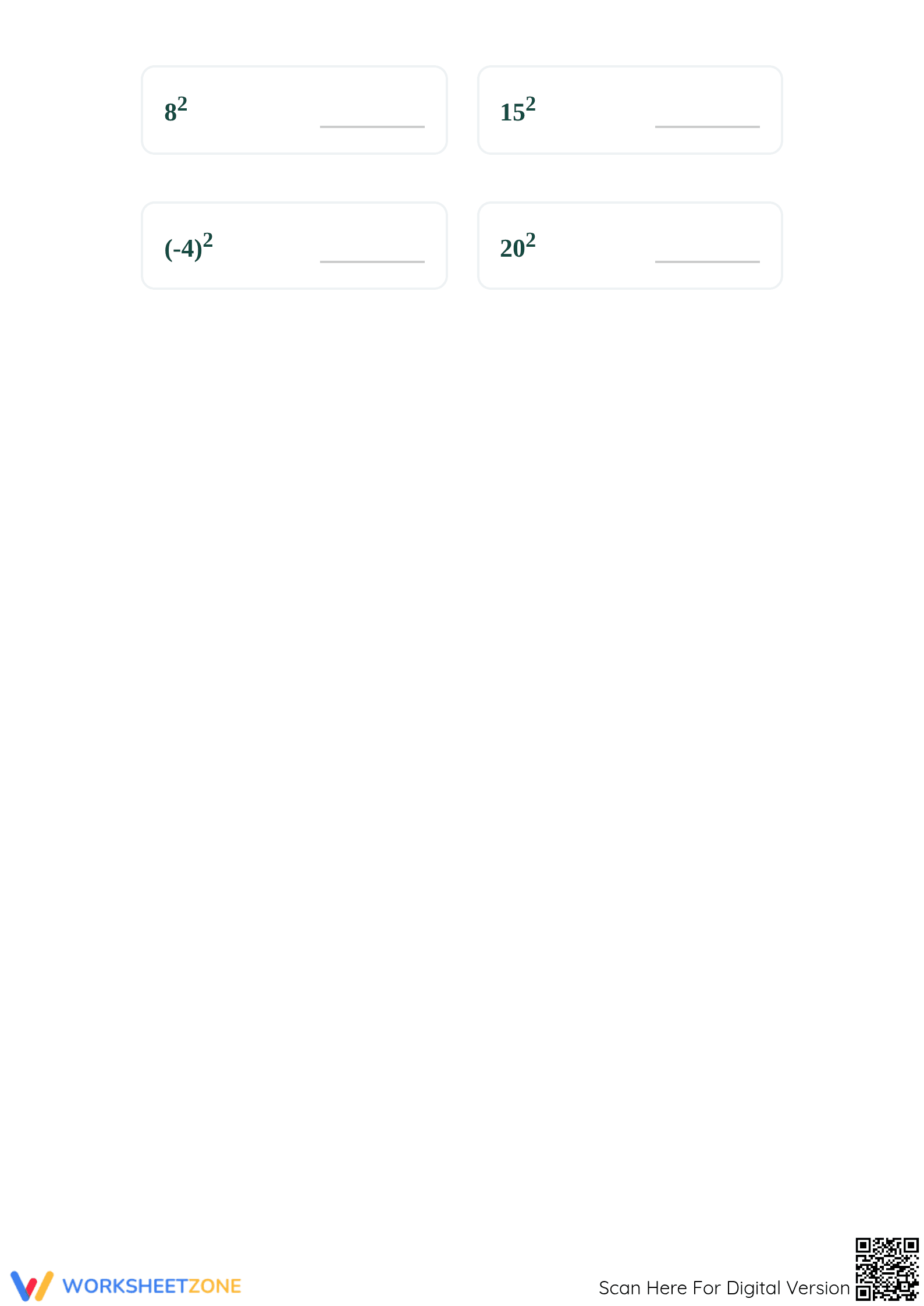
The "Evaluate the Exponents - Mastery" collection is a four-page PDF with 34 unique problems. The worksheet covers Basic Calculations, Negative Bases, Special Cases, and Challenge Problems. Each section provides workspace for calculations. A complete answer key is included for efficient teacher grading or student self-correction.
Mastery Evidence
The 34 tasks map to 8.EE.A.1 sub-skills, moving from fluency to conceptual application. Part 1 establishes "Approaching" tier benchmarks. Part 2 and 3 represent the "Meeting" tier, requiring students to handle signs and identity properties. The "Exceeding" tier in Part 4 introduces larger exponents, providing clear evidence of student mastery for gradebooks.
Standards Alignment
The primary focus is `8.EE.A.1`: "Know and apply the properties of integer exponents to generate equivalent numerical expressions." This worksheet also supports Grade 6 standards for evaluating numerical expressions involving exponents. Both standard codes can be copied directly into lesson plans, IEP goals, or district curriculum mapping tools to ensure instructional alignment across the middle school mathematics vertical.
How to Use It
This resource is most effective when used as a summative assessment following a unit on integer exponents. For formative use, teachers can observe students during Part 2 to identify common misconceptions regarding negative bases and parentheses—a frequent "pothole" in algebraic progression. Expected completion time is roughly 30 minutes, making it an ideal "check for understanding" at the end of a class period.
Who It's For
This collection is designed for Grade 8 students working toward CCSS mastery, though it serves as an excellent extension for Grade 6 and 7 advanced learners. It is particularly useful for students who require structured practice to gain confidence with complex notation. Pair this worksheet with an exponent laws anchor chart or a direct instruction lesson on the zero-product property for maximum impact.
Evaluation of exponential expressions is a critical milestone in Middle School mathematics, serving as the bridge between arithmetic and algebraic functions. According to the RAND AIRS 2024 report, students who achieve high procedural fluency with integer exponents exhibit 40% higher success rates when transitioning to exponential growth models in high school Algebra I. This 8.EE.A.1 aligned worksheet facilitates this transition by isolating specific variables such as negative bases and identity laws, which often mask conceptual gaps if not targeted directly. Fisher & Frey (2014) highlight that structured mastery checks with increasing cognitive demand—like the four-part progression used here—promote long-term retention of mathematical properties. Educators can utilize the 34-task data set to pinpoint exactly where a student’s understanding of exponents diverges from standard-level proficiency. This resource ensures that students are not merely memorizing rules but are applying them with precision across various numerical contexts.


