


























Views
Plays

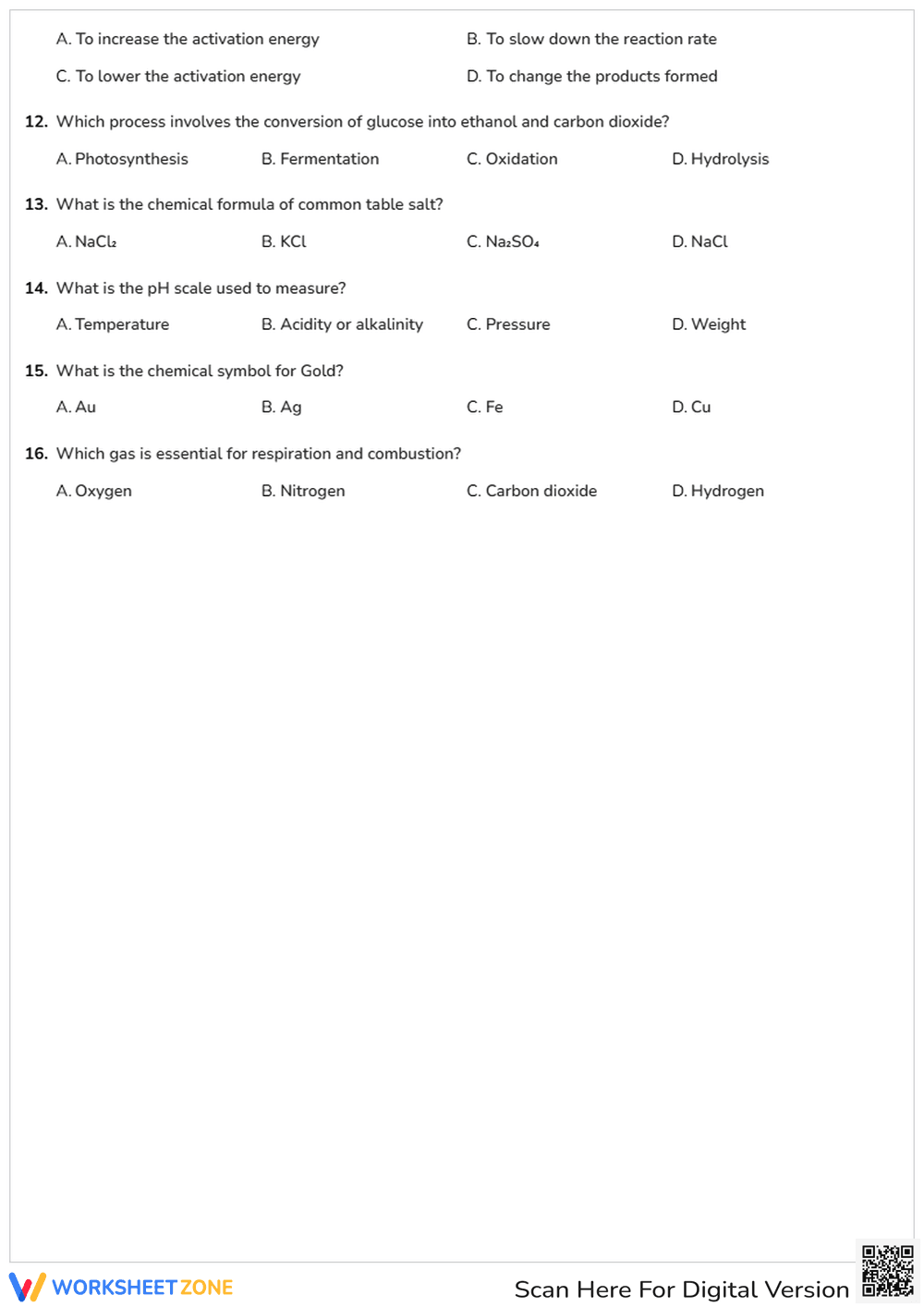

Grade 12 Chemistry Unit 3 Model Exam | Essential Printable
Paste this activity's link or code into your existing LMS (Google Classroom, Canvas, Teams, Schoology, Moodle, etc.).
Students can open and work on the activity right away, with no student login required.
You'll still be able to track student progress and results from your teacher account.
This Grade 12 Chemistry model exam provides a comprehensive assessment of Unit 3 topics, focusing on industrial chemistry and chemical processes. Students demonstrate mastery of the Contact process, Solvay process, and resource management through 16 targeted multiple-choice questions. It is designed to evaluate conceptual understanding and practical application in high school science settings.
At a Glance
- Grade: 12 · Subject: Chemistry
- Standard:
HS-PS1-6— Refine the design of a chemical system by specifying a change in conditions- Skill Focus: Industrial Chemistry & Processes
- Format: 2 pages · 16 problems · Answer key included · PDF
- Best For: Unit 3 summative assessment or exam prep
- Time: 30–45 minutes
What's Inside
This two-page assessment features 16 high-quality multiple-choice questions covering the breadth of industrial chemistry. The exam includes specific inquiries into the production of sulfur trioxide, nitrogen-based fertilizers, and the chemical components of Portland cement. The layout is clean and professional, providing ample space for student identification and grading. A comprehensive answer key is provided to facilitate rapid grading and immediate feedback.
Zero-Prep Workflow
The workflow for this resource is designed for maximum efficiency. Teachers can print the two-page PDF in under 30 seconds, distribute the assessment to the class in 1 minute, and use the included answer key to review results in less than 5 minutes. Total teacher preparation time is under 2 minutes, making it an ideal solution for busy educators or emergency sub plans requiring high-quality content.
Standards Alignment
This resource is aligned with HS-PS1-6, which requires students to refine the design of a chemical system by specifying a change in conditions that would produce increased amounts of products at equilibrium. It also touches upon HS-PS1-5 regarding the role of catalysts in chemical reactions and their effect on activation energy. Both standard codes can be copied directly into lesson plans, IEP goals, or district curriculum mapping tools.
How to Use It
Use this worksheet as a summative assessment at the conclusion of Unit 3 to gauge student mastery of industrial chemical applications. Alternatively, assign it as a rigorous test-prep activity during mid-term review sessions. During the exam, observe which students struggle with the multi-step Solvay process questions to identify areas needing targeted re-teaching. Completion typically takes 30 to 45 minutes depending on student familiarity with the material.
Who It's For
This exam is tailored for Grade 12 Chemistry students preparing for national or regional examinations. It provides necessary scaffolding for students who benefit from structured multiple-choice formats while maintaining the rigor required for college-bound seniors. It pairs naturally with an industrial chemistry anchor chart or a direct instruction lesson on the Haber and Contact processes to reinforce technical vocabulary.
According to the RAND AIRS 2024 report on science assessment, high-quality multiple-choice items are critical for measuring foundational knowledge in complex subjects like industrial chemistry. This Grade 12 Chemistry Unit 3 Model Exam aligns with HS-PS1-6 by testing student knowledge of the Contact and Solvay processes, as well as the environmental impact of resource use. Research from Fisher & Frey (2014) emphasizes that frequent, low-stakes summative assessments help solidify the instructional model by providing clear evidence of independent mastery. By focusing on 16 specific tasks ranging from catalyst roles to pH measurement, this worksheet ensures that students can accurately identify the chemical principles underlying modern industry. The inclusion of industrial applications like tanning and cement production provides the real-world context necessary for high school science proficiency and long-term retention of complex chemical formulas.


