


























Views
Downloads





Essential Symbolic Reading Worksheet | Grade 10 English II
Paste this activity's link or code into your existing LMS (Google Classroom, Canvas, Teams, Schoology, Moodle, etc.).
Students can open and work on the activity right away, with no student login required.
You'll still be able to track student progress and results from your teacher account.
This Grade 10 English II worksheet teaches students to test and revise symbolic readings when confronted with anomalous textual evidence. Working through an original narrative passage, learners cite rigorous details to move beyond superficial interpretations, qualifying literary claims and analyzing character self-deception through close reading.
At a Glance
- Grade: 10 · Subject: English II
- Standard:
RL.9-10.1— Cite strong textual evidence to support and test interpretive analyses- Skill Focus: Test a Symbolic Reading Against a New Detail
- Format: 6 pages · 10 problems · Answer key included · PDF
- Best For: Close reading and analytical revision practice
- Time: 45–60 minutes
What's Inside
The 6-page printable resource features an opening theoretical framework on self-correcting analysis, followed by an original short story titled “The Regulator on the Mantel.” Students complete 10 analytical tasks divided across theoretical constraints, textual evidence tracking, and formal thesis revision, supported by a 4-page answer key.
Skill Progression
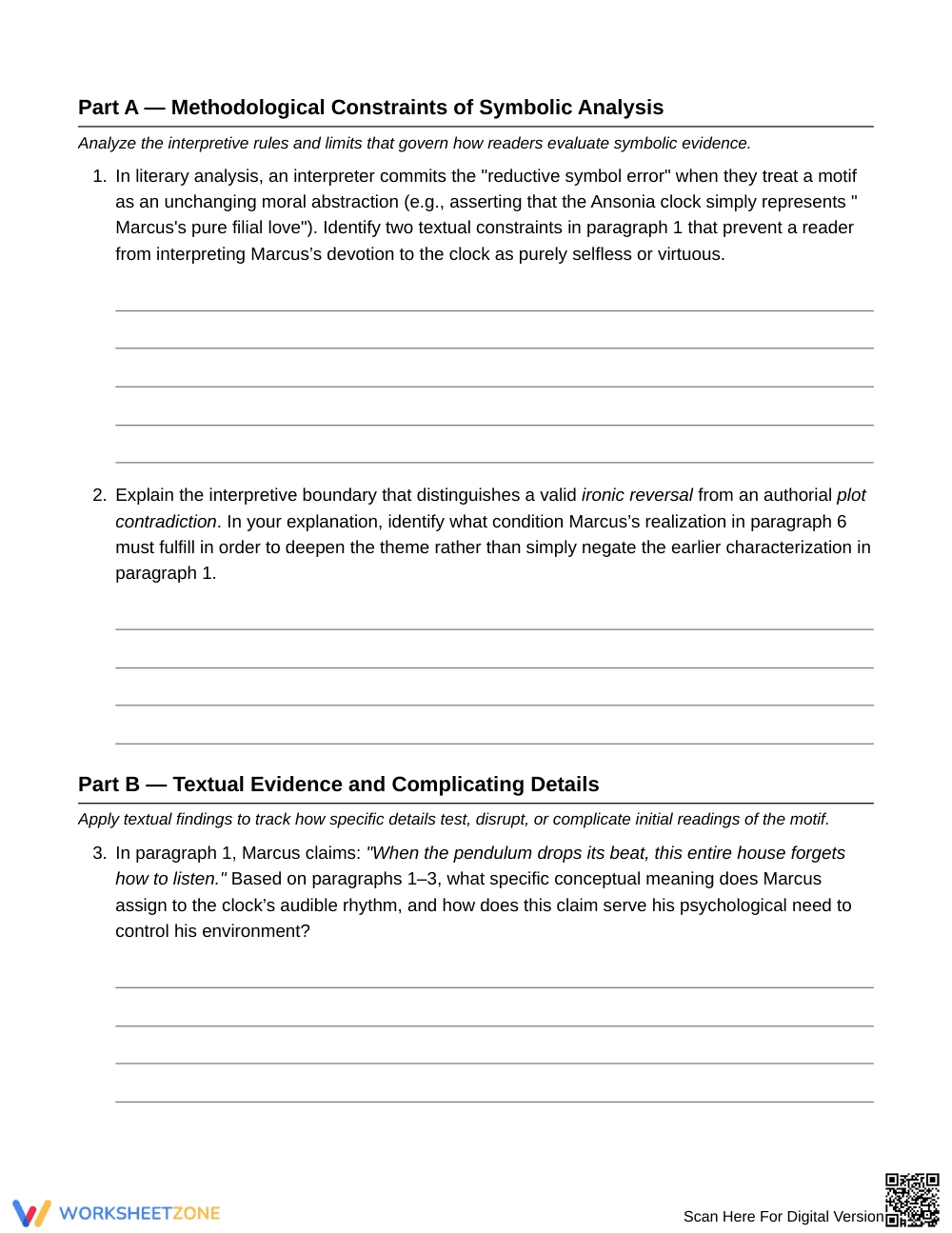
- Guided practice (Part A, 2 tasks): Students evaluate rules governing symbolism, defining reductive interpretation errors and distinguishing ironic reversals from plot inconsistencies.
- Supported practice (Part B, 6 tasks): Learners analyze text excerpts, examining mechanical failure and physical counter-evidence to track disrupted character assumptions.
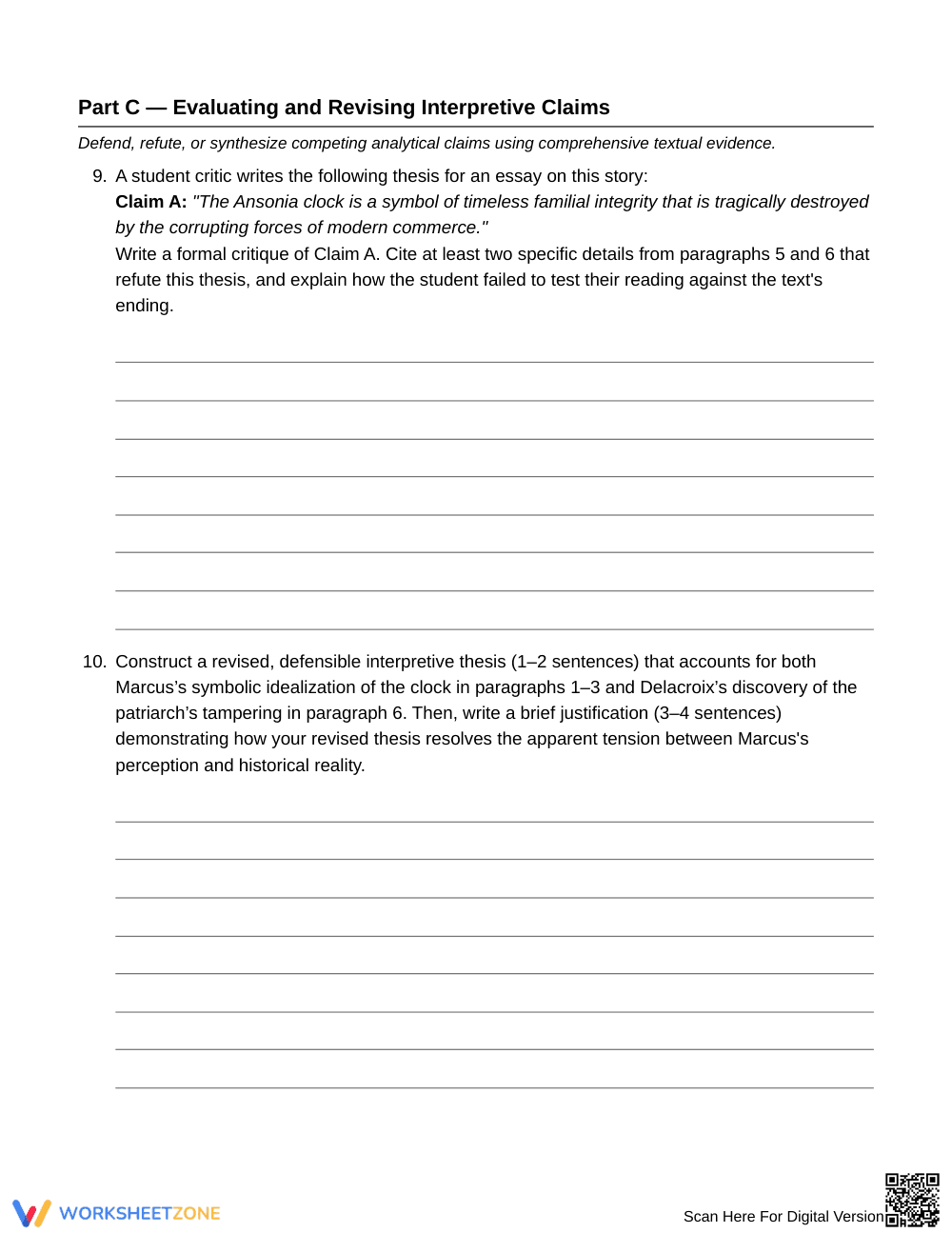
- Independent practice (Part C, 2 tasks): Students critique an oversimplified thesis and construct a synthesized claim that reconciles conflicting evidence.
This sequence follows a gradual-release model, moving students from foundational concepts to independent thesis construction.
Standards Alignment
This activity aligns directly to CCSS RL.9-10.1: “Cite strong and thorough textual evidence to support analysis of what the text says explicitly as well as inferences drawn from the text.” It also supports RL.9-10.2 regarding motif development. Both standard codes can be copied directly into lesson plans, IEP goals, or district curriculum mapping tools.
How to Use It
This worksheet is ideal for close reading practice following instruction on motifs and dramatic irony. During classwork, monitor Part B to check whether students cite the specific mechanical artifacts in paragraph 6. Expected completion time is 45 to 60 minutes.
Who It's For
Designed for tenth-grade English II students and advanced readers, this lesson deepens critical analysis. For emerging readers, provide highlighters to trace mechanical motifs across paragraphs 1 and 6. Pair this resource with an anchor chart on literary nuance or a direct instruction lesson on thesis construction.
According to research by Fisher & Frey (2014) on close reading, secondary students build true analytical independence when tasks require them to re-examine texts in response to contradictory evidence. This resource operationalizes standard RL.9-10.1 by guiding tenth-grade students to test a symbolic reading against a new detail. Rather than accepting static symbolic definitions, learners interrogate narrative anomalies, examine acoustic contrasts, and revise faulty literary claims. The gradual scaffolding supports readers in identifying subtle dramatic irony and reconciling initial hypotheses with concluding textual evidence. By requiring students to articulate why an initial reading fails and formulate a nuanced synthesis, the 10 structured prompts cultivate the close-reading discipline demanded by college-ready literacy benchmarks across secondary English language arts curricula.


