




























Views
Downloads




Essential Symbol Claims Worksheet | Grade 11 English III

Paste this activity's link or code into your existing LMS (Google Classroom, Canvas, Teams, Schoology, Moodle, etc.).
Students can open and work on the activity right away, with no student login required.
You'll still be able to track student progress and results from your teacher account.
This English III worksheet guides Grade 11 students to dismantle rigid symbol equations and construct nuanced, evidence-based literary arguments. Working with an original allegorical narrative, learners analyze where simplistic interpretations collapse, explore narrative ambiguity, and compose layered claims honoring textual complexity.
At a Glance
- Grade: 11 · Subject: English III
- Standard:
RL.11-12.1— Cite strong and thorough textual evidence to evaluate interpretations and resolve textual ambiguities- Skill Focus: Repair a Forced One-to-One Symbol Claim
- Format: 6 pages · 10 problems · Answer key included · PDF
- Best For: Close reading and analytical essay revision
- Time: 45–60 minutes
What's Inside
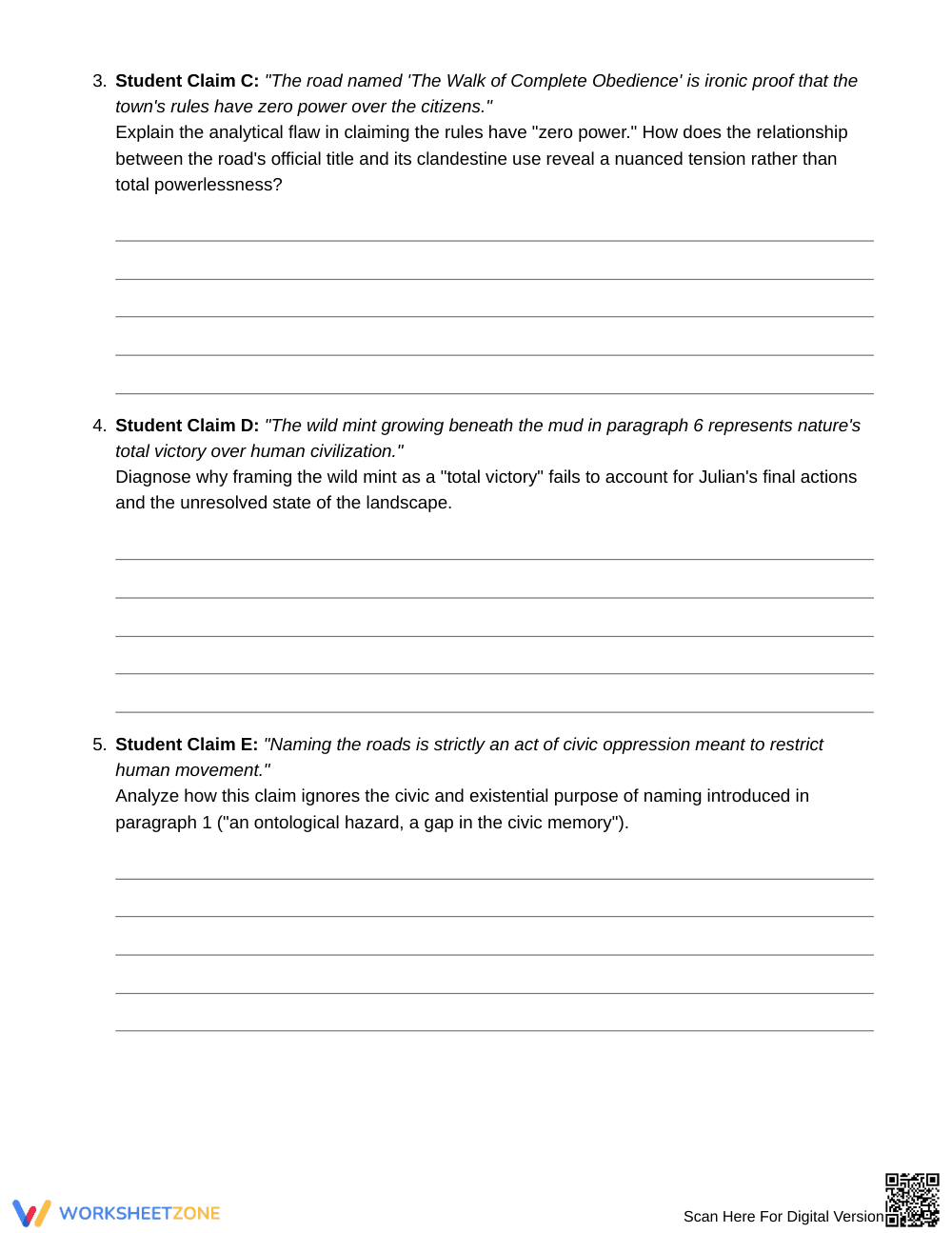
This 6-page printable document features the allegorical text "The Ordinance of the Cartographers," an instructional framework with a modeled claim repair demonstration, and 10 analytical tasks. Students complete 5 diagnostic items in Part A and 5 claim-construction tasks in Part B, supported by a detailed 3-page answer key with exemplary models.
Skill Progression
- Guided practice: A critical framework and worked demonstration illustrate how to diagnose reductive "X = Y" equations and generate balanced interpretations.
- Supported practice: In Part A (tasks 1–5), students evaluate 5 flawed claims, isolating unexamined textual paradoxes and character motives with paragraph prompts.
- Independent practice: In Part B (tasks 6–10), students write 5 original, evidence-supported claims and a comprehensive thematic thesis.
This structure follows a gradual-release model, transitioning learners from teacher-scaffolded diagnosis to independent analytical writing.
Standards Alignment
This resource aligns with `RL.11-12.1`, requiring students to cite strong and thorough textual evidence to support analysis of explicit and inferential textual meanings while determining where the text leaves matters uncertain. It also supports `RL.11-12.2` by prompting students to track how recurring allegorical motifs build central themes. Both standard codes can be copied directly into lesson plans, IEP goals, or district curriculum mapping tools.
How to Use It
Implement this worksheet after direct instruction on allegory during an essay draft revision workshop. Have students work in pairs through Part A to identify flawed reasoning, then transition to independent completion for Part B. During circulation, check whether students identify textual contradictions rather than merely writing general disagreements. The activity requires 45–60 minutes.
Who It's For
This activity is designed for Grade 11 English III and pre-AP literature students developing college-level argumentative nuance. Scaffolded prompts assist developing writers in locating textual paradoxes, while the synthesis task extends advanced learners. Pair this worksheet with an allegory anchor chart or Franz Kafka's parables.
Instruction in literary analysis frequently falters when secondary students treat complex allegorical motifs as static equations rather than dynamic artistic expressions. Aligned directly to standard RL.11-12.1, this instructional resource equips eleventh-grade students to repair forced one-to-one symbol claims by evaluating narrative ambiguity, identifying internal contradictions, and constructing layered, evidence-backed arguments. As demonstrated by Fisher & Frey (2014) in their foundational research on the gradual release of responsibility, developing sophisticated reading comprehension requires structured transitions from diagnostic deconstruction to independent argument generation. By guiding learners to critique reductive interpretations of extended motifs and substantiate counter-claims using explicit textual citations, this curriculum material directly targets the higher-order critical thinking competencies necessary for college-level textual analysis. Educators can reliably integrate these ten targeted analytical tasks into existing curriculum units to ensure high school writers generate nuanced claims that honor narrative complexity.


