




























Views
Downloads



Essential Solubility Curve Worksheet | Grades 9-12 Science

Paste this activity's link or code into your existing LMS (Google Classroom, Canvas, Teams, Schoology, Moodle, etc.).
Students can open and work on the activity right away, with no student login required.
You'll still be able to track student progress and results from your teacher account.
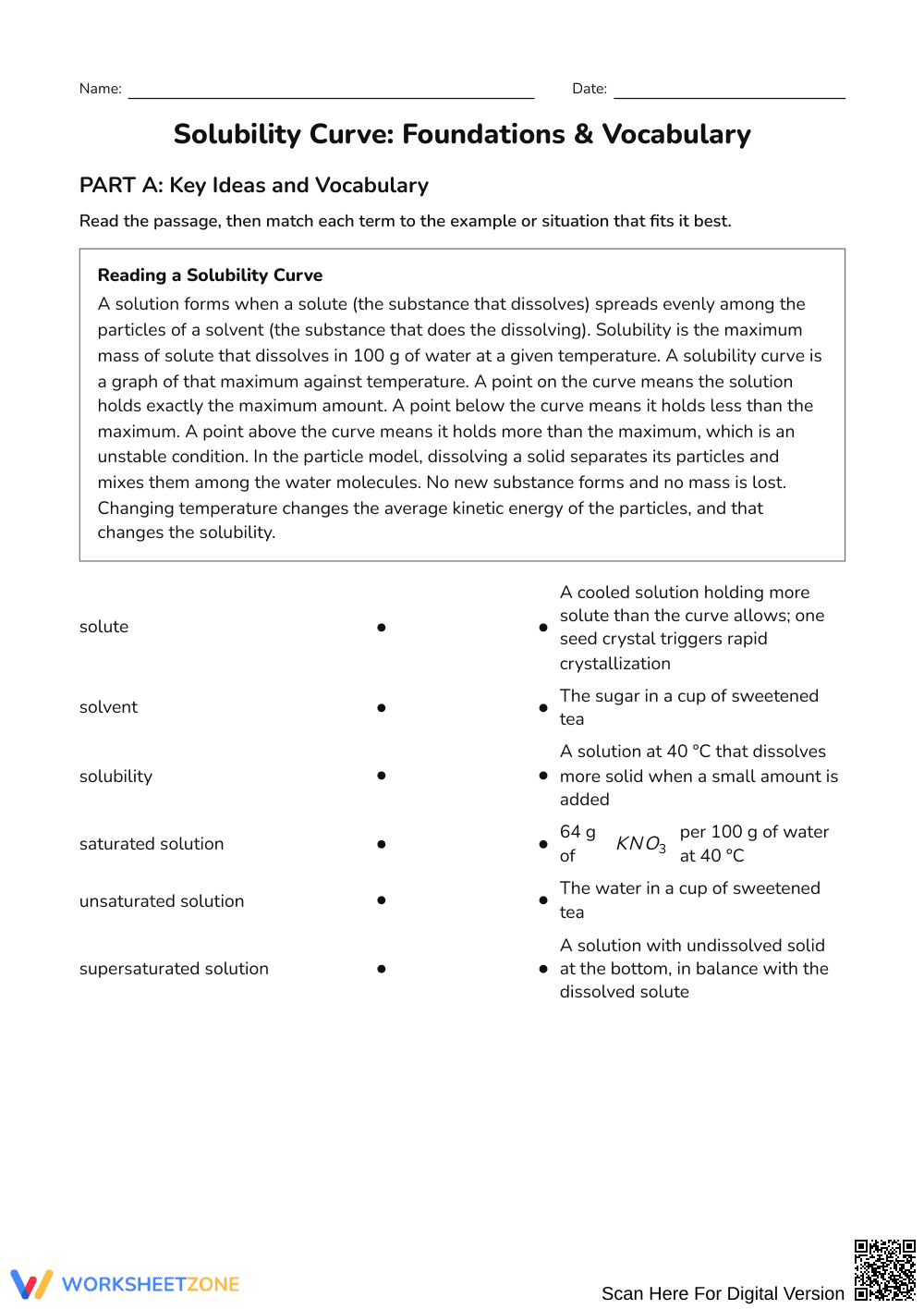
This high school science worksheet builds core competencies in interpreting solubility curves and solution chemistry. Students define essential terms, analyze particle models, evaluate mass conservation misconceptions, and interpret graphical solubility data across 25 structured problems to master saturated, unsaturated, and supersaturated solutions.
At a Glance
- Grade: Grades 9–12 · Subject: Science
- Standard: High School Chemistry — Interpret solubility curves and apply particle models of matter
- Skill Focus: Solubility curve vocabulary, saturation states, and particle dissolving
- Format: 4 pages · 25 problems · Answer key included · PDF
- Best For: First-time instruction or targeted chemistry review
- Time: 40–50 minutes
What's Inside
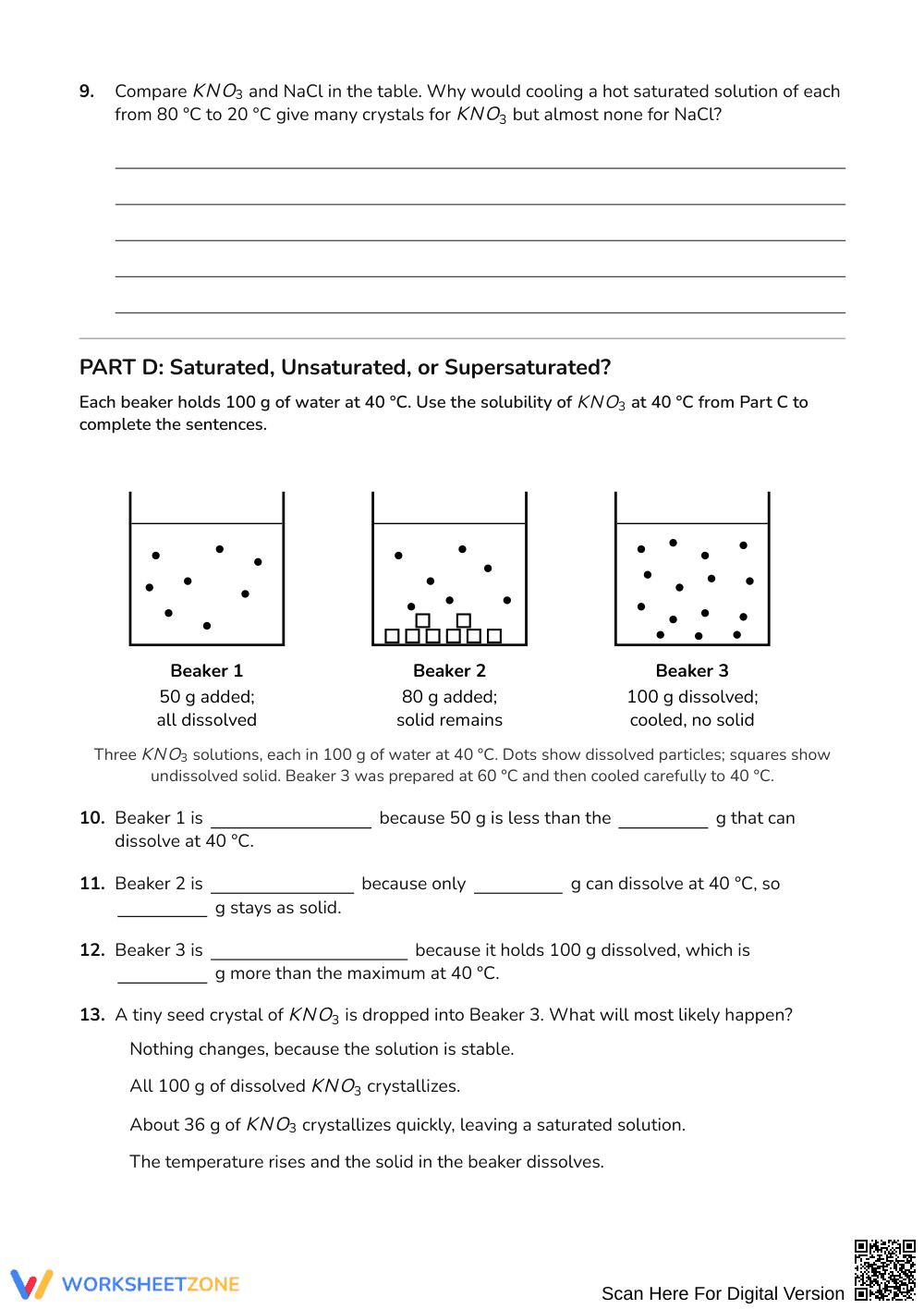
This 4-page student worksheet features 25 items organized into four progressive parts. Materials include an introductory reading passage on particle interactions, a matching vocabulary exercise, multiple-choice mixture identification, a conservation-of-mass misconception check, and a data-rich potassium nitrate solubility graph with an accompanying reference table. A complete 4-page answer key provides step-by-step mathematical reasoning and particle-level explanations.
Skill Progression
- Guided practice (Part A): Six vocabulary-matching items connect terms like solute, solvent, and supersaturated solution directly to concrete scenarios following an introductory text.
- Supported practice (Part B & Part C): Nine items prompt students to classify mixtures, describe crystal dissolution, debunk a mass-loss misconception, and read solubility values from a data table.
- Independent practice (Part C & Part D): Ten analytical questions require learners to explain temperature effects, compare solute behaviors, classify beakers using particle diagrams, and predict crystallization.
This sequence follows a gradual-release framework, advancing students from foundational terms to multi-step quantitative and visual curve analysis.
Standards Alignment
This worksheet aligns directly with high school physical science standards for matter and its interactions, emphasizing particulate models of matter and solution thermodynamics. Students analyze graphical displays of data to determine relationships between temperature and solute solubility. Curriculum alignments can be copied directly into lesson plans, IEP goals, or district curriculum mapping tools.
How to Use It
Assign this resource during initial instruction on solution properties or after introducing solubility graphs. As students complete Part B, observe whether they correctly conserve mass during dissolving to remediate misconceptions before graph calculations. The resource requires 40 to 50 minutes of instructional time.
Who It's For
This practice set serves high school chemistry and physical science students developing data literacy. Scaffolded particle diagrams and clear definitions support English learners and striving readers, while crystallization calculations challenge on-grade students. Pair this resource with an introductory solubility laboratory or interactive teacher demonstration.
High school physical science curricula require students to interpret solubility curves, differentiate between saturation states, and apply particulate models of matter to dissolving processes. According to Fisher & Frey (2014), structured instructional progressions that guide students from explicit vocabulary and misconception analysis to independent graphic data evaluation significantly improve conceptual retention in secondary science classrooms. This comprehensive 4-page, 25-task worksheet aligns with standard secondary chemistry expectations by guiding learners from fundamental solution terms through qualitative particle interpretations and quantitative curve readings. Students evaluate how kinetic energy affects solute-solvent collisions, correct common mass-conservation misunderstandings, and analyze saturation thresholds in potassium nitrate solutions. With an accompanying 4-page answer key containing full particulate explanations and step-by-step mathematical calculations, this classroom-ready resource provides secondary science educators with a verified tool for formative assessment and rigorous instruction.


