


























Views
Downloads




Essential Size and Density Worksheet | Grade 6 Science
Paste this activity's link or code into your existing LMS (Google Classroom, Canvas, Teams, Schoology, Moodle, etc.).
Students can open and work on the activity right away, with no student login required.
You'll still be able to track student progress and results from your teacher account.
This Grade 6 physical science worksheet helps students master the concept of density as an intrinsic characteristic property of matter. Through data analysis, calculations, and particle-level reasoning, learners discover why altering sample size does not change a substance's density, dispelling common misconceptions regarding mass, volume, and buoyancy.
At a Glance
- Grade: 6 · Subject: Science
- Standard: Analyze and interpret data on properties of substances to determine characteristic identities
- Skill Focus: Explain Why Size Does Not Determine Density
- Format: 5 pages · 8 problems · Answer key included · PDF
- Best For: Independent practice after density concept introduction
- Time: 35–45 minutes
What's Inside
The 5-page worksheet provides 8 comprehensive multi-part problems supported by a reference box defining mass, volume, density, and intrinsic properties. Students evaluate synthetic lab data, calculate mass-to-volume ratios, compare extensive versus intensive physical properties, and analyze competing student claims. A detailed 3-page teacher answer key provides full computational steps, units, and particle-level scientific explanations.
Skill Progression
- Guided Practice: Tasks 1 and 2 guide students to distinguish relevant variables (mass and water displacement) from irrelevant physical traits (color and shape), followed by comparative ratio calculations.
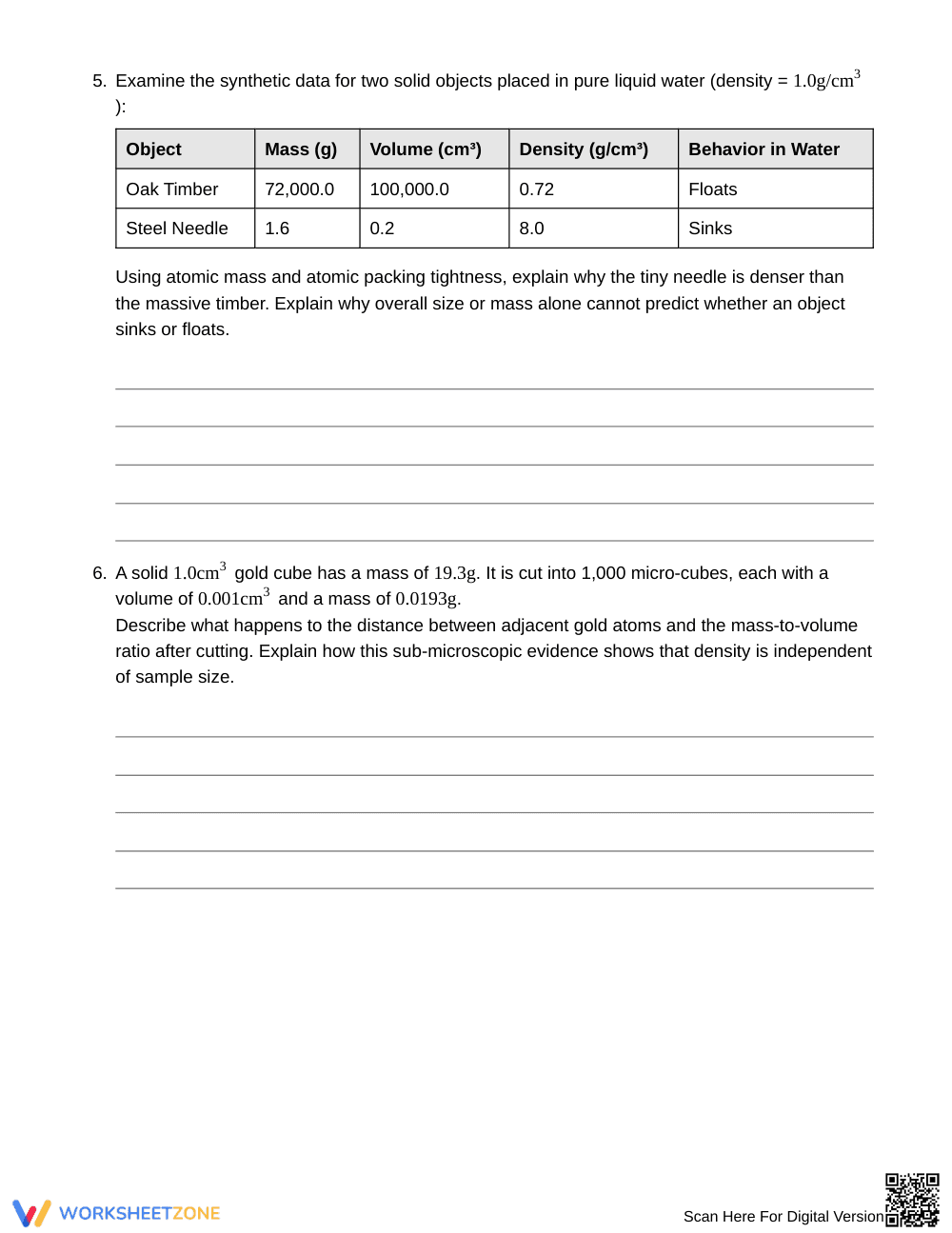
- Supported Practice: Tasks 3 through 6 challenge students to explain atomic spacing, mass-to-volume invariance during geometric division, and the difference between extensive and intensive properties using real-world substances.
- Independent Practice: Tasks 7 and 8 prompt students to critique opposing claims and construct evidence-based scientific refutations about heavy boulders, micro-chips, and identical-volume cylinders.
This structured progression follows a gradual-release model, moving from scaffolded data interpretation to independent evidence-based scientific argumentation.
Standards Alignment
This resource aligns with middle school physical science standards requiring students to analyze and interpret data on the properties of substances before and after substances interact to determine if a chemical reaction has occurred, and to evaluate characteristic properties like density to identify materials. Both standard concepts can be copied directly into lesson plans, IEP goals, or district curriculum mapping tools.
How to Use It
Use this resource after initial direct instruction on mass, volume, and density formulas. It functions effectively as a mid-unit formative check or partner collaboration activity. As a formative assessment tip, observe whether students confuse gravitational weight with mass or incorrectly assume larger objects are always denser. Students typically finish within 35 to 45 minutes.
Who It's For
This worksheet is designed for general Grade 6 science classrooms, introductory physical science units, and middle school remediation. Differentiate by providing the built-in reference box for developing learners or challenging advanced students to calculate atomic packing factors. Pair this activity with a hands-on water displacement lab or a physical properties anchor chart.
Middle school physical science curriculum requires students to analyze and interpret quantitative data to explain how density serves as a characteristic property independent of sample size. According to Fisher & Frey (2014), structured gradual-release frameworks that transition students from guided data extraction to complex claim refutation significantly enhance scientific reasoning and conceptual retention. In this 8-task worksheet, sixth-grade learners calculate mass-to-volume ratios, evaluate atomic packing arrangements, and systematically refute common misconceptions about size and buoyancy. By separating extensive properties like mass and volume from intensive physical properties like density, students develop rigorous evidence-based argumentation skills. The included 3-page answer key details particle-level mechanisms and exact mathematical steps, making it an essential diagnostic tool for identifying student misconceptions during matter and density units across general, inclusion, and remedial middle school science settings.


