


























Views
Downloads




Essential Scale Factor & Lengths Worksheet | Grade 7 Math
Paste this activity's link or code into your existing LMS (Google Classroom, Canvas, Teams, Schoology, Moodle, etc.).
Students can open and work on the activity right away, with no student login required.
You'll still be able to track student progress and results from your teacher account.
This Grade 7 math worksheet develops student mastery of scale factor, proportional reasoning, and scale drawings. Learners compute actual dimensions, perimeters, and areas from architectural blueprints and parcel maps, while distinguishing unitless scale factors from labeled scales. Structured practice builds geometric fluency across reductions and enlargements.
At a Glance
- Grade: 7 · Subject: Math
- Standard:
7.G.A.1— Solve scale drawing problems by computing actual lengths, perimeters, and geometric area measures.- Skill Focus: Scale Factor and Corresponding Lengths
- Format: 5 pages · 16 problems · Answer key included · PDF
- Best For: Guided classroom practice and targeted skill review
- Time: 45–60 minutes
What's Inside
This 5-page worksheet includes 16 multi-step math problems organized across three progressive parts, initiated by a core principles reference box. Students examine blueprint schematics, parcel maps, and geometric figures. A comprehensive 2-page answer key provides complete calculations and explanations for rapid evaluation.
Skill Progression
- Guided practice (Part A — Tasks 1–4): Builds conceptual understanding by distinguishing labeled scales from unitless scale factors and computing area scaling with provided formulas.
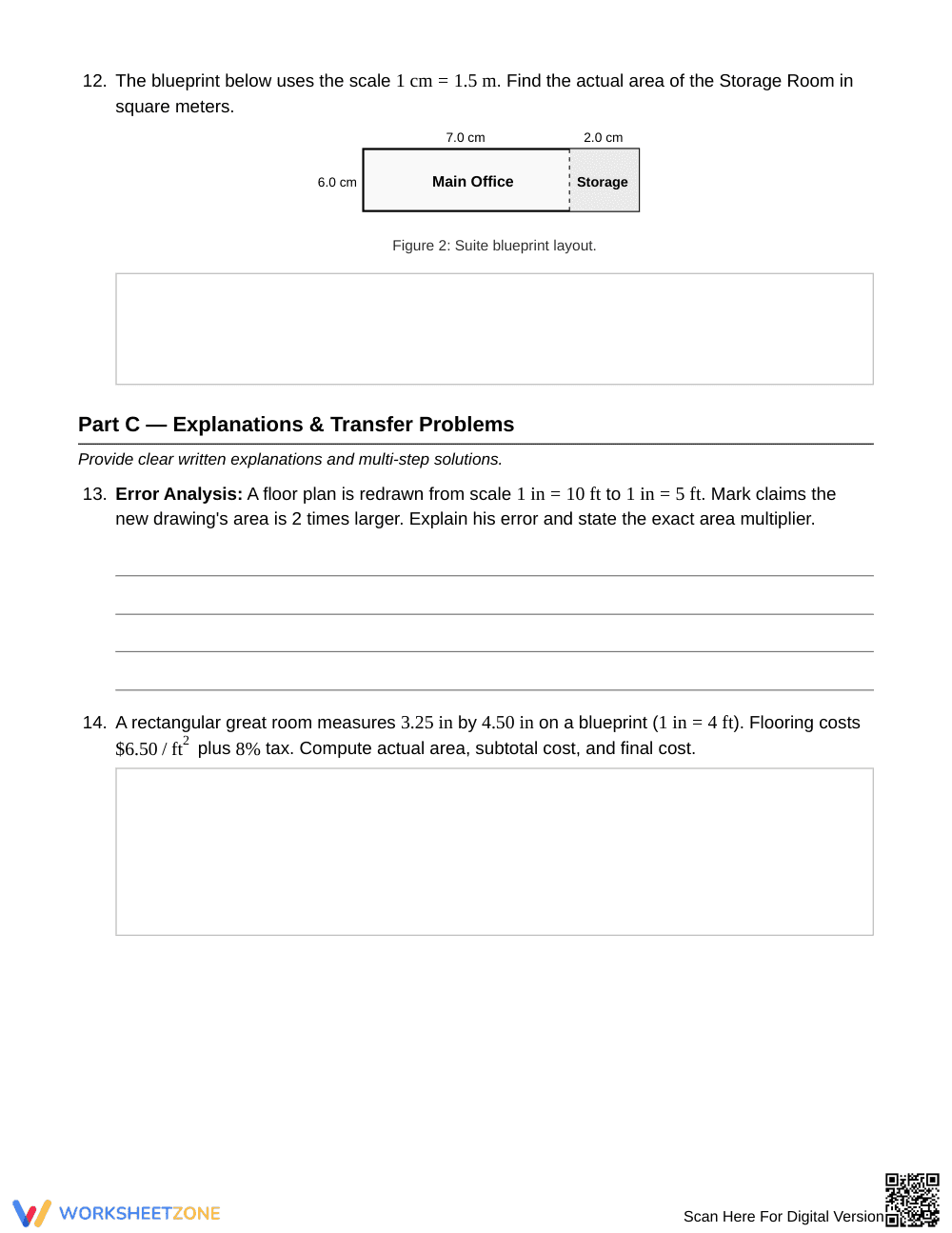
- Supported practice (Part B — Tasks 5–12): Develops procedural competence through blueprint diagrams, finding actual perimeter, unknown side lengths, and area with moderate teacher support.
- Independent practice (Part C — Tasks 13–16): Requires autonomous synthesis through error analysis, real-world flooring cost estimations, and multi-scale ratio comparisons.
This sequence follows a gradual-release instructional model to move learners from foundational ratio concepts to unassisted geometric problem solving.
Standards Alignment
This resource aligns directly to 7.G.A.1, which requires students to solve problems involving scale drawings of geometric figures, computing actual lengths and areas. It also reinforces supporting standard 7.RP.A.2 regarding proportional relationships. Both standard codes can be copied directly into lesson plans, IEP goals, or district curriculum mapping tools.
How to Use It
Use this worksheet during mid-unit instruction following direct modeling of scale conversions. For small-group work, assign Parts A and B during a 45-minute lesson, observing whether students square the scale factor when determining area. Alternatively, assign Part C as a 20-minute summative exit ticket or homework task to gauge independent mastery.
Who It's For
This activity serves Grade 7 math classes, accelerated Grade 6 students, and Grade 8 intervention groups. Built-in reference rules support struggling learners, while multi-step applications challenge advanced students. Pair this packet with an introductory lesson on proportional reasoning or a hands-on classroom blueprint project.
According to Fisher & Frey (2014), student learning improves significantly when instructional tasks follow an explicit gradual-release sequence that transitions responsibility from teacher modeling to independent performance. This five-page curriculum packet embodies that design by addressing standard 7.G.A.1, challenging Grade 7 students to analyze scale drawings, calculate unitless scale factors, and determine corresponding lengths and geometric areas. Through sixteen structured tasks, students advance from basic proportional conversions to blueprint calculations, spatial perimeter determinations, and rigorous error analysis. Providing contextual anchors helps middle school students resolve frequent geometric misconceptions regarding one-dimensional linear scaling versus two-dimensional quadratic area relationships. As highlighted in foundational research by Fisher & Frey (2014), pairing visual blueprints with guided scaffolded prompts and autonomous transfer problems cultivates sustained procedural accuracy, conceptual understanding, and verifiable standards mastery across diverse middle school classroom demographics.


