


























Views
Downloads



Essential Scale Drawings Worksheet | Grade 7 Math
Paste this activity's link or code into your existing LMS (Google Classroom, Canvas, Teams, Schoology, Moodle, etc.).
Students can open and work on the activity right away, with no student login required.
You'll still be able to track student progress and results from your teacher account.
Master scale drawings, scale factors, and proportional dimension changes with this Grade 7 math resource. Students compute actual perimeters, areas, and missing scale lengths from architectural blueprints and survey maps. By linking ratios to geometric measurement, learners bridge proportional reasoning with spatial analysis to solve complex real-world area and dimension problems.
At a Glance
- Grade: 7 · Subject: Math
- Standard:
7.G.A.1— Compute actual lengths and areas from scale drawings of geometric figures- Skill Focus: Scale-Drawing Check
- Format: 5 pages · 16 problems · Answer key included · PDF
- Best For: Mid-unit assessment or independent review
- Time: 40–55 minutes
This 5-page printable packet contains 16 problems across three sections, supported by a reference box with essential scaling formulas. Students encounter multiple-choice conceptual items, floor plan diagrams, scale conversions, and composite geometric figures. A complete 2-page answer key provides step-by-step solutions and model written responses.
Skill Progression
- Guided practice (Part A, 4 problems): Foundation prompts establish core concepts, including converting scales to unitless ratios and identifying quadratic area scaling factors.
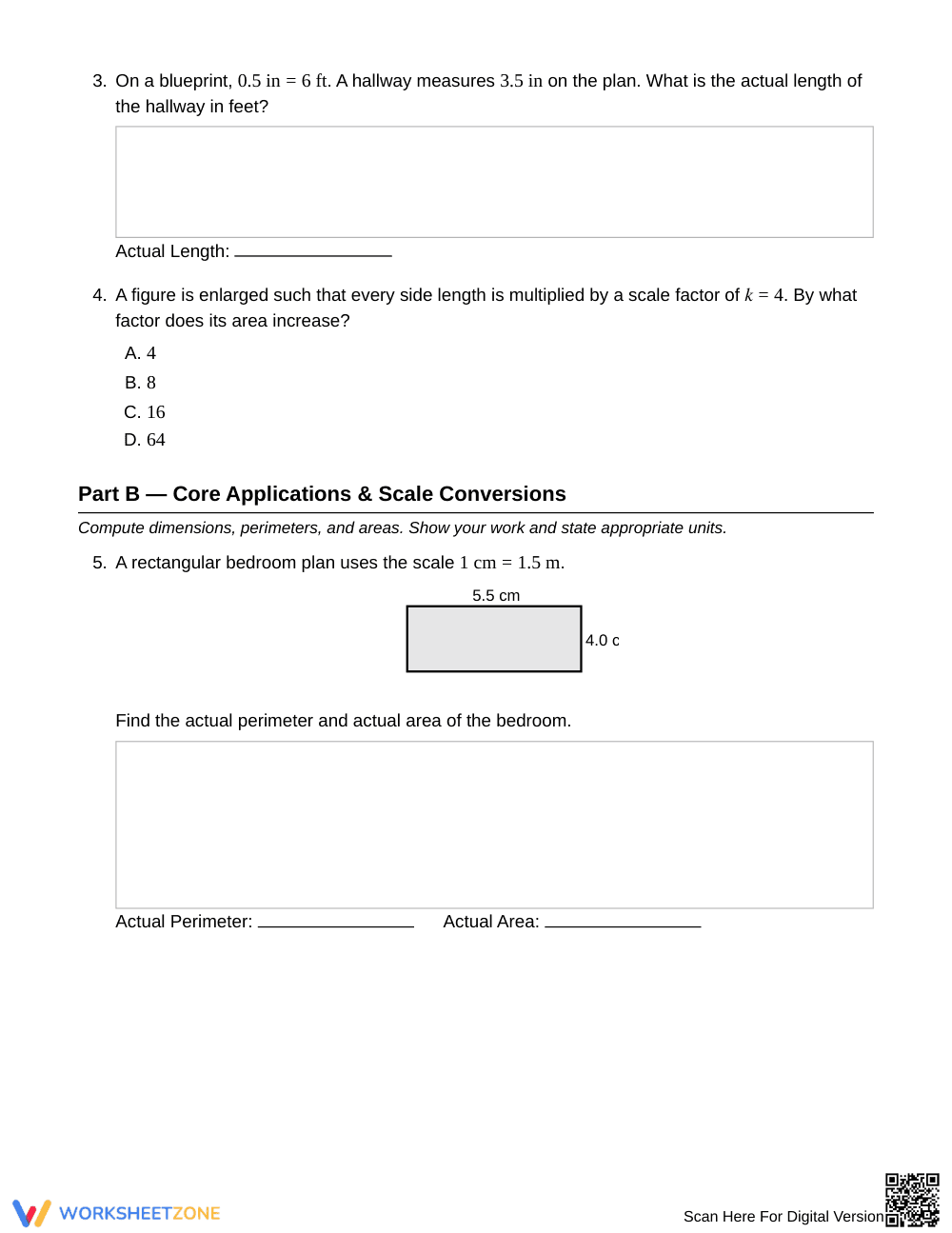
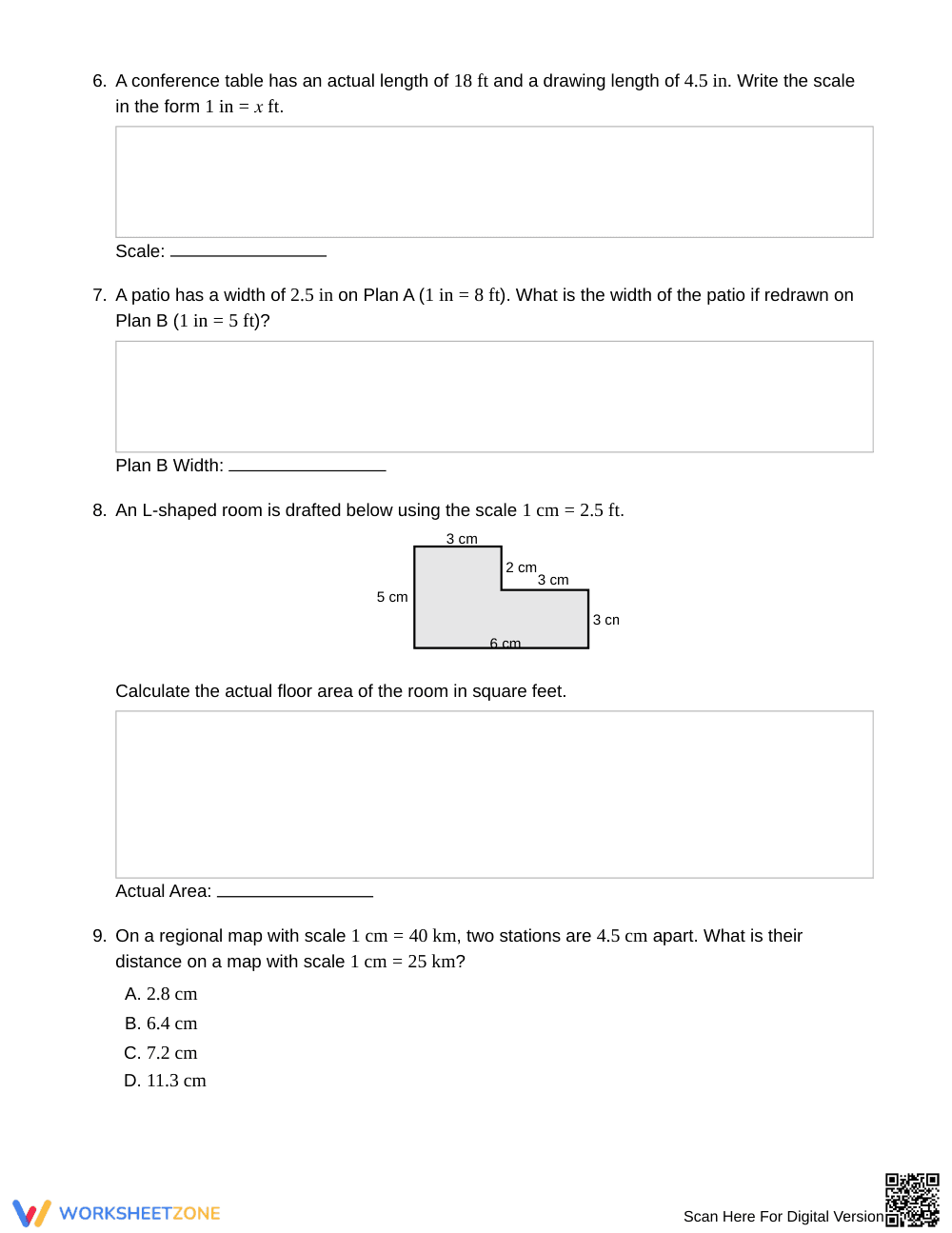
- Supported practice (Part B, 8 problems): Visual floor plans and map scenarios require students to calculate actual perimeters, scaled areas, and cross-scale conversions.
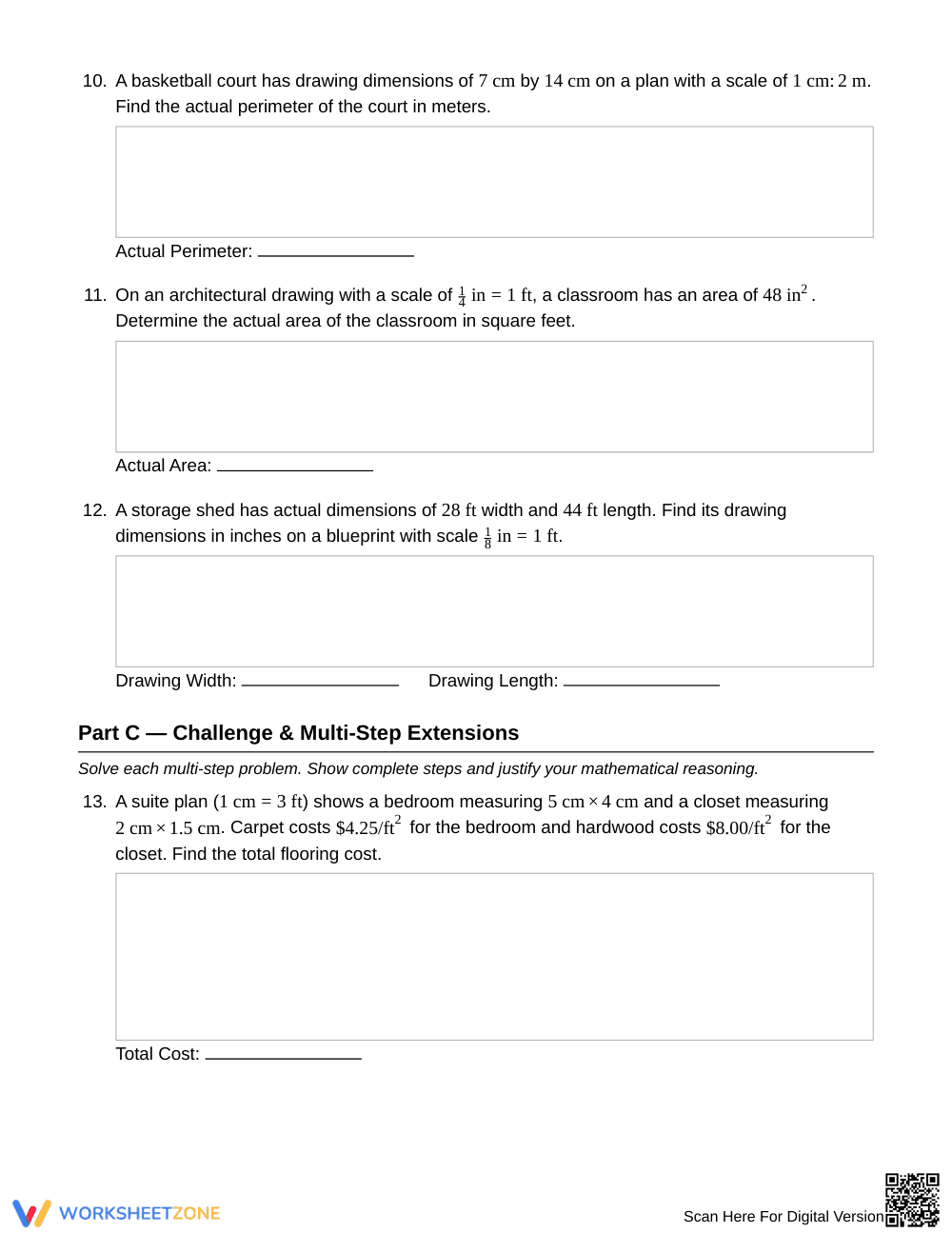
- Independent practice (Part C, 4 problems): Multi-step word problems require calculating flooring costs, analyzing student misconceptions, and determining composite stage surface areas.
This structured progression reflects the gradual-release model, moving from initial concept verification toward autonomous mathematical reasoning.
Standards Alignment
This worksheet aligns directly with 7.G.A.1, requiring students to solve problems involving scale drawings of geometric figures, including computing actual lengths and areas and reproducing drawings at differing scales. Supporting standard 7.RP.A.2 reinforces proportional relationships between corresponding lengths. Both standard codes can be copied directly into lesson plans, IEP goals, or district curriculum mapping tools.
How to Use It
Administer this resource after direct instruction on scale ratios as a summative mid-unit check or assign Parts A and B for collaborative partner practice before Part C. During seatwork, observe whether students square the scale factor when calculating area rather than multiplying linearly. Students typically complete the 16 problems in 40 to 55 minutes.
Who It's For
Designed for Grade 7 math classes, accelerated Grade 6 cohorts, and Grade 8 students needing geometry remediation. The reference formula box supports English learners and students with accommodations. Pair this worksheet with a hands-on architectural floor plan drawing activity for deeper tactile practice.
According to EdReports 2024 evaluations of middle school mathematics curricula, rigorous alignment to standard 7.G.A.1 demands that students consistently connect linear scale factors to two-dimensional area transformations. Too often, commercial practice materials isolate basic scale factor calculation from geometric area relationships, resulting in persistent student misunderstandings on state assessments. This 16-problem worksheet directly counters that instructional gap by requiring learners to compute actual lengths and areas from blueprints while explicitly demonstrating why area scales by the square of the linear ratio. By pairing structured computational tasks with written error analysis and multi-step modeling, the resource reinforces the critical conceptual shifts highlighted in EdReports reviews. Middle school educators can deploy this 5-page resource during scale drawing units to measure student mastery with precision, guide targeted intervention, and ensure standards-based accountability across diverse classroom environments.


