


























Views
Downloads




Essential Scale Copies Worksheet | Grade 7 Math
Paste this activity's link or code into your existing LMS (Google Classroom, Canvas, Teams, Schoology, Moodle, etc.).
Students can open and work on the activity right away, with no student login required.
You'll still be able to track student progress and results from your teacher account.
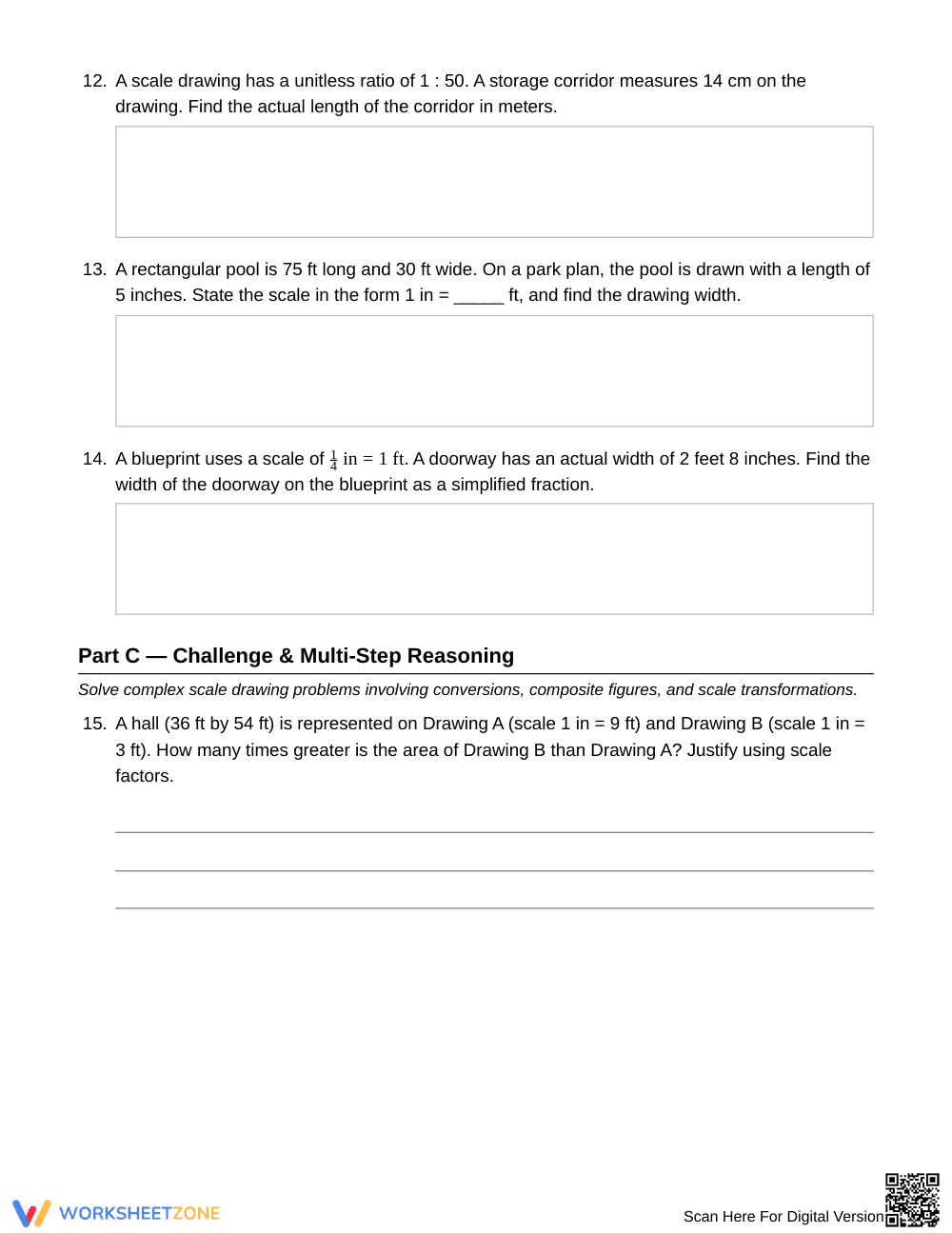
This Grade 7 math worksheet builds student mastery in calculating scale factors, finding missing side lengths, and computing actual areas from scale drawings. Proportional reasoning tasks transition learners from basic scale ratios to complex architectural floor plans and multi-step geometric area transformations.
At a Glance
- Grade: 7 · Subject: Math
- Standard:
7.G.A.1— Compute actual lengths and areas from scale drawings- Skill Focus: Find Missing Dimensions in Scale Copies
- Format: 5 pages · 18 problems · Answer key included · PDF
- Best For: Core instruction and guided practice
- Time: 45–60 minutes
This 5-page printable resource contains 18 structured problems and a complete 2-page answer key. A reference header defines scale ratios and the linear-to-area scaling multiplier (k^2). The worksheet features visual floor plans, geometric polygons, and real-world blueprint tasks with fractional unit conversions.
Skill Progression
- Guided Practice (Part A, Problems 1–4): Establishes basic proportional reasoning with direct scale conversions, linear scale factors, and perimeter scaling.
- Supported Practice (Part B, Problems 5–14): Applies ratios to visual diagrams, missing floor plan dimensions, fractional units, and scaled area calculations.
- Independent Practice (Part C, Problems 15–18): Challenges students with multi-step reasoning, dual-scale comparisons, composite wall layouts, and tile installation costs.
This progression uses a gradual-release model to move students from initial modeling to independent mastery.
Standards Alignment
This worksheet aligns directly to 7.G.A.1: Solve problems involving scale drawings of geometric figures, including computing actual lengths and areas from a scale drawing. It also reinforces 7.RP.A.2 through proportional equations. Both standard codes can be copied directly into lesson plans, IEP goals, or district curriculum mapping tools.
How to Use It
Use this resource during core direct instruction or as post-lesson practice. In guided work, verify proportion setups in Part A before assigning Part B. Formative assessment tip: Check whether students scale area by k^2 rather than k on problems 6 and 8. Completion time is 45–60 minutes.
Who It's For
Designed for Grade 7 math classes, Grade 6 acceleration, and Grade 8 intervention. The formula header supports English learners and students with accommodations. Pair this worksheet with a measurement warm-up or an anchor chart on scale factors.
According to research in Fisher & Frey (2014) on the gradual release of responsibility model, structured instructional progressions that move systematically from guided modeling to complex application substantially improve middle school conceptual understanding and mathematical fluency. This Grade 7 mathematics worksheet addresses standard 7.G.A.1 by guiding students through 18 targeted tasks to compute actual lengths, scale factors, and geometric areas from scale drawings. Beginning with single-step proportional equations and advancing to multi-step architectural floor plans and composite layouts, the practice set reinforces how linear lengths scale by factor k while two-dimensional areas scale by k^2. Featuring authentic blueprint diagrams, unit conversions, and a complete two-page answer key, this resource provides an effective, classroom-tested tool for standards-based assessment, targeted intervention, and purposeful skill building in proportional geometry across diverse learning environments.


