


























Views
Downloads


Essential Reading-Frame Models Worksheet | Grade 10 Biology
Paste this activity's link or code into your existing LMS (Google Classroom, Canvas, Teams, Schoology, Moodle, etc.).
Students can open and work on the activity right away, with no student login required.
You'll still be able to track student progress and results from your teacher account.
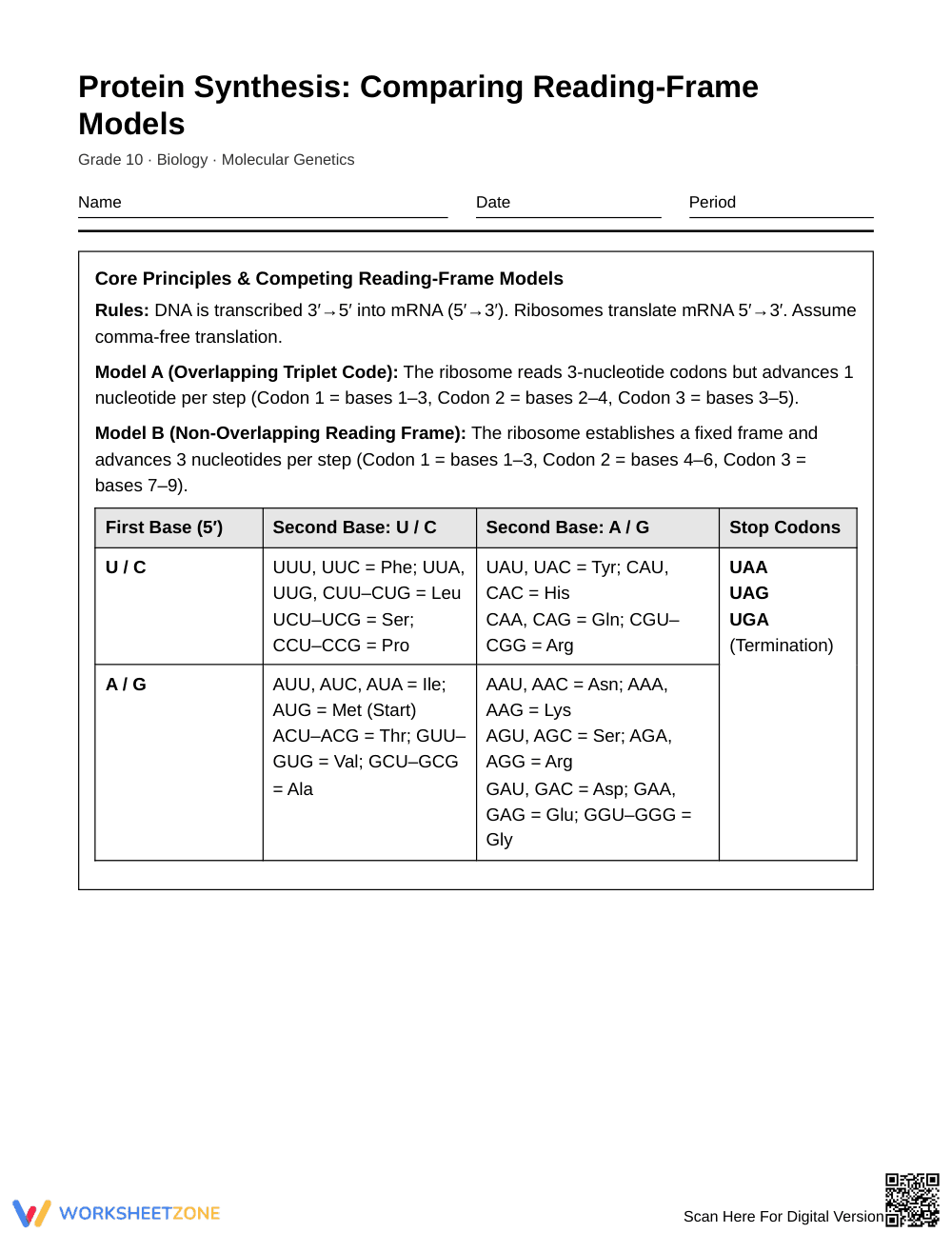
This molecular genetics worksheet guides Grade 10 biology students to compare overlapping and non-overlapping mRNA reading-frame models. Students predict translational outcomes, evaluate point substitutions and frameshift indels, and analyze historical mutagenesis data to verify the triplet codon mechanism governing cellular protein synthesis.
At a Glance
- Grade: 10 · Subject: Biology
- Standard: Genetics Core — Model translation mechanics and deduce polypeptide sequences from nucleic acid codes
- Skill Focus: Transcription & Translation: Compare Reading-Frame Models
- Format: 5 pages · 10 problems · Answer key included · PDF
- Best For: Molecular genetics problem solving
- Time: 45–60 minutes
What's Inside
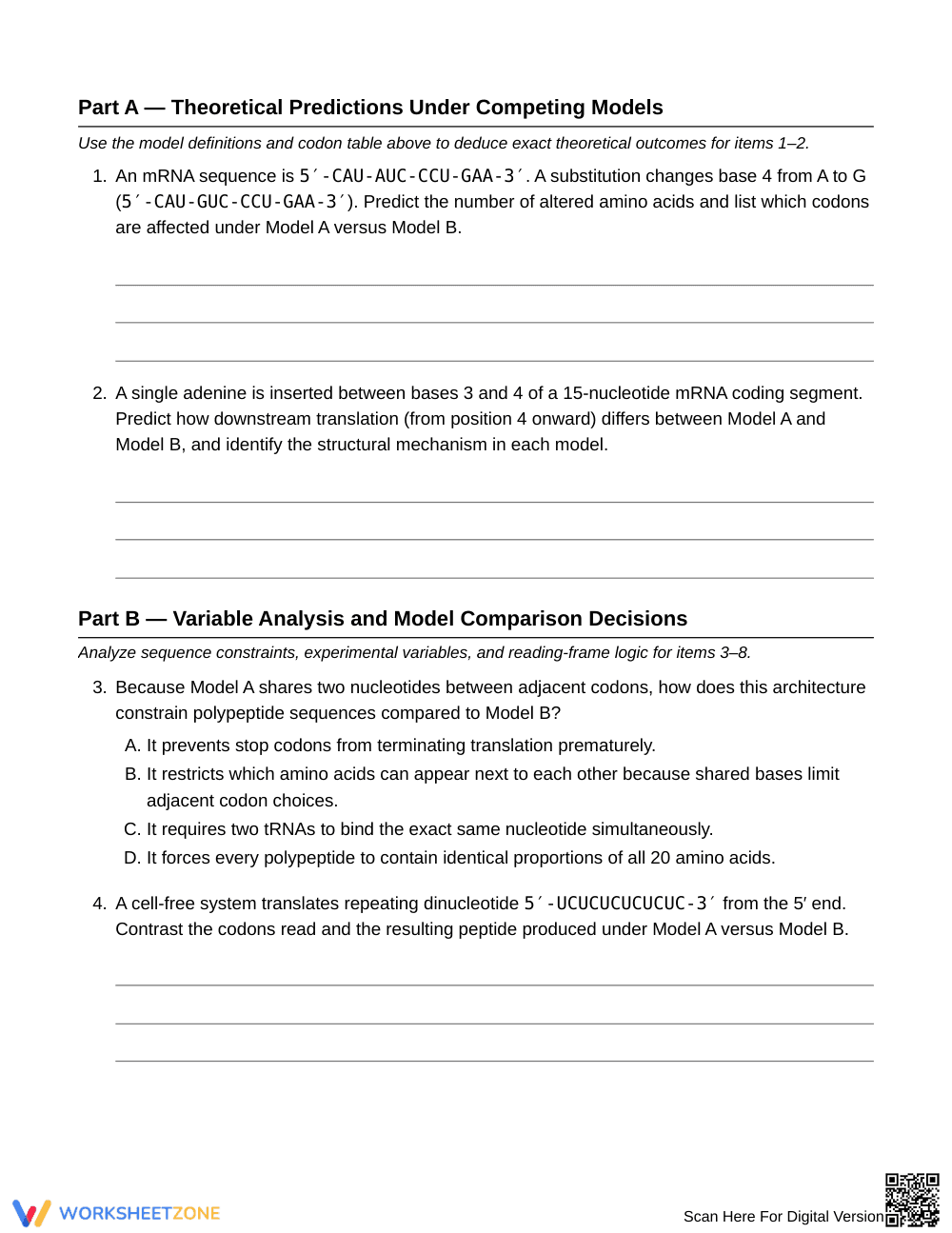
The 5-page resource contains 10 analytical problems across three sections. A reference header provides defined model rules alongside an mRNA codon table. Students complete theoretical sequence predictions, variable analysis questions, and two synthetic experimental datasets. A 2-page answer key provides complete translational deductions and explanatory rationales.
Skill Progression
- Guided practice (Problems 1–2): High scaffold level with explicit model definitions, prompting students to deduce theoretical amino acid changes under Model A versus Model B after substitutions and insertions.
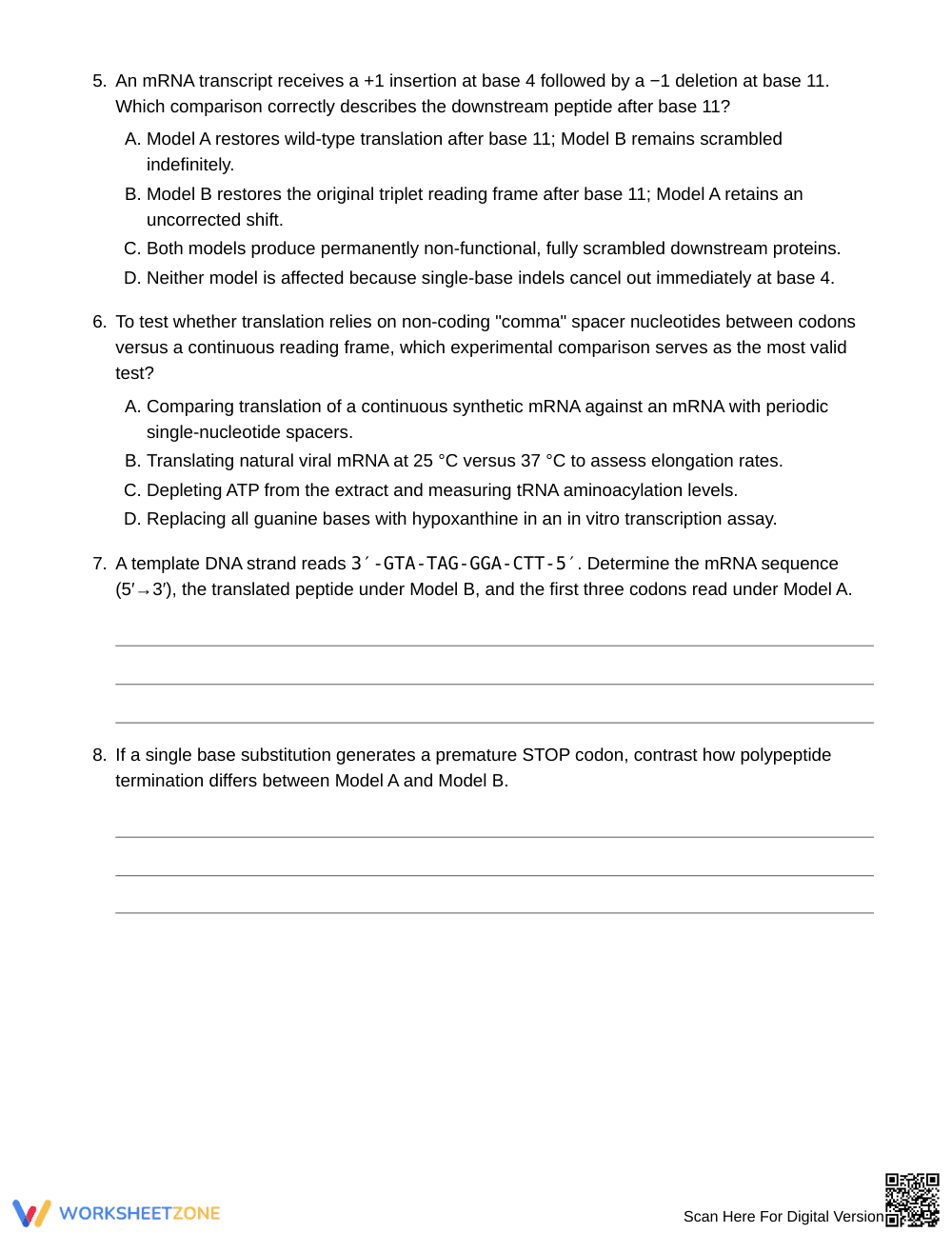
- Supported practice (Problems 3–8): Moderate scaffold level where students analyze sequence constraints, dinucleotide repeats, compensatory indels, and DNA transcription.
- Independent practice (Problems 9–10): Low scaffold level challenging learners to evaluate empirical mutagenesis assays to falsify overlapping models and confirm triplet frame structure.
This structured sequence follows the gradual release of responsibility model, moving students from guided predictions to independent data evaluation.
Standards Alignment
This worksheet aligns with high school biology standards requiring students to explain how DNA and RNA sequences determine amino acid chains in proteins. It reinforces scientific data analysis and computational thinking. Both standard codes can be copied directly into lesson plans, IEP goals, or district curriculum mapping tools.
How to Use It
Use this activity after direct instruction on protein synthesis and mutation types. In small-group stations, students can collaborate on Part A and Part B sequence predictions before independently analyzing the experimental data in Part C. During class, observe how students interpret the compensatory frameshift in item 5 to gauge their understanding of reading-frame restoration. The expected completion time is 45 to 60 minutes.
Who It's For
This resource is designed for Grade 10 biology and honors life science students studying translation. Support emerging learners by highlighting codon boundaries on mRNA strands, and challenge advanced students with the historical indel assays. Pair this worksheet with an interactive translation simulation or codon chart.
According to research highlighted by Fisher & Frey (2014), structured progression through gradual release tasks significantly strengthens student mastery of complex biological mechanisms such as transcription and translation. Evaluating competing scientific models requires students to coordinate biochemical rules with empirical evidence. In this 10-problem genetics worksheet, Grade 10 biology students compare overlapping versus non-overlapping reading-frame models to determine how ribosomes decode nucleotide triplets into polypeptides. By analyzing theoretical substitutions, indels, and historical mutagenesis datasets, learners move beyond rote transcription drills to evaluate the structural logic of the genetic code. The scaffolded progression from theoretical prediction to empirical proof cultivates scientific reasoning, enabling high school students to clearly explain how frame shifts, point mutations, and codon boundaries dictate cellular phenotype.


