




























Views
Downloads




Essential Qualifying Claims Worksheet | Grade 8 ELA

Paste this activity's link or code into your existing LMS (Google Classroom, Canvas, Teams, Schoology, Moodle, etc.).
Students can open and work on the activity right away, with no student login required.
You'll still be able to track student progress and results from your teacher account.
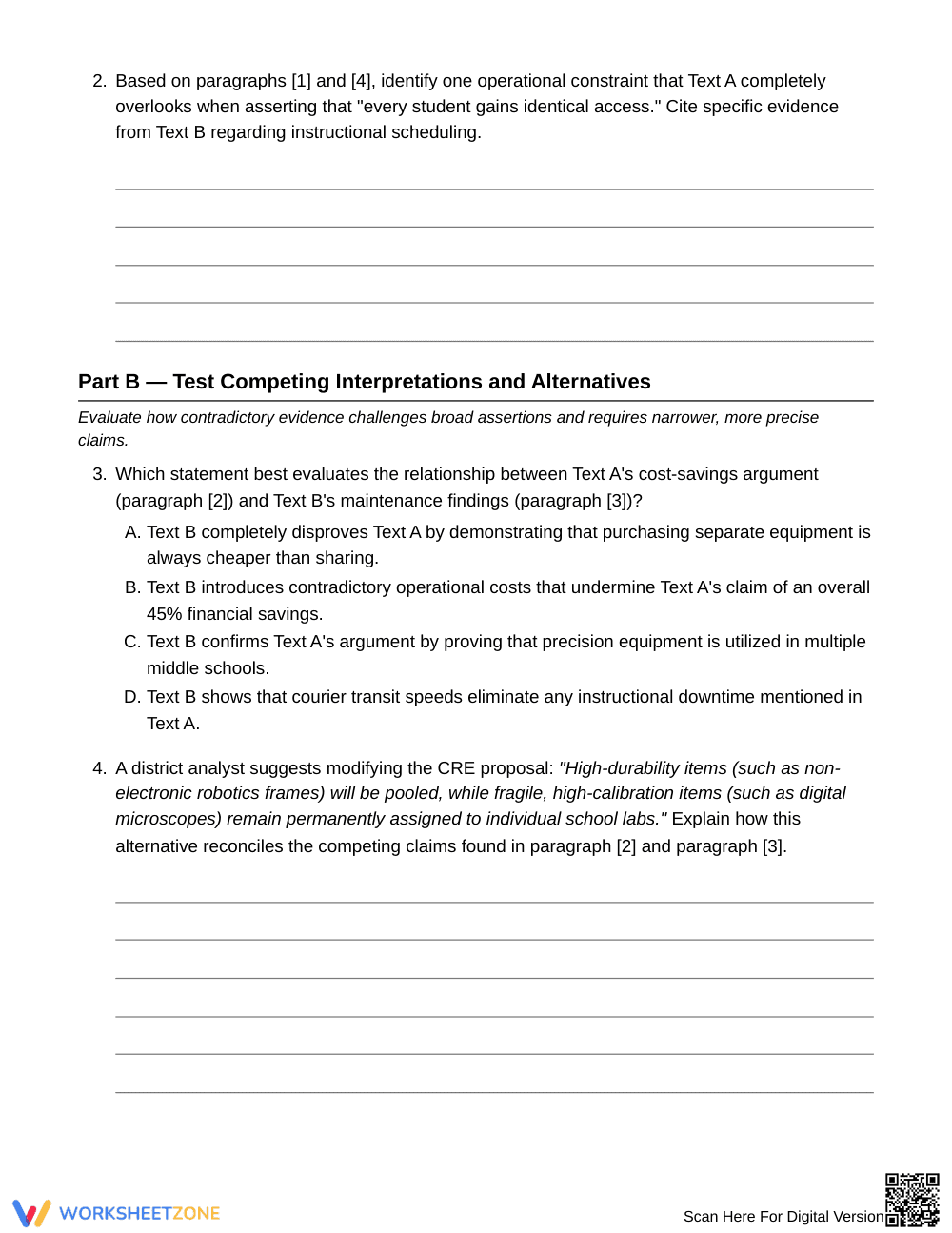
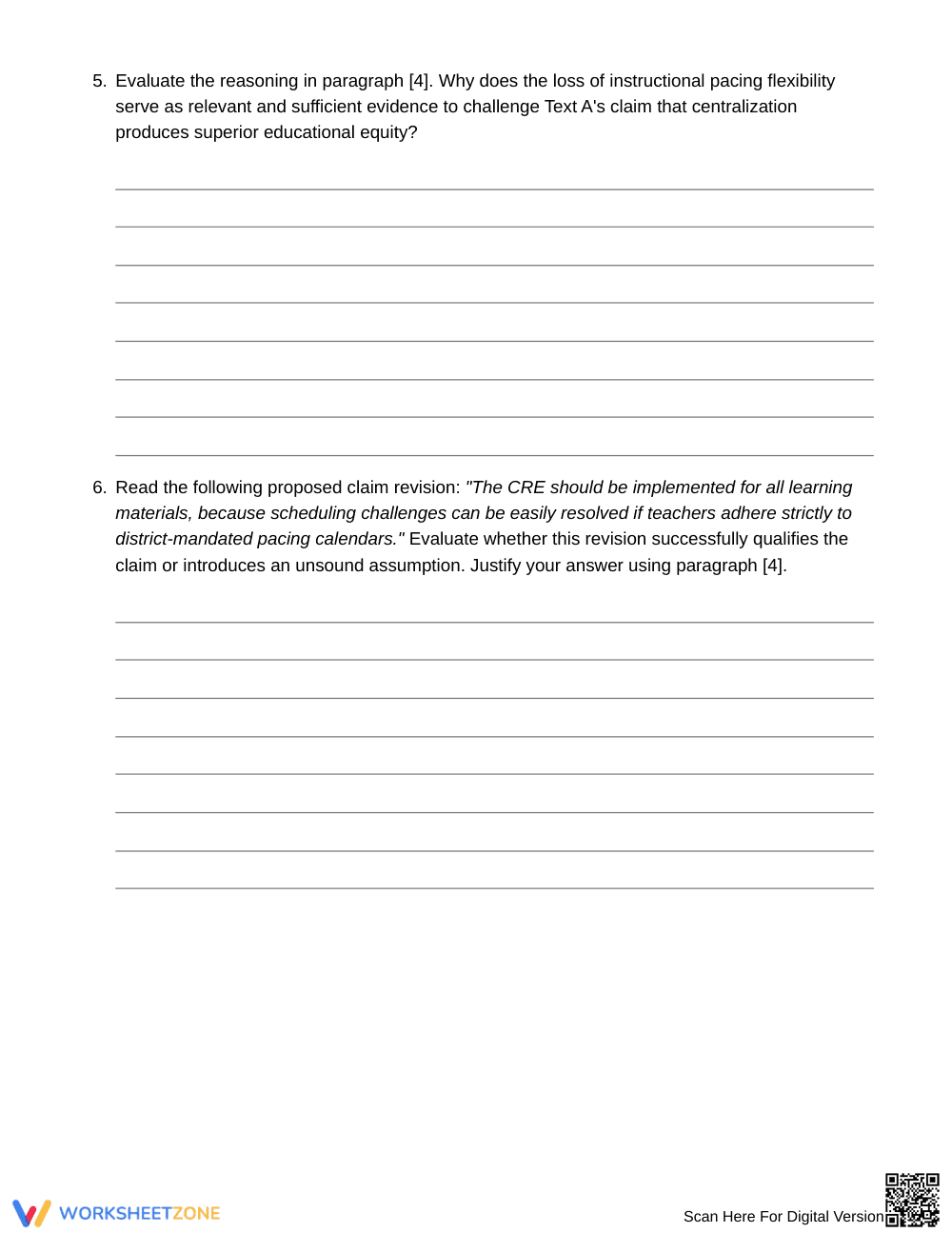
This Grade 8 argument analysis worksheet helps students evaluate opposing texts and revise absolute claims using contradictory evidence. Students analyze competing perspectives on school resource sharing, identify flawed assumptions, and construct nuanced, evidence-based qualifications that maintain logical validity across complex informational texts.
At a Glance
- Grade: 8 · Subject: ELA
- Standard:
RI.8.8— Evaluate argument claims and qualify statements using contradictory evidence- Skill Focus: Qualify a Claim After Contradictory Evidence
- Format: 5 pages · 8 problems · Answer key included · PDF
- Best For: Argumentative reading and writing practice
- Time: 40–50 minutes
This 5-page printable resource features two paired informational passages presenting competing policy viewpoints alongside 8 rigorous analytical tasks. The worksheet includes an introductory core concept box defining qualifying conditions, structured short-response questions, multiple-choice evaluation, and a 2-page detailed answer key with exemplar qualified claims and analysis.
Skill Progression
- Guided practice (Tasks 1–2): Students examine paired texts to locate absolute premises, map operational constraints, and identify specific limitations in initial claims.
- Supported practice (Tasks 3–6): Students evaluate competing interpretations through multiple-choice reasoning, reconcile conflicting data sets, and assess whether proposed revisions solve underlying logical flaws.
- Independent practice (Tasks 7–8): Students synthesize findings across both texts to independently draft and defend a fully qualified claim that balances trade-offs and evidence.
This sequence follows the gradual release of responsibility model, moving learners systematically from text analysis to independent argumentative synthesis.
Standards Alignment
This resource aligns directly to standard RI.8.8: Delineate and evaluate the argument and specific claims in a text, assessing whether the reasoning is sound and the evidence is relevant and sufficient to support the claims. Students explicitly test claim boundaries against conflicting data to determine sufficiency and logical validity. Both standard codes can be copied directly into lesson plans, IEP goals, or district curriculum mapping tools.
How to Use It
Deploy this activity during middle-unit instruction on argumentative reading or as targeted preparation before an argumentative writing assessment. During independent work, conduct formative observations by checking Task 4 to ensure students understand how conditional phrasing reconciles competing evidence rather than simply choosing one side. The complete resource requires approximately 40 to 50 minutes of instructional time.
Who It's For
Designed for eighth-grade ELA students, this activity supports on-grade analytical readers while providing scaffolded conceptual definitions for developing writers. Pair this printable with a direct instruction lesson on logical fallacies or an anchor chart showing qualifying transitional phrases such as "primarily," "provided that," and "under specific conditions."
Mastering standard RI.8.8 requires middle school readers to move beyond binary evaluation toward nuanced claim modification. When students qualify claims using contradictory evidence, they learn to evaluate whether reasoning is sound and identify when data limits an author's assertions. According to Fisher & Frey (2014), structured close-reading routines that prompt students to reconcile conflicting informational texts significantly enhance disciplinary literacy and critical argumentation skills. This Grade 8 ELA worksheet guides learners through eight targeted tasks to isolate absolute premises, weigh conflicting field data, and draft qualified statements supported by text evidence. By engaging in this structured analytical progression, students build the metacognitive discernment needed to critique flawed reasoning and construct rigorous, balanced academic arguments across secondary content areas.


