


























Views
Downloads

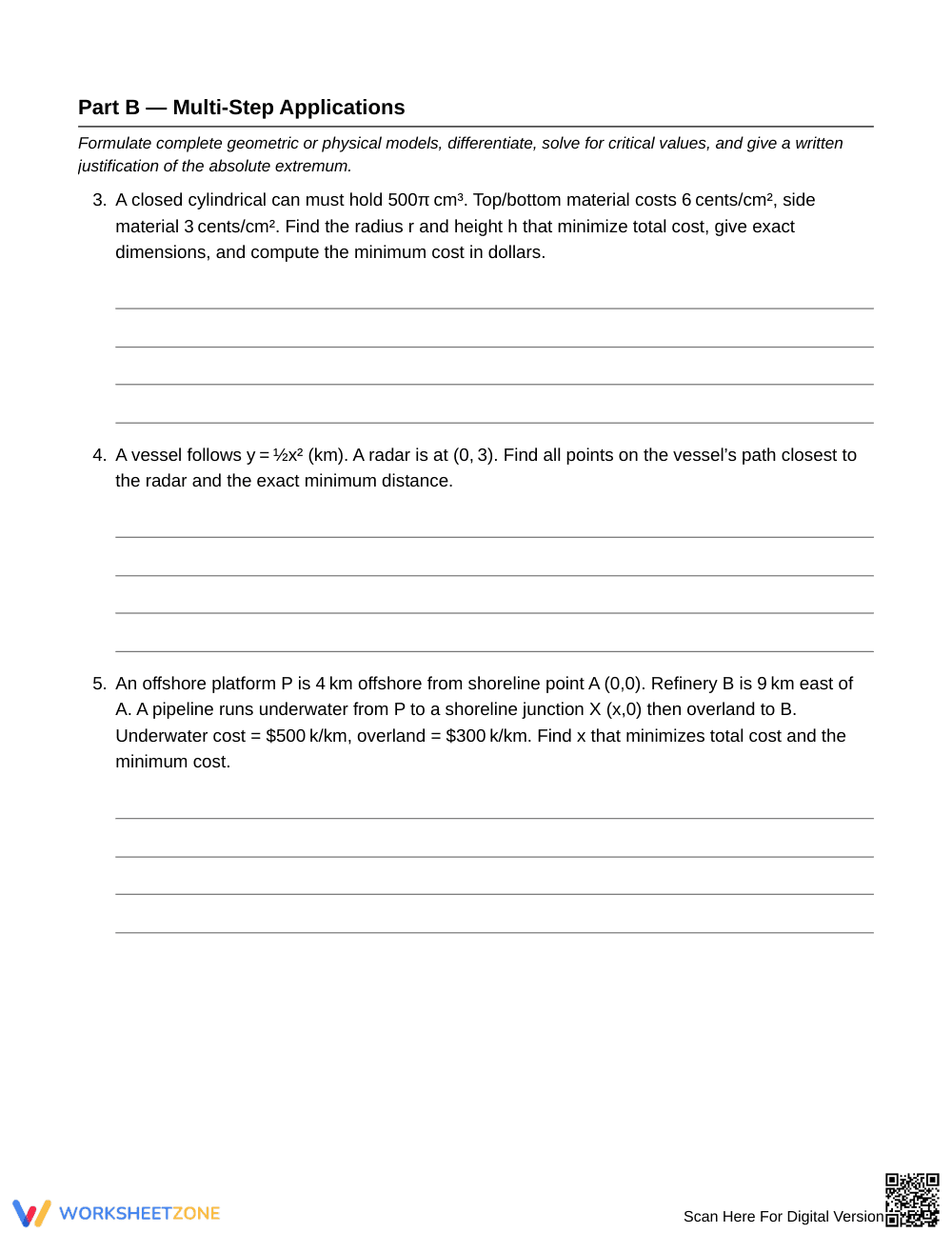


Essential Optimization Worksheet | Grade 12 Calculus
Paste this activity's link or code into your existing LMS (Google Classroom, Canvas, Teams, Schoology, Moodle, etc.).
Students can open and work on the activity right away, with no student login required.
You'll still be able to track student progress and results from your teacher account.
Mastering calculus optimization requires translating real-world constraints into differentiable single-variable functions. This Grade 12 worksheet provides 10 structured optimization problems that build mathematical modeling skills. Students formulate objective equations, determine feasible domains, calculate critical values, and justify absolute extrema using derivative tests.
At a Glance
- Grade: 12 · Subject: Calculus
- Standard: Constrained Optimization — Model geometric and physical scenarios to optimize single-variable functions
- Skill Focus: Optimize a Quantity Under Constraints
- Format: 4 pages · 10 problems · Answer key included · PDF
- Best For: AP calculus practice and applications
- Time: 60–90 minutes
The 4-page worksheet opens with a worked example detailing open-top box optimization. Across 10 rigorous tasks, students solve direct geometric perimeter problems, freight cost functions, container surface areas, radar distance minimization, pipeline routing, and beam strength models. A full 2-page answer key provides complete derivative setups, critical values, and written extremum justifications.
Skill Progression
- Guided practice (Worked Example & Part A, 2 problems): Students examine box modeling before applying first derivative tests to paddock fencing and freight speed cost equations.
- Supported practice (Part B, 6 problems): Learners build geometric constraints to optimize cylindrical cans, radar distances, pipeline routes, poster dimensions, beam strength, and cone volumes.
- Independent practice (Part C, 2 problems): Students analyze multi-variable reaction constraints and compare dual-design tank costs to make justified engineering recommendations.
This sequence implements gradual release, transitioning students from foundational constraints to applied decision-making.
Standards Alignment
This resource aligns with high school and AP Calculus standards for analytical applications of derivatives. Students use differential calculus to model applied contexts, determine critical points on bounded intervals, and verify global extrema using derivative tests. Standard alignment notes can be copied directly into lesson plans, IEP goals, or curriculum mapping tools.
How to Use It
Assign this worksheet after direct instruction on the Extreme Value Theorem and optimization procedures. Alternatively, split Parts B and C across consecutive class periods for collaborative AP review. Formatively check whether students properly isolate secondary variables before taking derivatives. Expected completion time spans 60 to 90 minutes of focused work.
Who It's For
Designed for Grade 12 Calculus and AP Calculus AB/BC students mastering applied derivatives. Offer coordinate sketches to assist visual learners with spatial setups, and challenge advanced students to identify binding constraints in Part C. Pair this resource with an interactive graphing calculator activity or optimization summary chart.
Explicit modeling of multi-step problem solving bridges the gap between mechanical differentiation and genuine mathematical application in advanced STEM coursework. According to research on structured cognitive apprenticeships by Fisher & Frey (2014), purposeful instructional scaffolding—moving deliberately from worked demonstrations through guided geometric translation to autonomous decision-making—significantly enhances students' capacity to retain procedural algorithms and transfer conceptual reasoning to unfamiliar contexts. By integrating explicit domain constraints, algebraic substitution, derivative testing, and economic trade-off analysis across 10 varied applications, this calculus resource reinforces both technical fluency and analytical writing. High school seniors preparing for AP examinations or college-level engineering coursework develop the systematic reasoning necessary to model real-world optimization problems accurately, evaluate boundary limits, and defend their mathematical conclusions with formal calculus justifications.


