


























Views
Downloads



Essential Ohm's Law Worksheet | Grades 8–12 Science
Paste this activity's link or code into your existing LMS (Google Classroom, Canvas, Teams, Schoology, Moodle, etc.).
Students can open and work on the activity right away, with no student login required.
You'll still be able to track student progress and results from your teacher account.
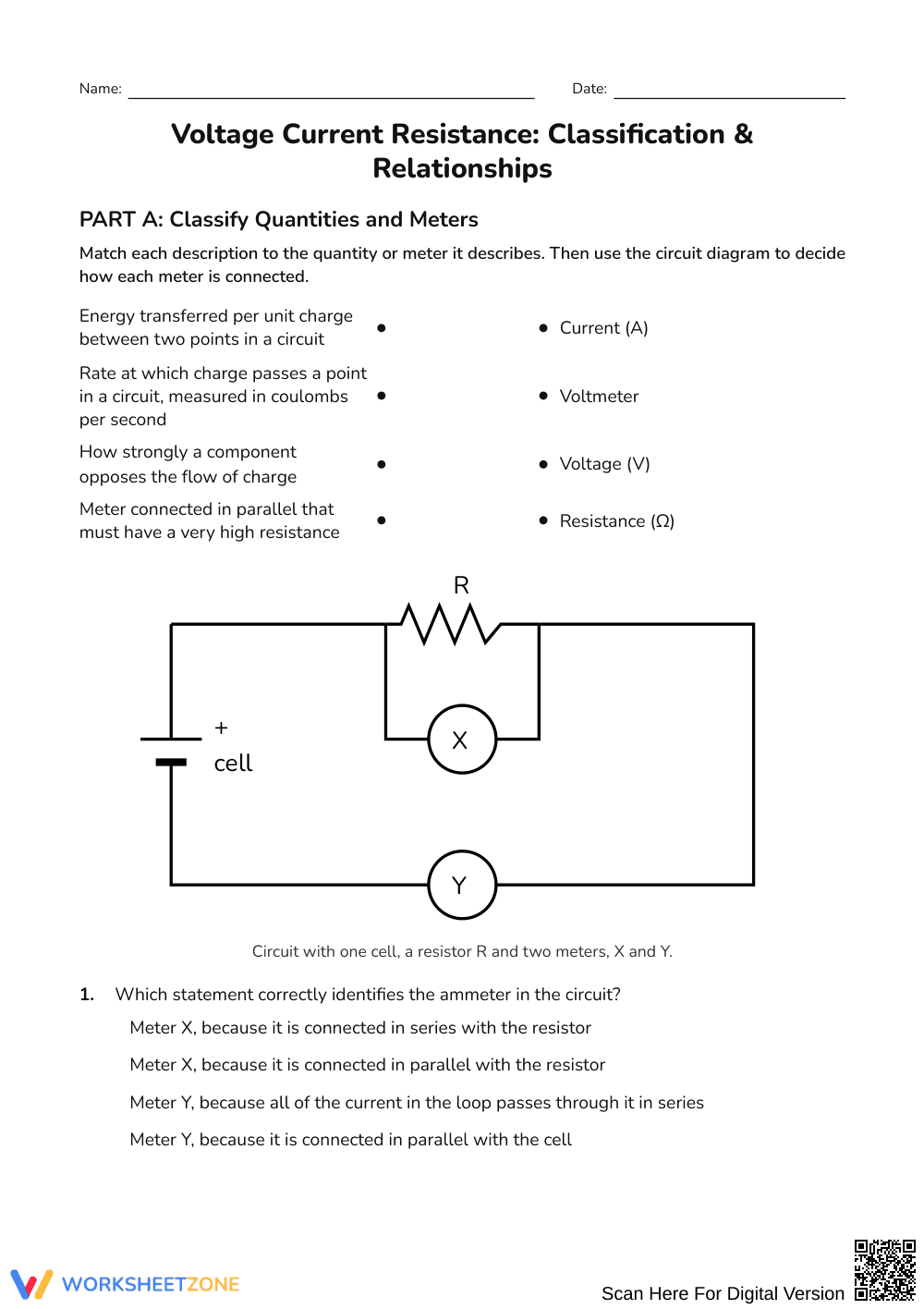
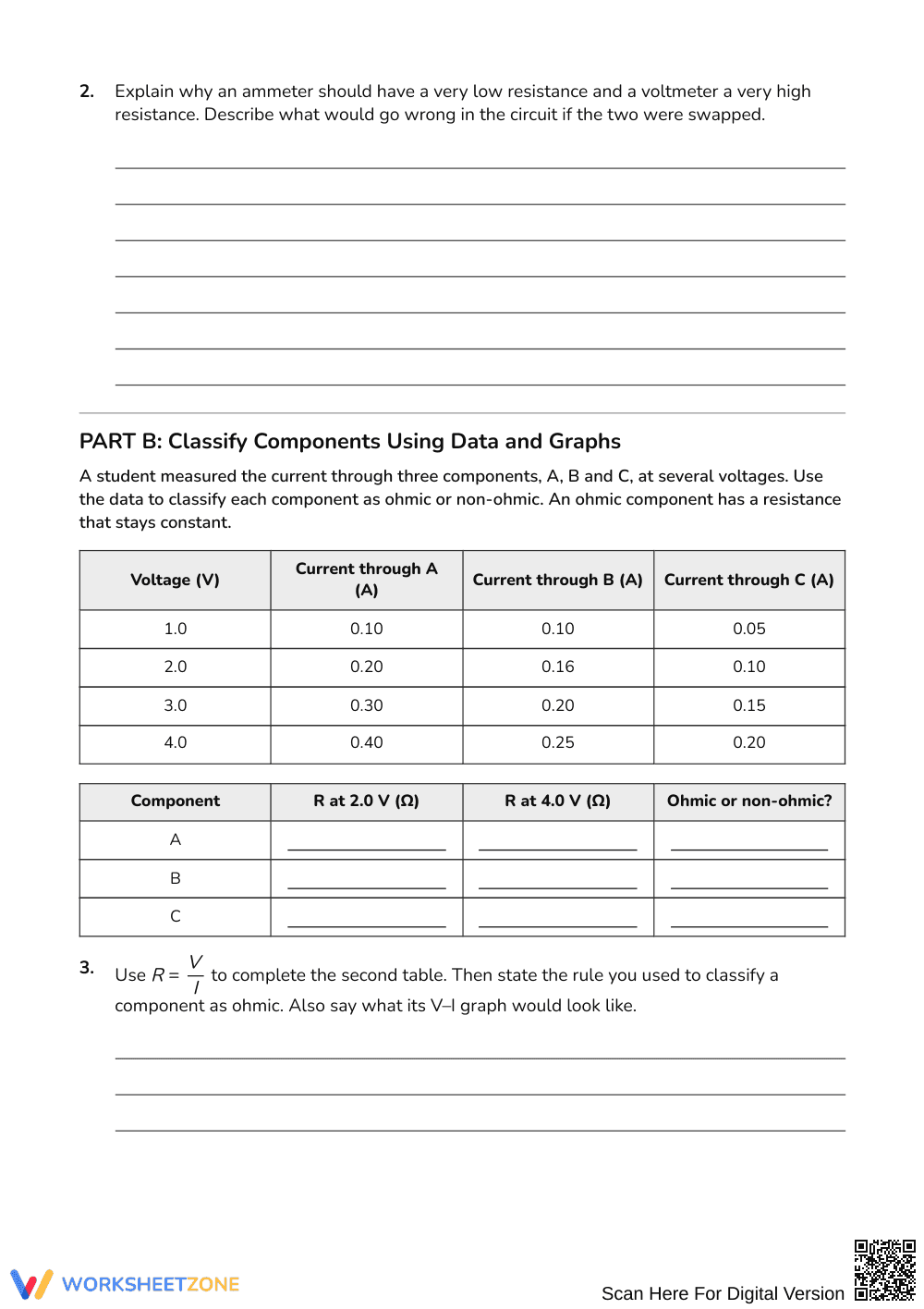
This comprehensive physical science worksheet equips secondary students to master the mathematical and conceptual relationships between voltage, current, and resistance. Learners classify electrical quantities, analyze circuit meter configurations, identify ohmic versus non-ohmic components using data tables, and apply Ohm's law to predict circuit behavior through 29 targeted tasks.
At a Glance
- Grade: Grades 8–12 · Subject: Science (Physics)
- Standard: Analyze electric circuits and apply mathematical models to predict current
- Skill Focus: Classification & Circuit Relationships
- Format: 4 pages · 29 problems · Answer key included · PDF
- Best For: Guided practice or concept reinforcement
- Time: 45–60 minutes
What's Inside
The four-page printable resource includes structured data tables, schematic diagrams, matching prompts, proportional reasoning calculations, and microscopic explanations of resistance. A four-page complete answer key provides worked calculations and sample explanations to make grading straightforward.
Skill Progression
- Guided Practice (Part A, 7 items): Students define basic quantities and examine schematic diagrams to classify ammeter and voltmeter placements, explaining why meter resistance values prevent measurement interference.
- Supported Practice (Part B, 10 items): Working from tabular experimental data, students calculate resistance across changing voltages, classify components as ohmic or non-ohmic, sketch graphical trends, and explain filament lamp heating at the particle level.
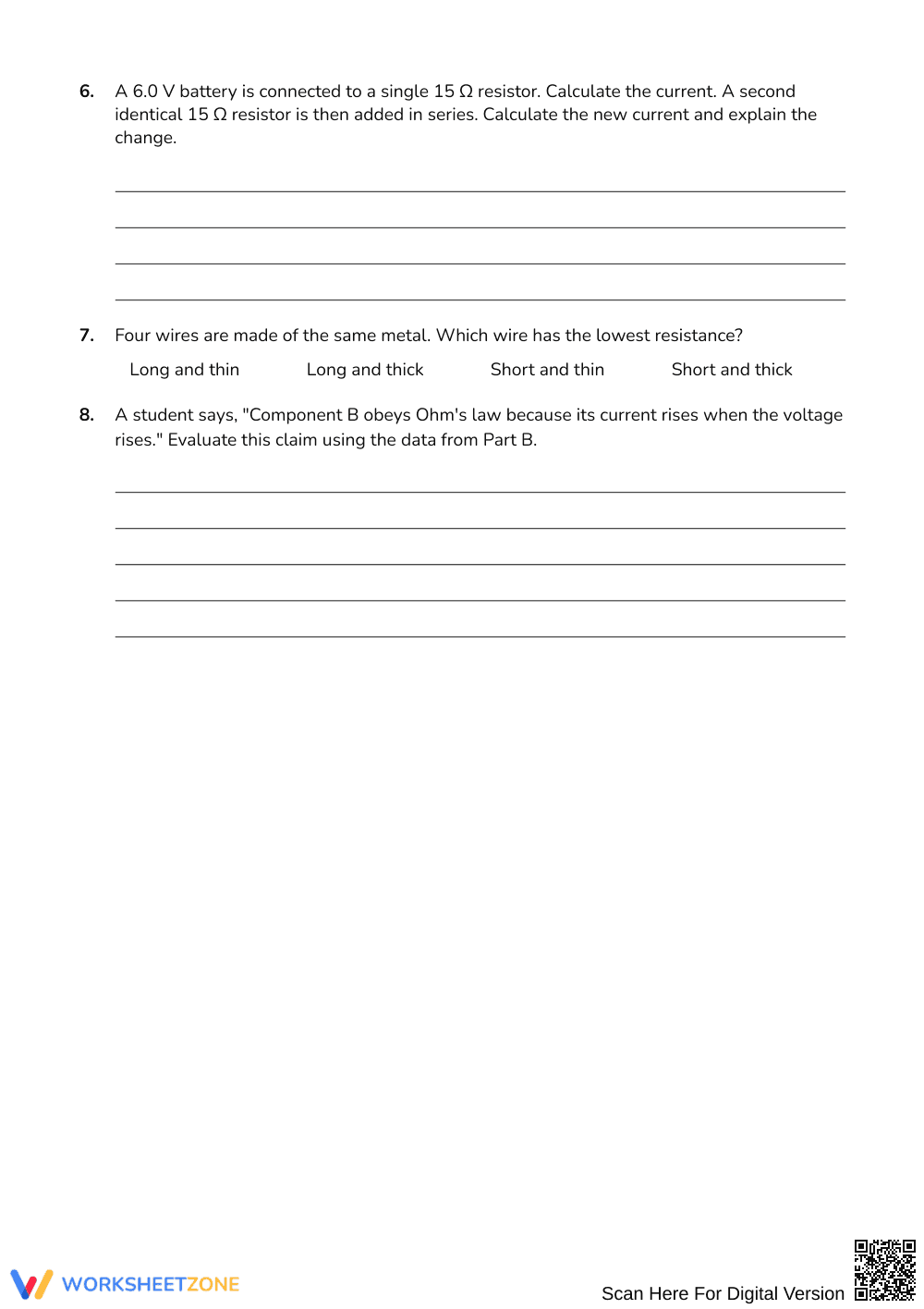
- Independent Practice (Part C, 12 items): Learners evaluate proportional changes using Ohm's law, solve multi-step series resistor problems, predict geometric wire resistance, and critique common misconceptions about electrical resistance.
This structure reflects a gradual-release model, moving from foundational vocabulary to qualitative graph analysis and quantitative circuit calculation.
Standards Alignment
This resource supports secondary physical science standards addressing energy transfer and electric circuits. Students apply mathematical representations of Ohm's law to solve problems involving current, potential difference, and resistance, while investigating how microscopic collisions between electrons and vibrating lattice ions cause electrical heating. This standard alignment can be copied directly into lesson plans, IEP goals, or district curriculum mapping tools.
How to Use It
Implement Part A and Part B during direct instruction following an introductory circuit lab, allowing students to verify physical observations with formal definitions. Use Part C as post-instruction independent practice or formative assessment. As students complete Part B, check whether they recognize that a curved voltage-current graph indicates changing resistance; students holding misconceptions often assume increasing current implies obedience to Ohm's law. Expected completion time is 45 to 60 minutes.
Who It's For
This worksheet serves general high school physics, physical science, and advanced middle school science courses. It offers built-in scaffolds such as reference formulas and comparison tables for developing learners, while challenging advanced students with microscopic mechanism questions. Pair this resource with hands-on breadboard circuit labs or virtual circuit simulations.
According to Fisher & Frey (2014), purposeful gradual-release instruction significantly improves conceptual retention and problem-solving automaticity in secondary STEM courses. By structuring circuit relationships across 29 focused problems—progressing from meter identification to tabular data analysis and algebraic proportional reasoning—this resource reinforces both qualitative schema and quantitative fluency. Students do not simply calculate Ohm's law formulaic values; they evaluate the physical mechanism of electron collisions in heated metallic filaments and distinguish linear ohmic components from non-linear devices. The clear sequence supports standards-aligned science curricula, offering teachers reliable formative feedback on student understanding of potential difference, current flow, and resistance. Consequently, this resource ensures secondary science students establish the necessary analytical foundation for advanced physics and engineering topics.


