




























Views
Downloads
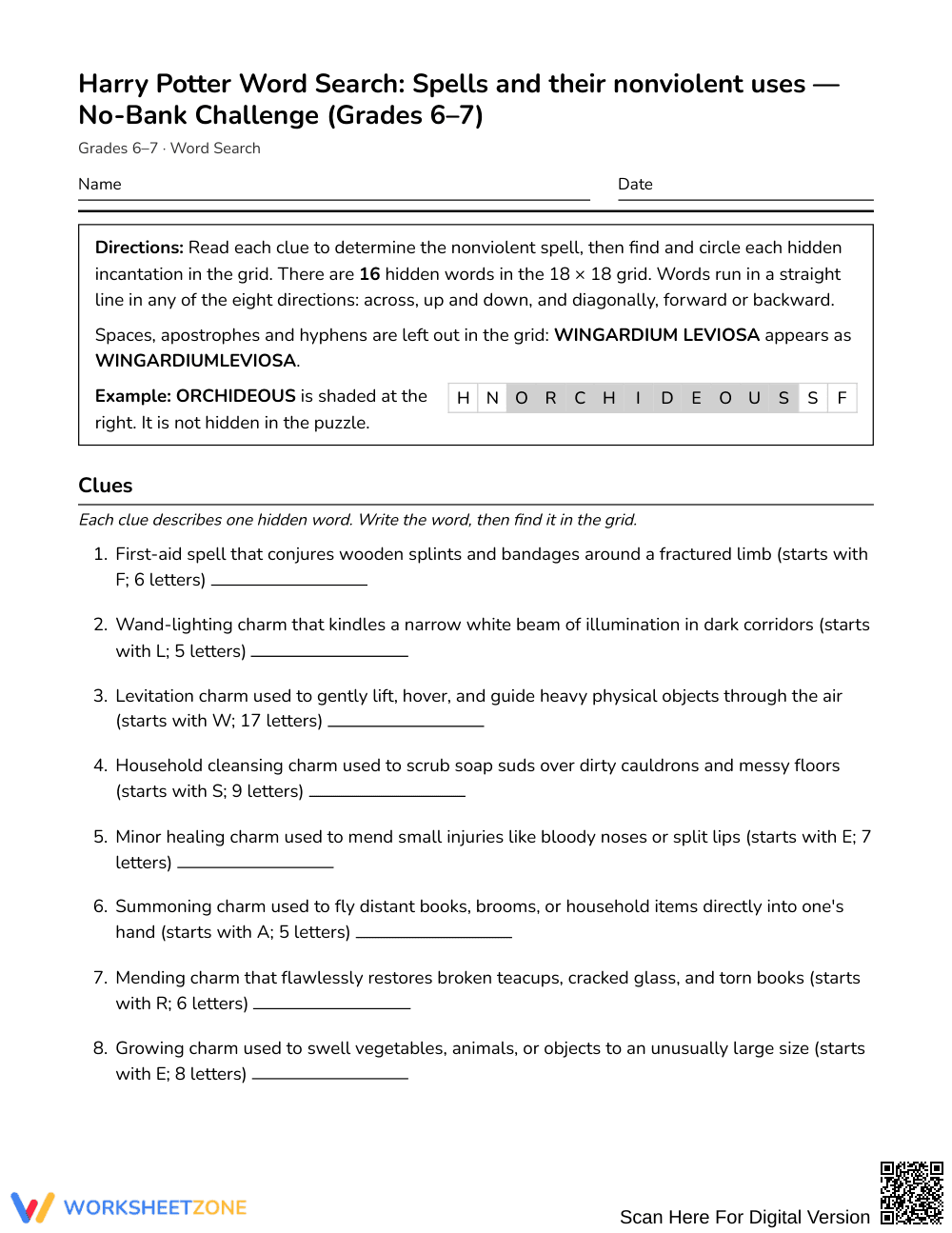
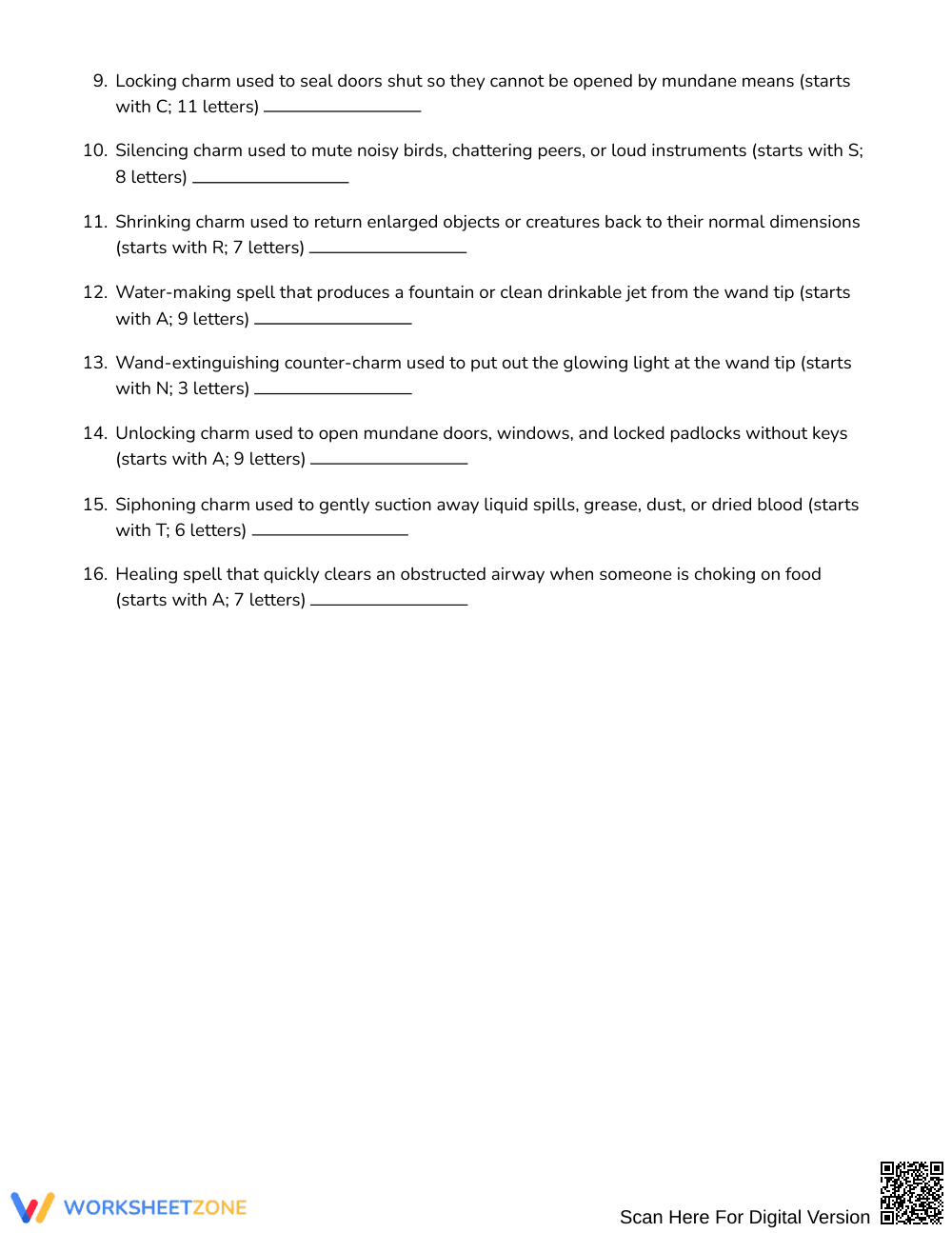


Essential Nonviolent Spells Word Search | Grades 6–7 ELA

Paste this activity's link or code into your existing LMS (Google Classroom, Canvas, Teams, Schoology, Moodle, etc.).
Students can open and work on the activity right away, with no student login required.
You'll still be able to track student progress and results from your teacher account.
This Grades 6–7 English Language Arts word search reinforces literary vocabulary through 16 incantations focused on nonviolent utility. Students read descriptive clues, deduce each matching spell, and find the terms within the grid. The activity sharpens contextual inference, word recognition, and reading comprehension in an engaging format.
At a Glance
- Grade: Grades 6–7 · Subject: English Language Arts (ELA)
- Standard: Not standards-assessed — vocabulary enrichment and contextual deduction
- Skill Focus: Spells and their nonviolent practical uses
- Format: 3 student pages · 16 words · Answer key included · PDF
- Best For: Independent vocabulary enrichment, literacy centers, and early finisher tasks
- Time: 25–35 minutes
What's Inside
The 3-page printable file delivers a no-bank challenge with 16 hidden words across an expansive letter matrix. Instead of using a simple word list, students read 16 functional clues describing restorative, defensive, or domestic charms like reparo and tergeo. A 4-page answer key provides highlighted letter paths for fast grading.
Puzzle Mechanics and Structure
This puzzle emphasizes active recall through specific design features:
- Grid Dimensions: Words are hidden within an 18 x 18 letter grid that prevents casual guessing.
- Search Directions: Words run in all 8 directions: N, NE, E, SE, S, SW, W, and NW.
- Clue-Based Search: Without a word bank, students must deduce each incantation from its clue before locating it.
Standards Alignment
This resource serves as vocabulary enrichment and is not aligned to a formal content standard. Rather than targeting standardized test benchmarks, the activity promotes morphological curiosity, context-clue analysis, and reading engagement through popular literature themes. Educators can incorporate this puzzle into thematic novel units, creative writing modules, or independent reading stations.
How to Use It
Introduce this word search after direct instruction on context clues or assign it to fast finishers during independent work time. Completion takes approximately 25 to 35 minutes. Formative tip: observe whether students identify the correct spell before searching the grid or scan aimlessly for letter groupings, indicating their degree of contextual comprehension.
Who It's For
This activity suits Grades 6–7 students developing inferential reading habits and Latin-based vocabulary. To differentiate, provide struggling readers with initial letter hints or pair advanced learners with a morphology extension chart exploring Latin roots like aqua or lumen. It pairs naturally with an introductory lesson on prefixes and suffixes.
Vocabulary enrichment activities that integrate contextual clues with gamified retrieval tasks build cognitive flexibility and long-term lexical retention. According to Fisher & Frey (2014), intentional word-learning experiences that prompt students to manipulate meanings through problem-solving reinforce morphological awareness and contextual deduction far more effectively than passive memorization. By removing the traditional word bank and requiring learners to identify 16 nonviolent spell incantations from functional definitions, this Grades 6–7 literacy resource shifts puzzle completion from simple visual scanning to active semantic retrieval. Students analyze descriptive syntax, decipher situational clues, and locate multi-directional terms across an 18 x 18 grid. This dual-action approach—combining semantic decoding with spatial pattern recognition—strengthens reading engagement and orthographic mapping. As a result, teachers obtain an adaptable, low-stakes vocabulary exercise that enriches middle-school reading curricula while maintaining rigorous student-centered engagement across diverse classroom learning environments.


