


























Views
Downloads



Essential Mass-Volume Density Worksheet | Grade 6 Science
Paste this activity's link or code into your existing LMS (Google Classroom, Canvas, Teams, Schoology, Moodle, etc.).
Students can open and work on the activity right away, with no student login required.
You'll still be able to track student progress and results from your teacher account.
This Grade 6 physical science worksheet equips students to master mass, volume, and density through systematic data analysis. Students interpret liquid-displacement measurements, apply the density formula to identify unknown substances, and evaluate experimental limitations. The structured layout ensures learners build confidence calculating characteristic properties and predicting sink-or-float behavior.
At a Glance
- Grade: 6 · Subject: Science
- Standard: Physical Science — Calculate density and interpret mass and volume data
- Skill Focus: Interpret Mass-Volume Measurements
- Format: 5 pages · 10 problems · Answer key included · PDF
- Best For: Middle school physical science data analysis
- Time: 35–45 minutes
What's Inside
This resource features 10 multi-step analytical tasks based on realistic synthetic laboratory data. Students consult a reference table of known substance densities and a student measurement table featuring liquid-displacement volumes. A complete 3-page answer key provides full computational steps, sample written explanations, and measurement troubleshooting solutions.
Skill Progression
- Guided practice (Tasks 1–2): Students read displacement values directly from data tables and evaluate student claims about the relationship between mass and volume.
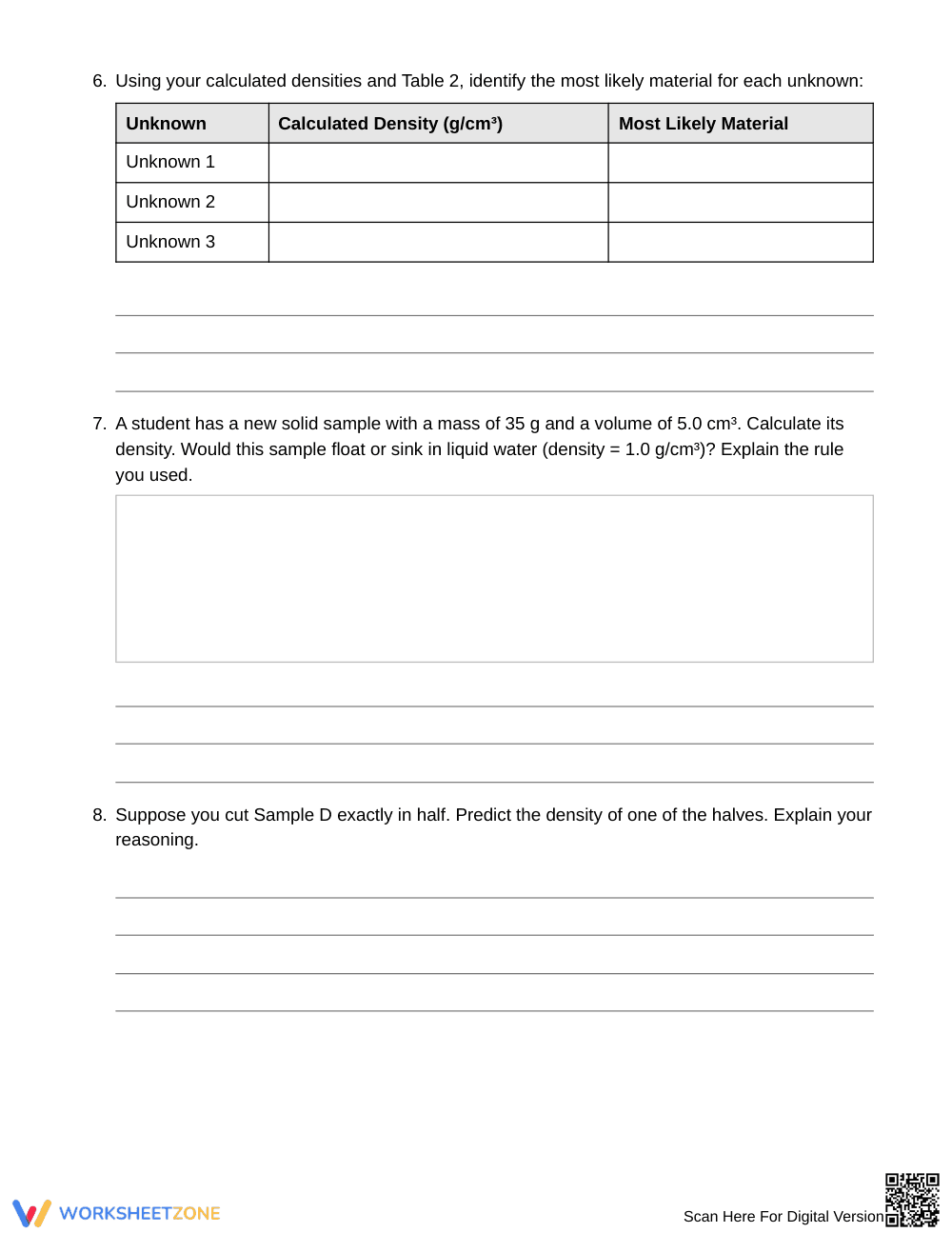
- Supported practice (Tasks 3–8): Learners apply the formula D = m ÷ V to calculate densities, identify three unknown substances, and test the sink-or-float principle.
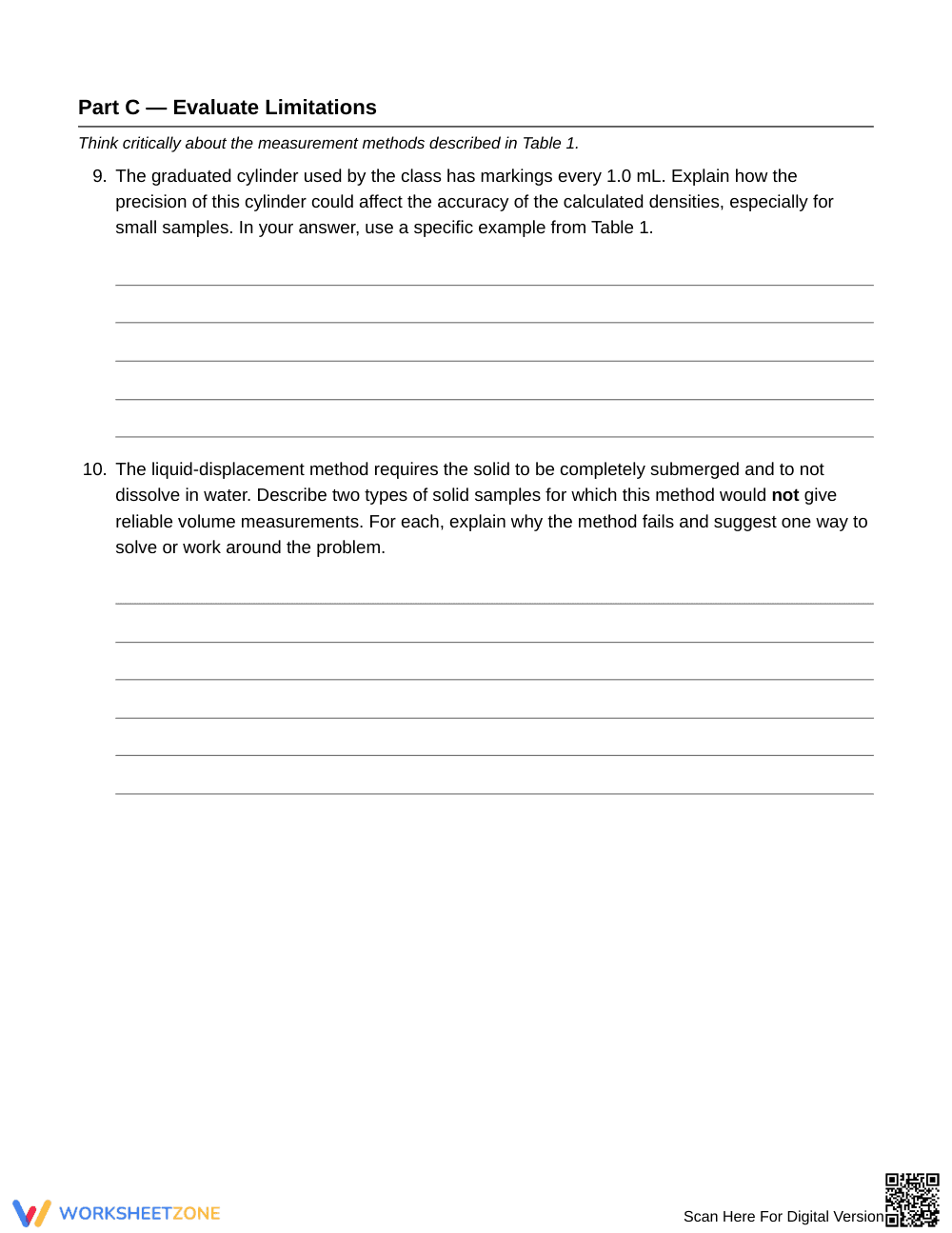
- Independent practice (Tasks 9–10): Students critically evaluate laboratory precision, graduated cylinder measurement limits, and solubility constraints.
This sequence embodies the gradual-release model, transitioning students from foundational table reading to rigorous experimental critique.
Standards Alignment
This resource aligns with middle school physical science standards requiring students to analyze and interpret data on the characteristic properties of substances. The activities emphasize quantitative reasoning and proportional thinking. Teachers can copy these core objectives directly into lesson plans, IEP goals, or district curriculum mapping tools.
How to Use It
Deploy this worksheet after direct instruction on the density equation and liquid-displacement procedures. For independent practice, assign the data tables during class where students work in pairs to verify calculations. Use Part C as a formative-assessment checkpoint to see if students understand how instrument precision impacts derived calculations. The full 10-task assignment typically takes between 35 and 45 minutes to complete.
Who It's For
This worksheet is tailored for Grade 6 science students studying introductory chemistry and physics concepts. Differentiation is built into the scaffolding, supporting emerging math learners with formula reminders while challenging advanced students with measurement critique questions. Pair this resource with a hands-on graduated cylinder lab or an interactive density simulation.
Middle school science instruction requires strong scaffolding when bridging mathematical computation with physical science concepts. According to Fisher & Frey (2014), structured data analysis tasks that follow a gradual-release framework significantly improve students' ability to synthesize experimental results and evaluate scientific claims. This 10-task Grade 6 worksheet reinforces the fundamental principle that density is an intensive, characteristic property of matter that remains invariant regardless of sample size. By engaging with realistic liquid-displacement measurements and multi-step computational problems, students systematically connect raw mass and volume metrics to derived physical quantities. The inclusion of critical evaluation prompts addresses common misconceptions regarding measurement precision and laboratory limitations, ensuring learners progress from basic formula memorization to genuine scientific literacy and inquiry-based reasoning. This resource serves as an effective instructional artifact for middle school classrooms targeting evidence-based inquiry and quantitative science analysis.


