


























Views
Downloads



Essential Magnetic Flux Change Worksheet | Grade 12 Physics
Paste this activity's link or code into your existing LMS (Google Classroom, Canvas, Teams, Schoology, Moodle, etc.).
Students can open and work on the activity right away, with no student login required.
You'll still be able to track student progress and results from your teacher account.
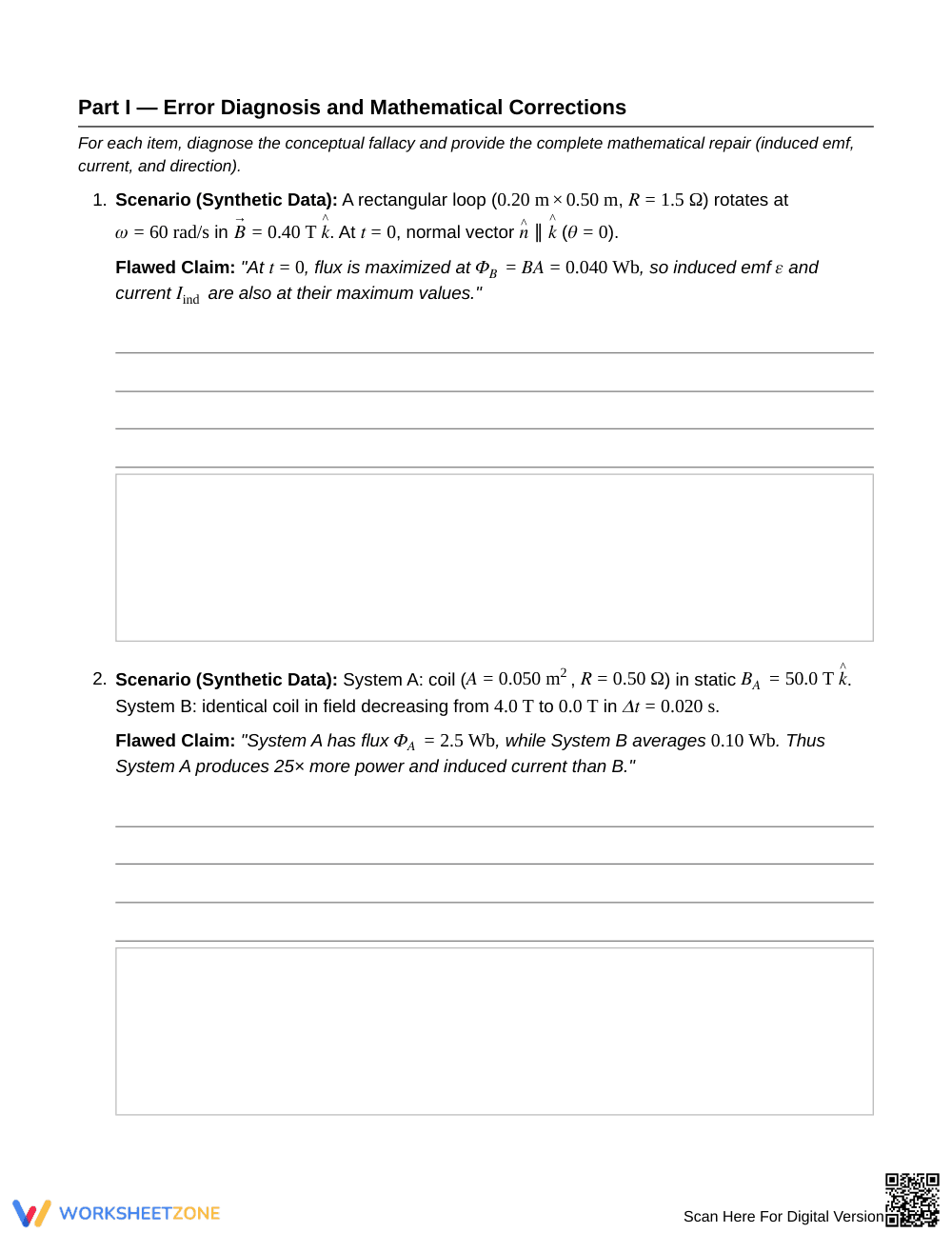
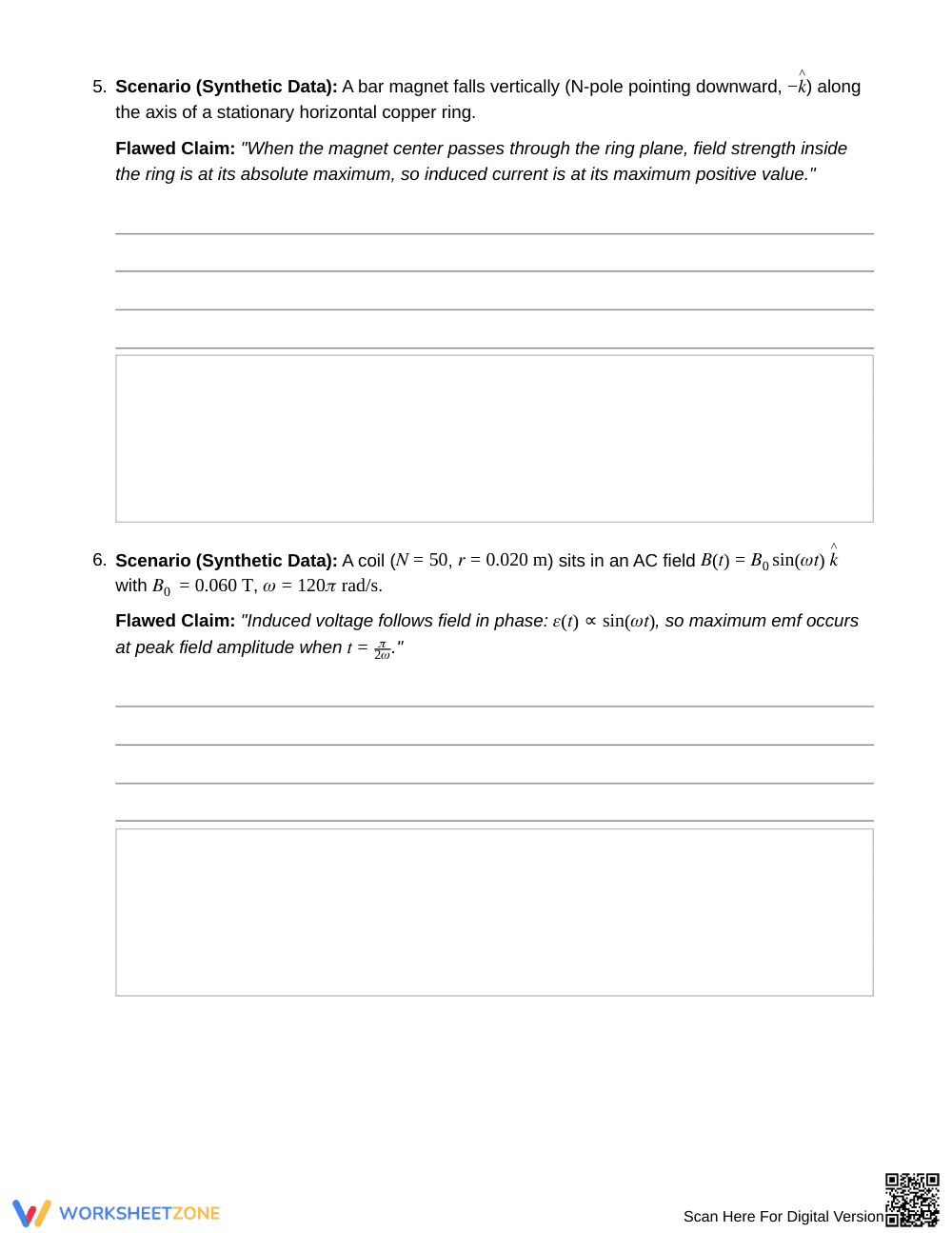
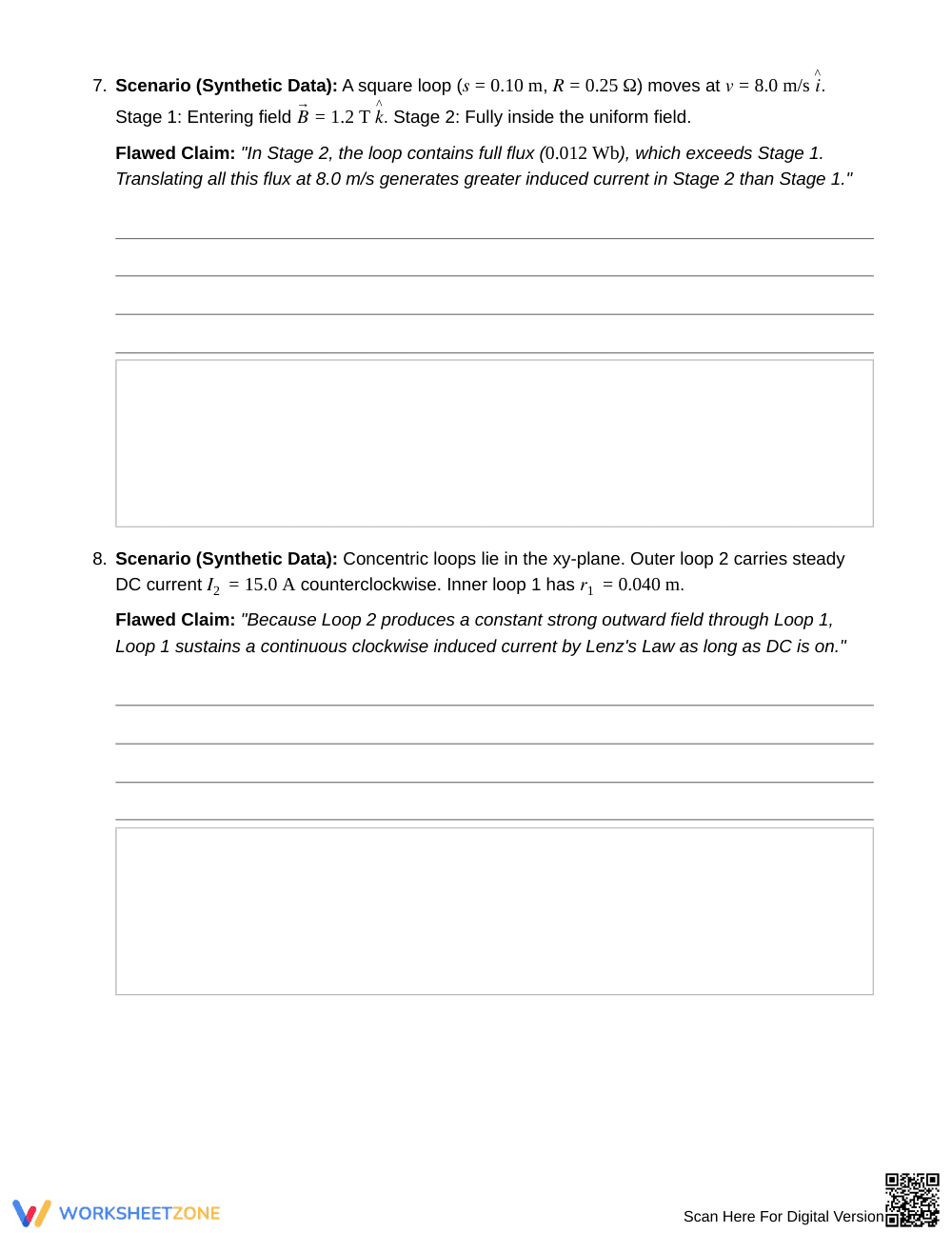
This Grade 12 physics resource targets the persistent misconception that magnetic flux magnitude dictates electromagnetic induction. Through 8 rigorous error-analysis scenarios, students examine flawed student reasoning, apply Faraday's and Lenz's laws, and compute exact values for induced electromotive force, current, and direction to establish genuine conceptual and mathematical mastery.
At a Glance
- Grade: 12 · Subject: Physics
- Standard: High School Physics — Differentiate magnetic flux from rate of change of flux during electromagnetic induction
- Skill Focus: Correcting flux versus flux-change fallacies
- Format: 5 pages · 8 problems · Answer key included · PDF
- Best For: AP Physics C and advanced electromagnetism review
- Time: 45–60 minutes
What's Inside
This 5-page printable instructional packet provides an authoritative coordinate convention reference, four core operational formulas, a fully annotated diagnostic model, and 8 structured diagnostic tasks. Each task presents synthetic student dialogue containing a specific conceptual trap, requiring students to identify the physics breakdown and execute a full quantitative correction across rotating loops, dynamic fields, and translating conductors. A comprehensive 2-page answer key provides complete mathematical derivations and directional proofs.
Skill Progression
- Guided Practice: A complete introductory worked example models the diagnostic protocol, contrasting a static 0.377 Weber flux against zero induced voltage to establish the analytical framework.
- Supported Practice: Items 1 through 4 guide learners through rotational phase offsets, differing field decay rates, directional signs via Lenz's law, and translating rail circuits with clear geometric cues.
- Independent Practice: Items 5 through 8 demand autonomous synthesis across falling bar magnets, sinusoidal alternating fields, boundary-crossing loops, and steady concentric direct-current circuits.
This progression mirrors an explicit gradual-release architecture, transitioning students from teacher-directed error deconstruction to unassisted physical reasoning.
Standards Alignment
Aligned with advanced secondary physics objectives for electromagnetism, this material targets the quantitative application of Faraday's Law, ε = −N(dΦ/dt), and Lenz's Law to determine induced currents in conductors. Supporting standards address vector dot products, time derivatives of magnetic fields, and motional electromotive force in dynamic circuits. These standard descriptions can be copied directly into lesson plans, IEP goals, or district curriculum mapping tools.
How to Use It
Deploy this activity immediately following direct instruction on Faraday's law and Lenz's law, before beginning inductors or Maxwell's equations. During independent student work, circulate and monitor Item 1 and Item 6: verify whether students confuse peak field amplitude with peak rate of change, prompting them to take the first derivative of cosine functions. Expect total completion within 45 to 60 minutes as paired collaborative coursework or an evaluative diagnostic check.
Who It's For
Designed for Grade 12 Advanced Placement (AP Physics C: Electricity and Magnetism), International Baccalaureate Higher Level Physics, or honors physics students. Pair this activity with an interactive coil-and-galvanometer laboratory demonstration to anchor abstract derivative concepts in observable physical phenomena.
Physics students frequently demonstrate what cognitive researchers identify as static-variable bias, wrongly inferring that maximum field strength produces peak induction. As documented by Fisher & Frey (2014) in their foundational work on formative feedback and error analysis, evaluating flawed synthetic student work compels learners to confront surface-level assumptions and construct resilient conceptual frameworks. By executing 8 diagnostic repairs across diverse electromagnetic scenarios, students resolve the distinction between magnetic flux and its instantaneous time rate of change. The 5-page worksheet combines rigorous coordinate conventions with step-by-step mathematical proofs, enabling students to calculate induced electromotive force, determine current direction with Lenz's law, and interpret calculus-based boundary conditions with precision. This deliberate diagnostic focus builds durable analytical competence essential for advanced scientific coursework and standardized assessment success.


