


























Views
Downloads



Essential Magnetic Fields Worksheet | Grade 12 Physics
Paste this activity's link or code into your existing LMS (Google Classroom, Canvas, Teams, Schoology, Moodle, etc.).
Students can open and work on the activity right away, with no student login required.
You'll still be able to track student progress and results from your teacher account.
This Grade 12 physics worksheet equips students to analyze magnetic fields, apply right-hand rules, and calculate Lorentz forces. Learners differentiate field interactions, evaluate vector cross products for charges and current-carrying wires, and predict electromagnetic induction. It provides rigorous practice bridging core theory and quantitative problem solving.
At a Glance
- Grade: 12 · Subject: Physics
- Standard: Electromagnetism — Calculate magnetic forces on charges and wires, and analyze electromagnetic induction
- Skill Focus: Magnetic Fields and Force Direction
- Format: 5 pages · 12 problems · Answer key included · PDF
- Best For: Advanced placement physics exam preparation
- Time: 45–60 minutes
What's Inside
This 5-page student packet contains 12 rigorous physics tasks organized into three distinct parts. The materials open with reference conventions and physical constants, progressing through qualitative concept distinctions, multi-step vector calculations with cross products, and a synthetic test matrix. A complete 3-page answer key provides full mathematical solutions and directional justifications.
Skill Progression
- Guided practice: Part A (Problems 1–4) offers conceptual comparisons, scaffolding qualitative work-energy principles, field line geometry, and motional EMF with reference constants.
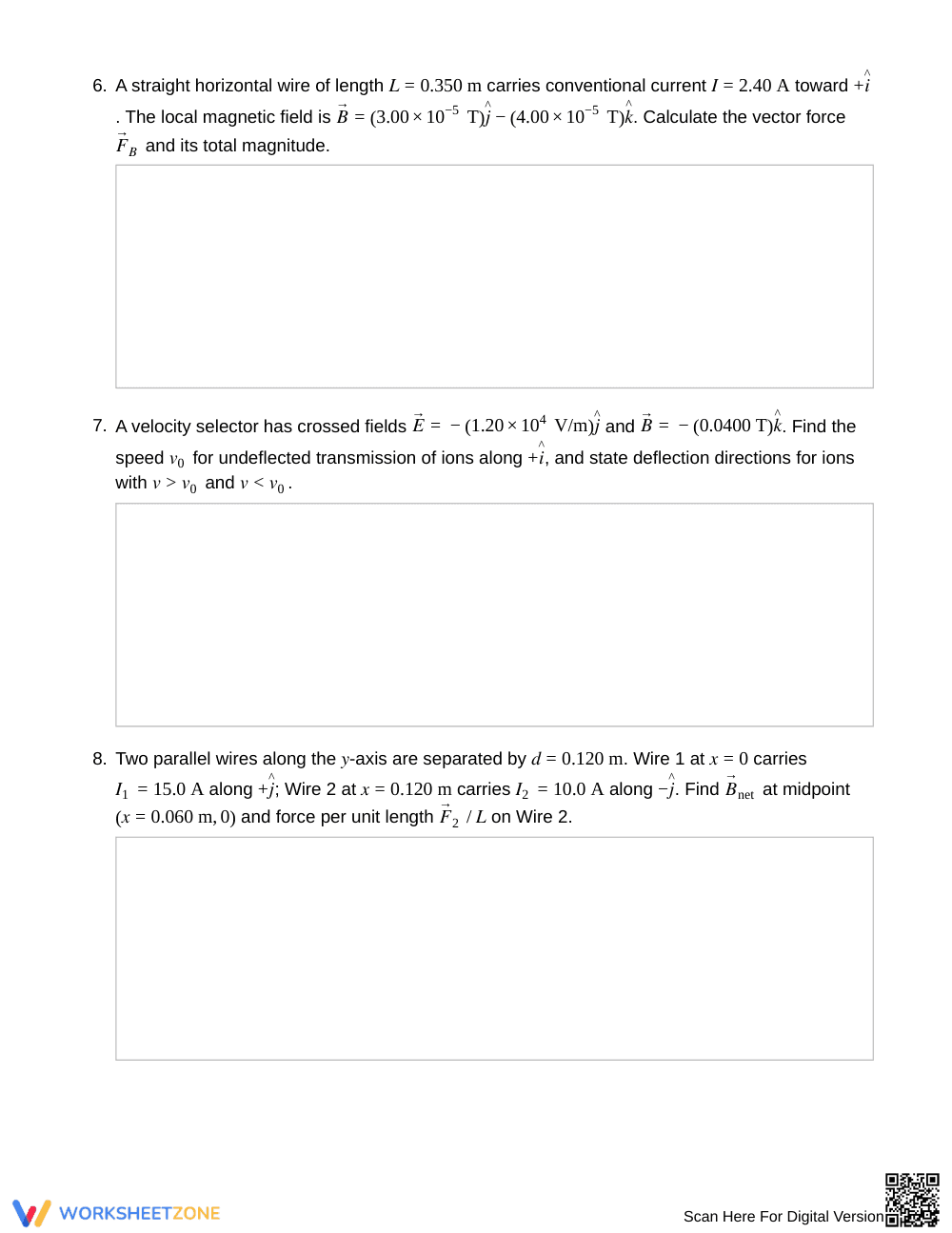
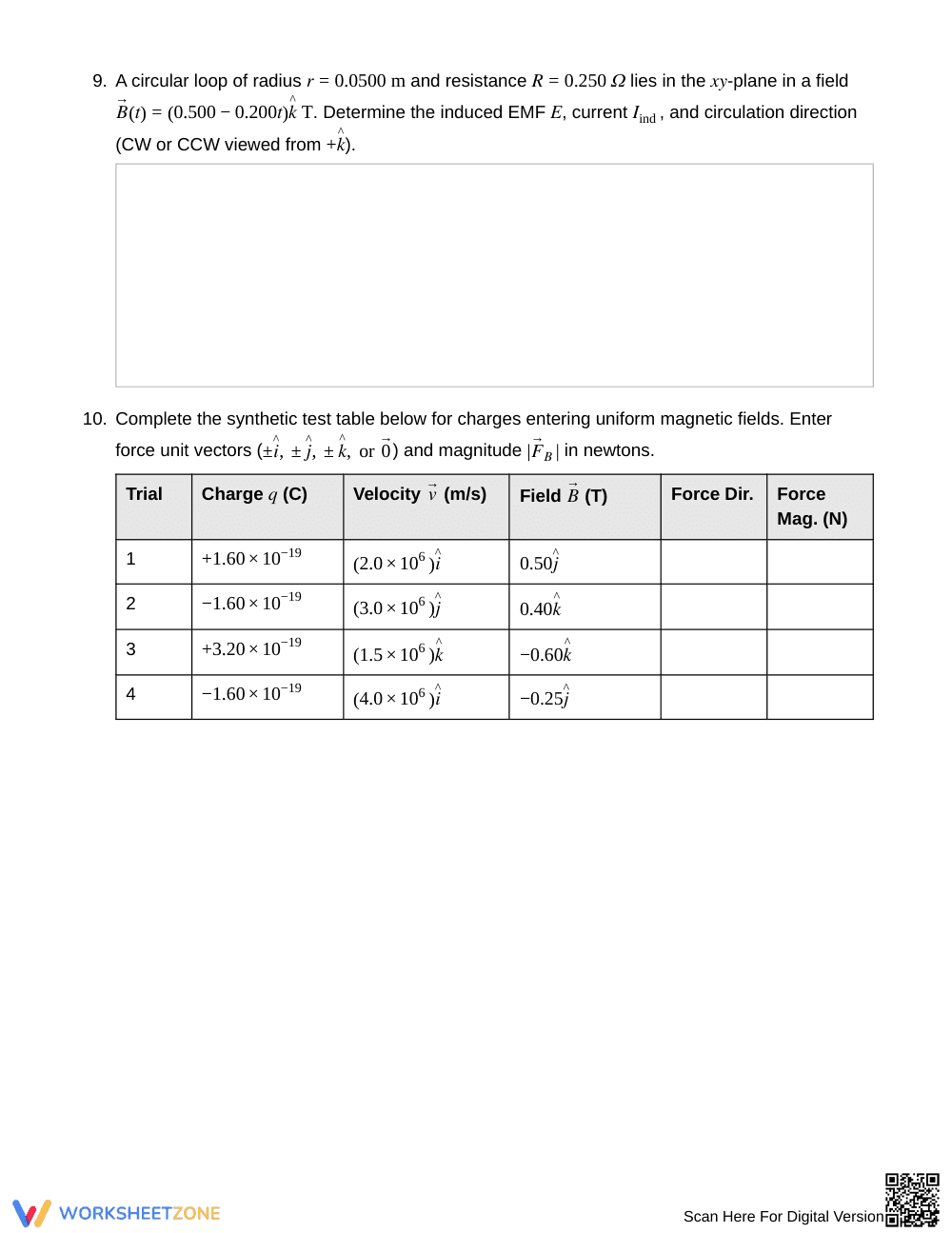
- Supported practice: Part B (Problems 5–10) prompts structured quantitative work, guiding students through vector cross products, velocity selectors, wire fields, and table entries.
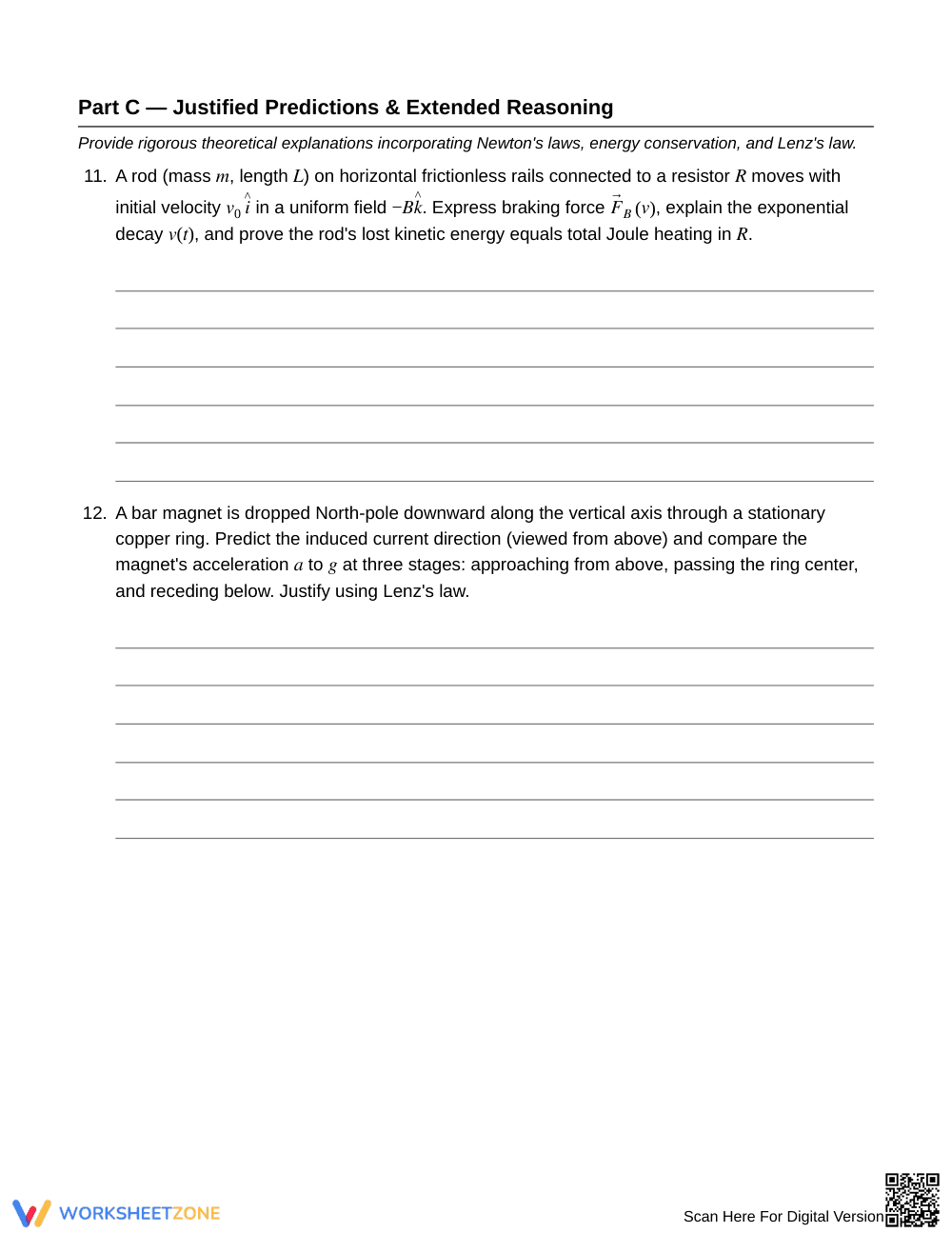
- Independent practice: Part C (Problems 11–12) demands unprompted theoretical reasoning, requiring students to derive magnetic braking equations and justify induction via Lenz's law.
This sequence implements gradual-release methodology, moving students from guided conceptual distinction to independent mathematical proof.
Standards Alignment
This resource aligns with high school physics standards for electromagnetism, requiring students to calculate magnetic forces on moving charges and current-carrying wires. It also supports standards on electromagnetic induction, applying Faraday's and Lenz's laws to predict induced EMF. Both standard codes can be copied directly into lesson plans, IEP goals, or district curriculum mapping tools.
How to Use It
Use this worksheet after direct instruction on the Lorentz force equation and right-hand rules. Assign Parts A and B during class for collaborative partner practice on vector cross products, or assign Part C as independent homework after covering Lenz's law. Formatively check whether students reverse force directions for negative charges. Completion takes 45 to 60 minutes.
Who It's For
This worksheet is designed for Grade 12 Advanced Placement and honors physics students. Support emerging learners by pairing the tasks with a 3D coordinate vector anchor chart. Challenge advanced students by having them extend the Part C magnetic braking derivation to non-uniform fields.
Grade 12 physics curricula demand that students master magnetic fields and force direction through both conceptual differentiation and vector mechanics. According to Fisher & Frey (2014), structured instructional sequences that move from foundational principles to guided computational tasks yield measurable gains in analytical problem-solving and conceptual retention. This 5-page worksheet implements that pedagogy across 12 targeted tasks, enabling learners to determine Lorentz force vectors, evaluate magnetic field geometry, and apply Lenz's law to induction scenarios. By synthesizing vector mathematics with fundamental conservation laws, students build durable mental models of electromagnetic interactions. The inclusion of coordinate references, tabular trial sets, and rigorous theoretical proofs ensures students acquire both procedural fluency and qualitative mastery. Educators can deploy this resource for AP exam preparation or core instruction to ensure high school seniors develop the quantitative reasoning required for university-level physical sciences.


