


























Views
Downloads



Essential Kinematic Models Worksheet | Grade 12 Physics
Paste this activity's link or code into your existing LMS (Google Classroom, Canvas, Teams, Schoology, Moodle, etc.).
Students can open and work on the activity right away, with no student login required.
You'll still be able to track student progress and results from your teacher account.
This Grade 12 physics worksheet challenges students to evaluate competing constant-acceleration models across complex, multi-stage kinematics scenarios. Through 10 analytical and computational tasks, learners calculate piecewise versus time-averaged predictions, analyze vector quantities, and discriminate between theoretical frameworks using empirical tracking data. The resource equips high school physicists to master rigorous motion analysis and experimental validation.
At a Glance
- Grade: 12 · Subject: Physics
- Standard: Advanced Physics Kinematics — Analyze multi-stage motion and evaluate competing mathematical models using observational data
- Skill Focus: Compare Constant-Acceleration Models
- Format: 5 pages · 10 problems · Answer key included · PDF
- Best For: Advanced kinematics exam and lab preparation
- Time: 45–60 minutes
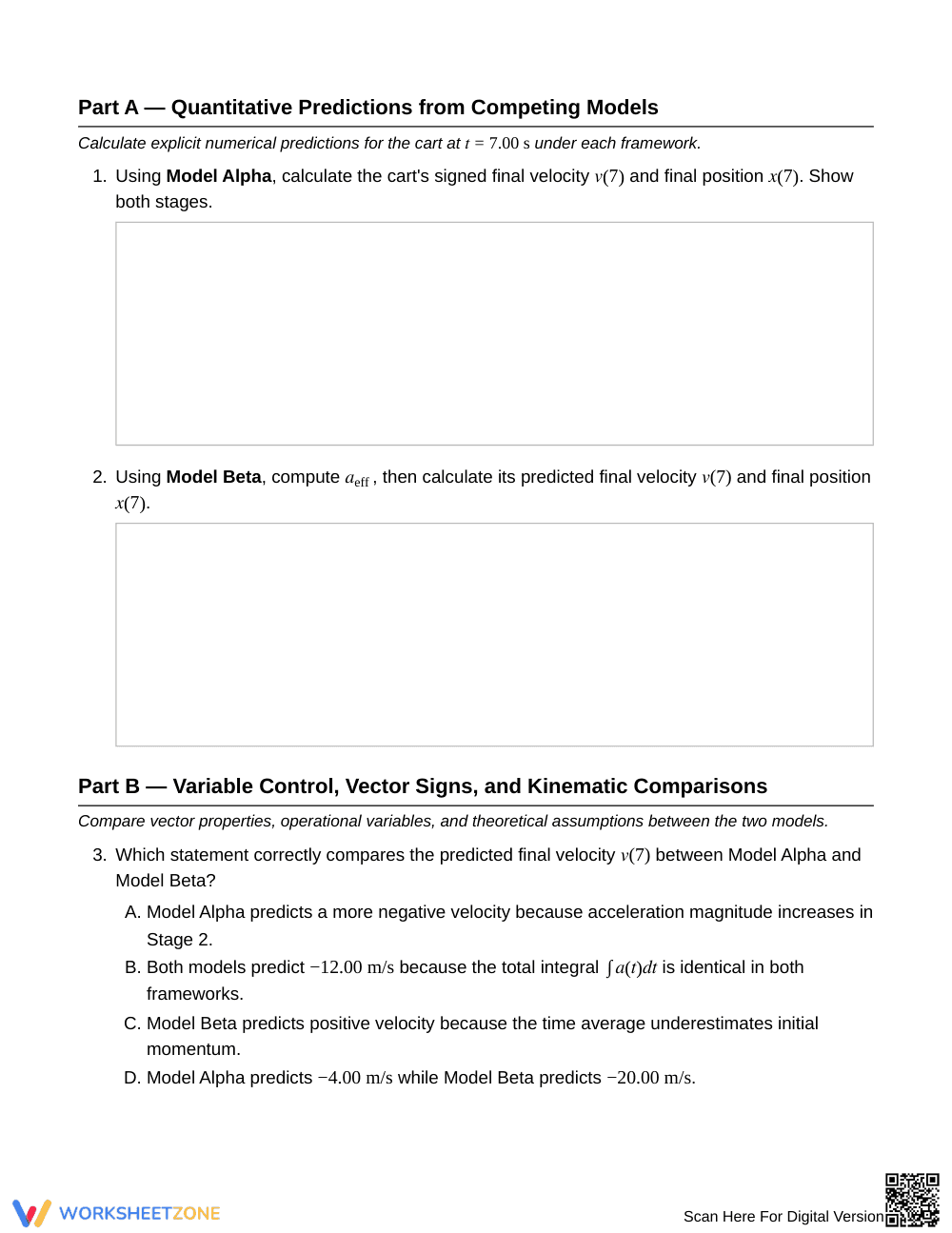
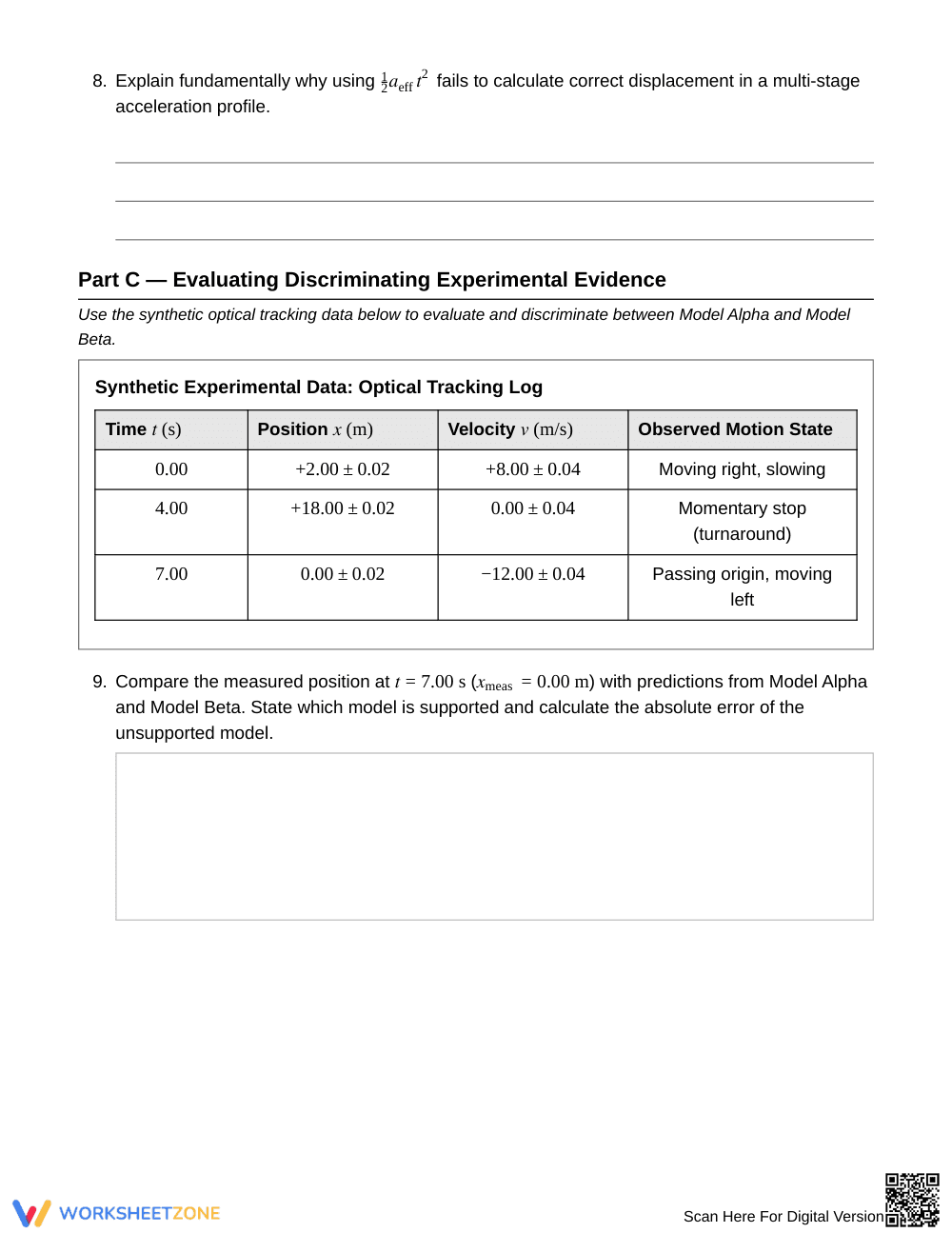
The 5-page student activity features a multi-phase pneumatic track cart scenario governed by varying vector accelerations. Students work through quantitative computations, conceptual sign and speed evaluations, variable identification, and empirical hypothesis testing against an optical tracking data log. A thorough 2-page answer key provides step-by-step mathematical solutions and scientific counterarguments.
Skill Progression
- Guided practice (Tasks 1–2): Students apply standard kinematic equations to calculate explicit final velocity and position values under Model Alpha and Model Beta frameworks with defined stage parameters.
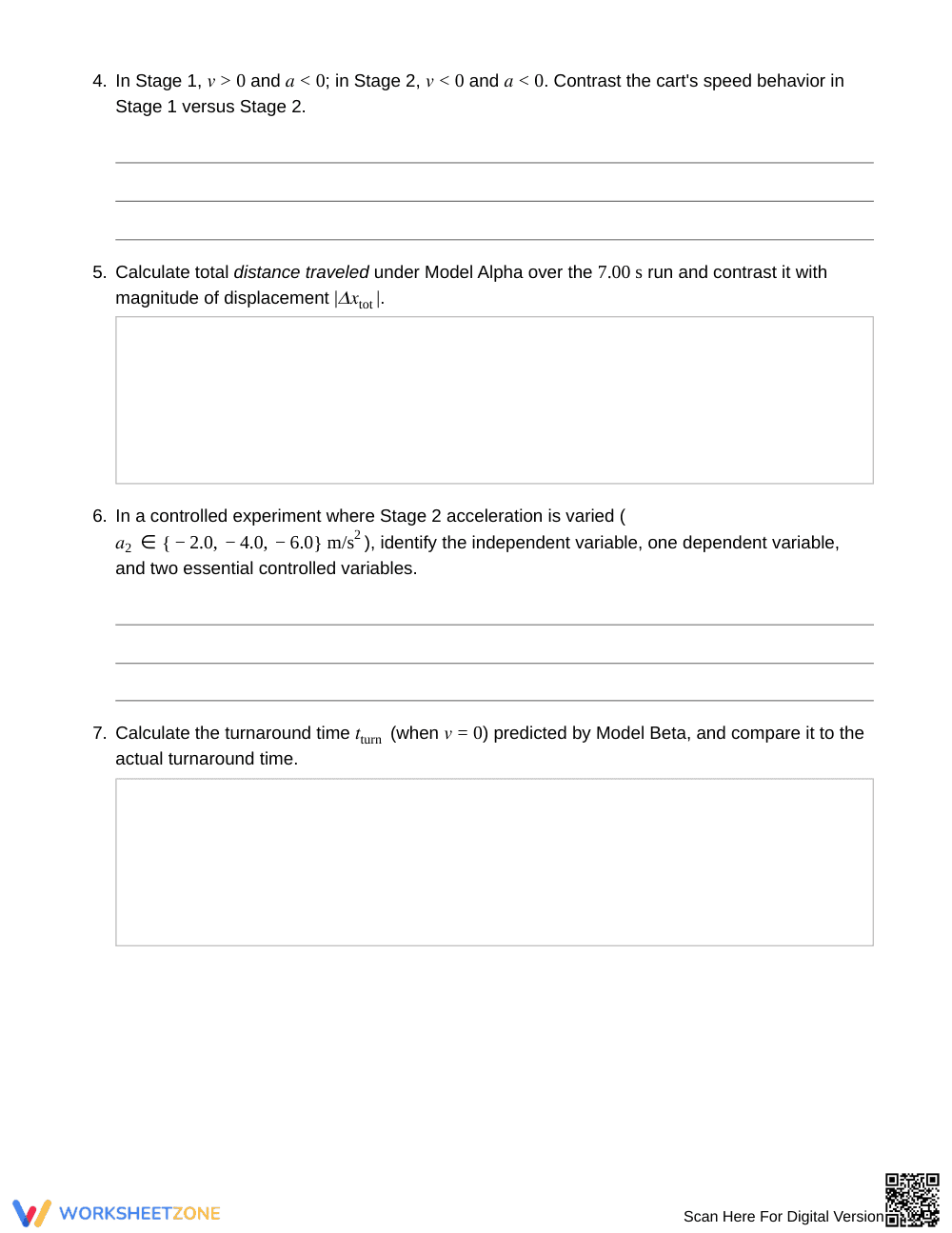
- Supported practice (Tasks 3–8): Learners analyze vector signs, distinguish distance from displacement, identify experimental control variables, and explain the mathematical breakdown of time-weighted acceleration models.
- Independent practice (Tasks 9–10): Students synthesize empirical optical tracking data to calculate absolute error, invalidate flawed assumptions, and formulate rigorous written scientific counterarguments.
This sequence mirrors the gradual-release model, shifting student cognitive load from formulaic computation to rigorous scientific argumentation.
Standards Alignment
This activity aligns with high school physics and AP Physics standards requiring students to design mathematical representations of multi-stage constant-acceleration motion and assess scientific claims using empirical evidence. These learning objectives can be copied directly into lesson plans, IEP goals, or district curriculum mapping tools.
How to Use It
Administer this worksheet after direct instruction on multi-stage kinematics or as a pre-lab conceptual checkpoint before introducing photogate track carts. For formative assessment, check Task 6 to ensure students understand that acceleration sign does not independently determine speeding up or slowing down. Expect typical completion times between 45 and 60 minutes.
Who It's For
Designed for Grade 12 physics, AP Physics 1, and introductory college-level mechanics students who need advanced practice with vector signs and piecewise motion. It pairs naturally with motion sensor lab activities, velocity-time graphing exercises, and direct instruction on piecewise kinematic functions.
Advanced kinematics instruction demands that high school physics students move beyond rote plug-and-chug formula calculations into conceptual model evaluation and empirical validation. According to Fisher & Frey (2014), structured instructional progressions that guide students from procedural problem-solving to independent evidence analysis yield deeper conceptual retention in STEM disciplines. This Grade 12 kinematics worksheet directly implements this pedagogical architecture by presenting two plausible mathematical models for a two-stage pneumatic cart run. Students examine why a simple time-weighted average acceleration fails to predict correct spatial displacement, even when resulting in an identical final velocity. By comparing theoretical predictions against real-world synthetic optical tracking logs, learners practice essential scientific argumentation skills: calculating model error, verifying vector conventions, and articulating why mathematical coincidence does not equal physical validity. This comprehensive 10-task resource provides rigorous, publication-grade practice that solidifies kinematic concepts and prepares students for college-level analytical mechanics.


