




























Views
Downloads


Essential Follow Explanations Worksheet | Grade 7 ELA

Paste this activity's link or code into your existing LMS (Google Classroom, Canvas, Teams, Schoology, Moodle, etc.).
Students can open and work on the activity right away, with no student login required.
You'll still be able to track student progress and results from your teacher account.
This Grade 7 reading worksheet trains students to follow how explanations unfold across paragraphs in complex informational texts. Using an original case study on community repair clinics, learners trace interactions between individuals, actions, and claims to evaluate how authors build coherent explanations step-by-step.
At a Glance
- Grade: 7 · Subject: ELA
- Standard:
RI.7.3— Analyze how individuals, events, and ideas interact across informational text- Skill Focus: Follow an Explanation Across Paragraphs
- Format: 5 pages · 10 problems · Answer key included · PDF
- Best For: Informational text close reading and analysis
- Time: 40–50 minutes
What's Inside
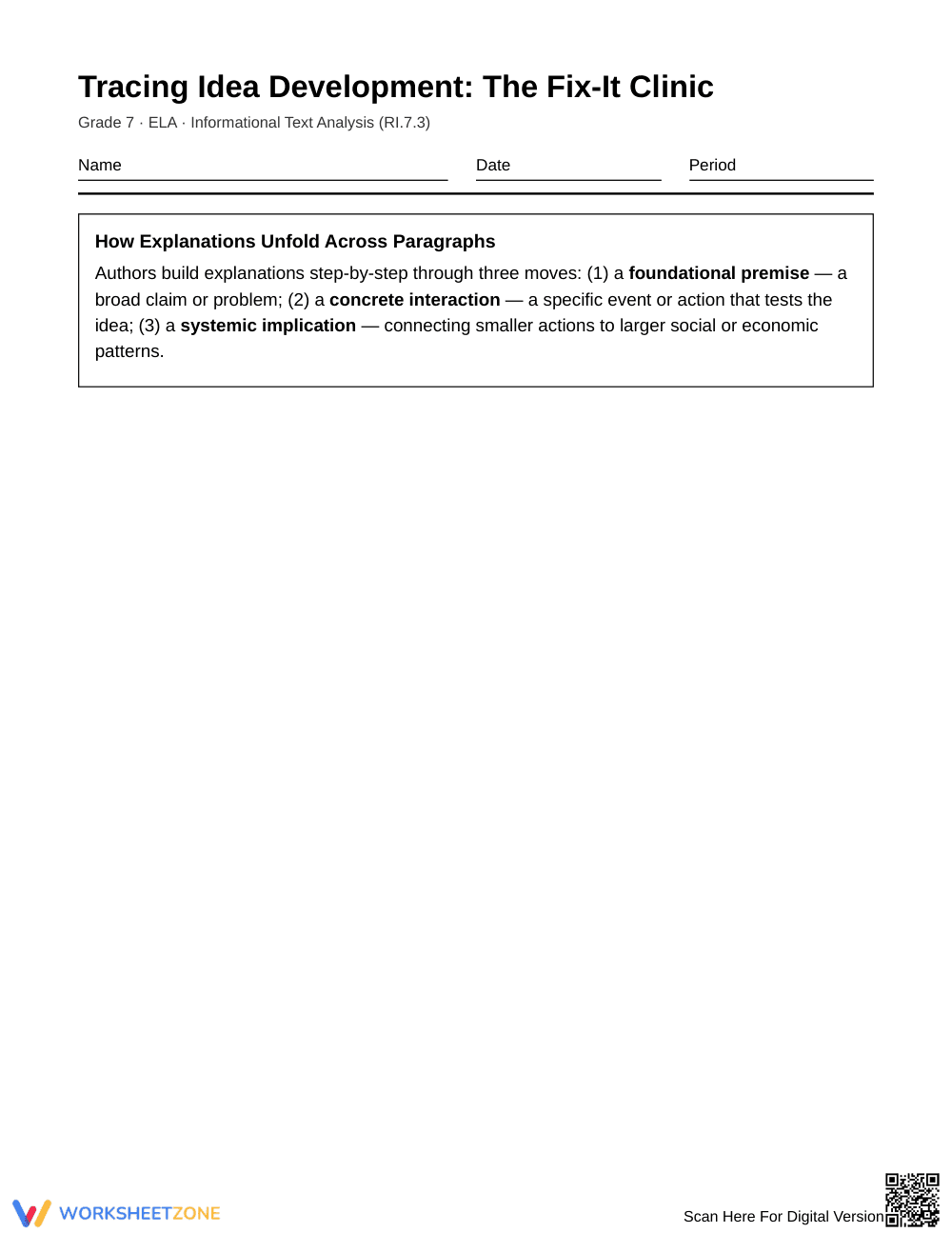
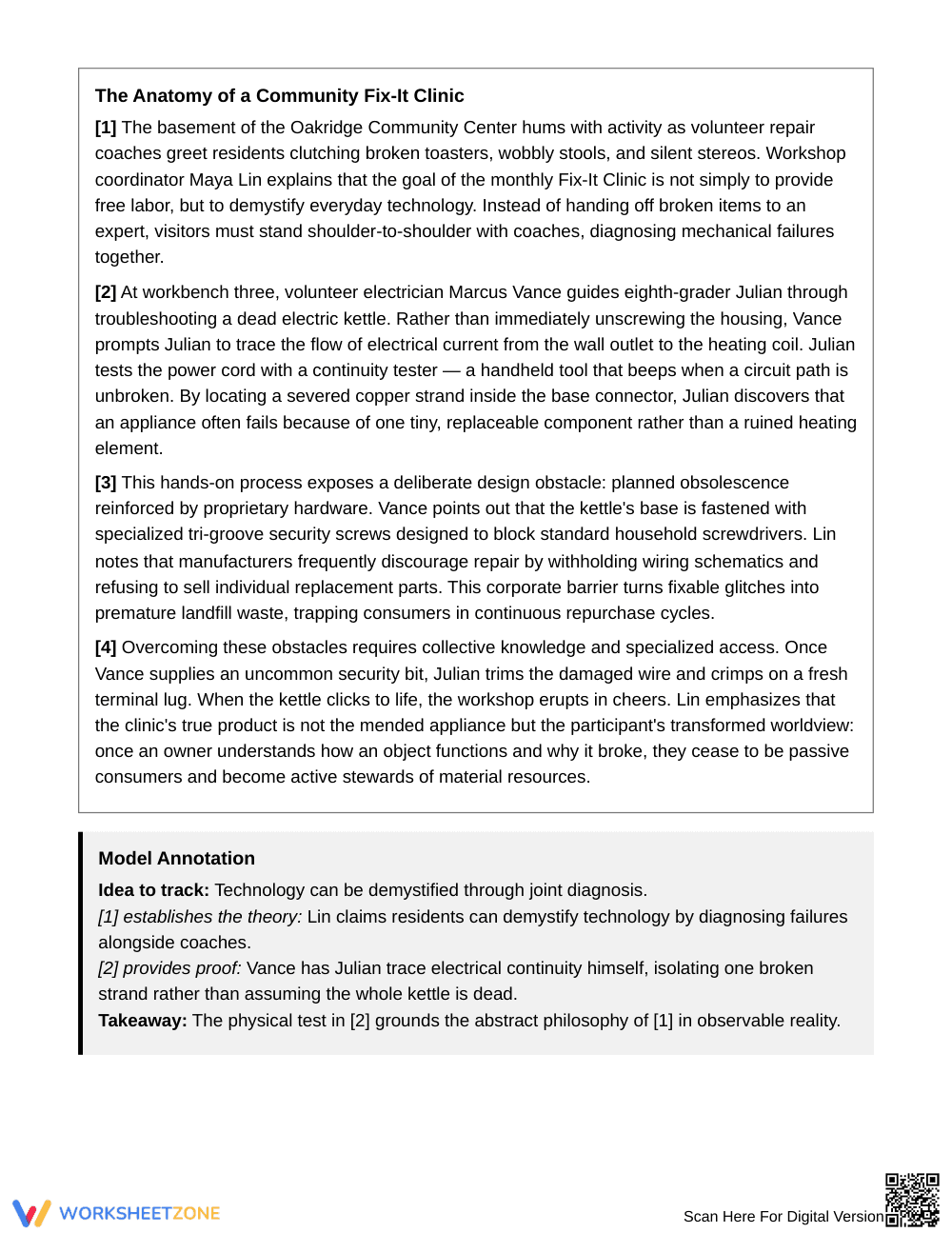
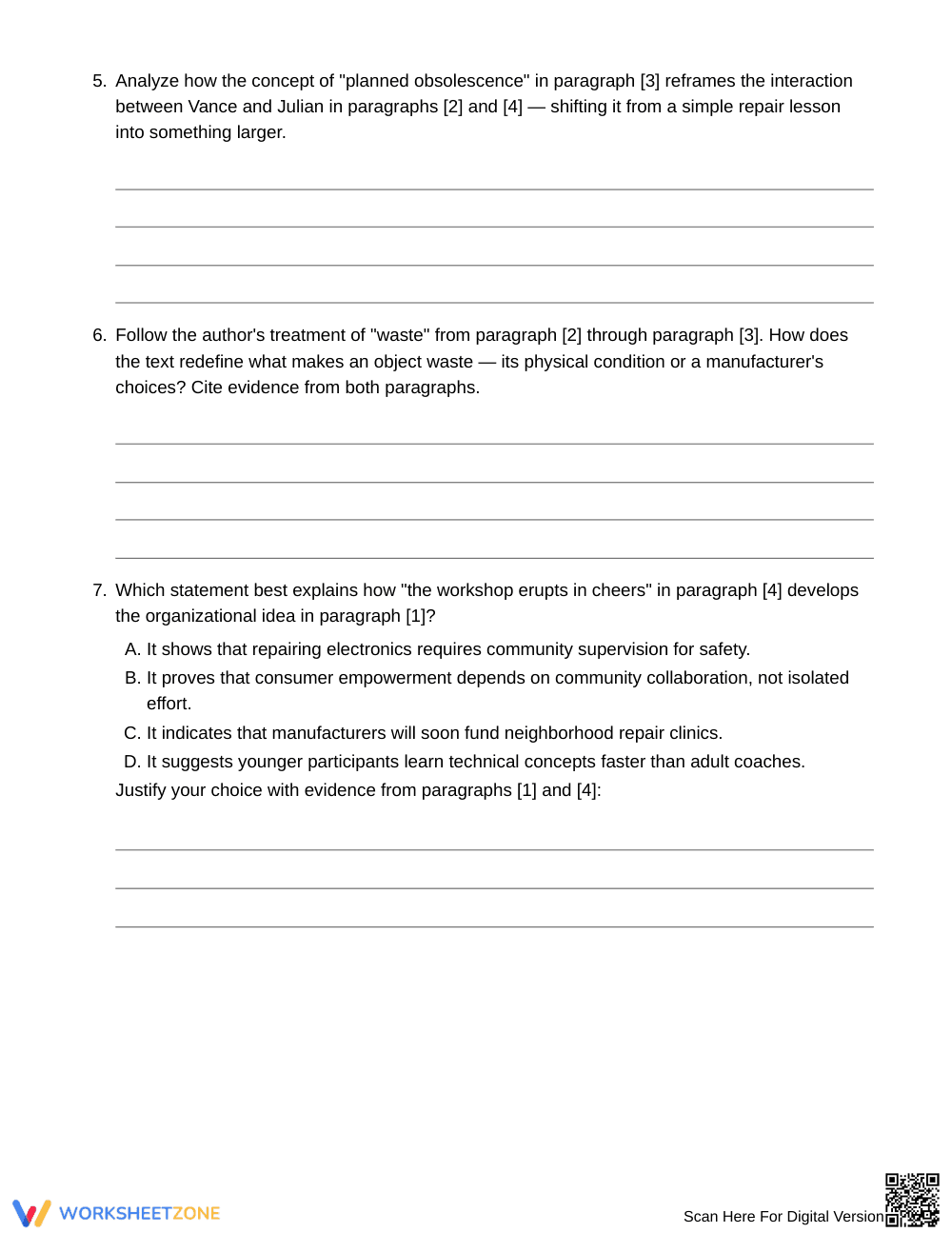
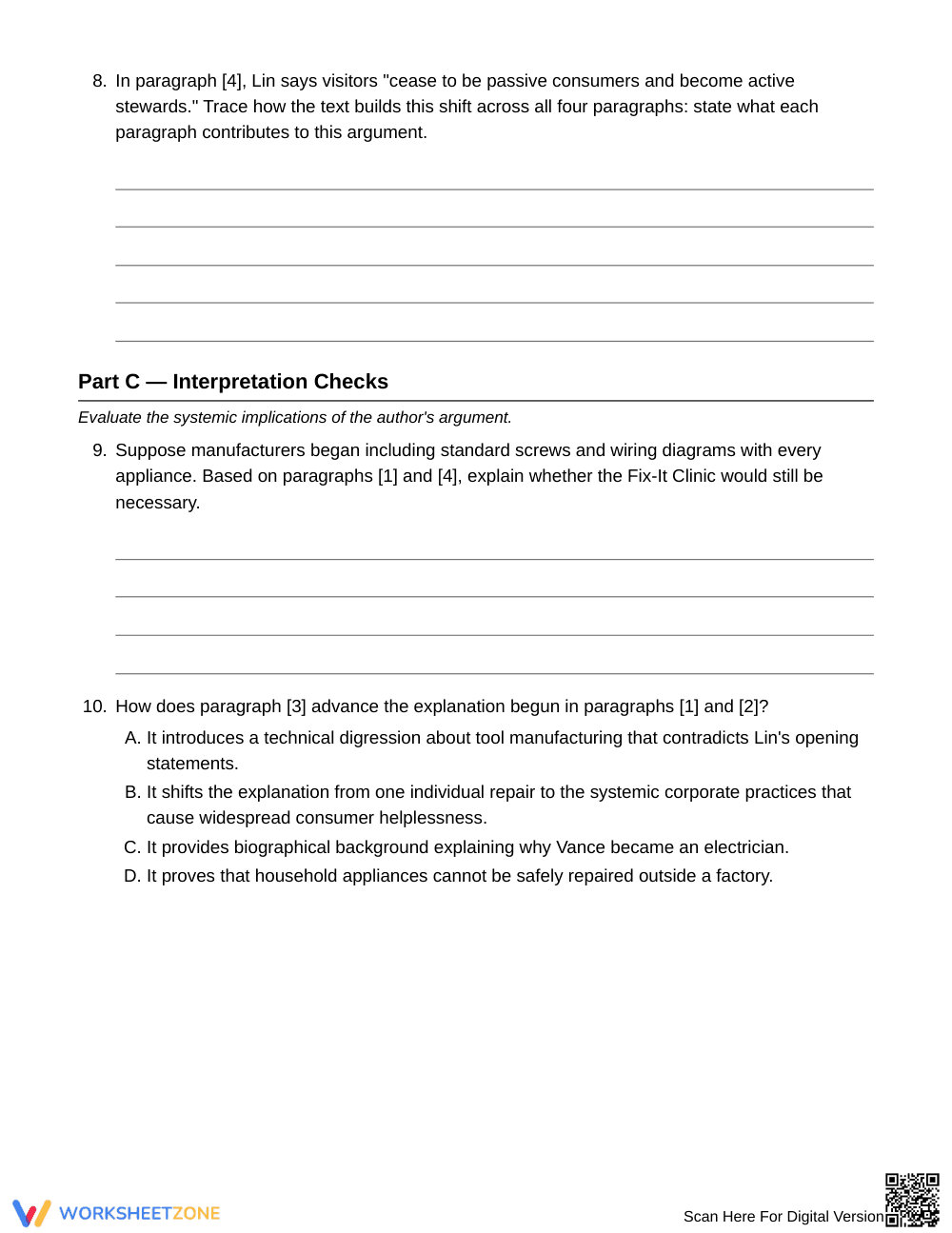
Across 5 printable pages, students explore a four-paragraph text titled "The Anatomy of a Community Fix-It Clinic." The worksheet features an instructional framing box on text structure, a model annotation, and 10 analytical questions organized across three targeted parts, supported by a 3-page explanatory answer key.
Skill Progression
- Guided practice (Part A, 3 problems): High scaffold prompts guide students to cite evidence linking introductory claims to specific actions and challenges across paragraphs.
- Supported practice (Part B, 5 problems): Medium scaffold questions examine technical vocabulary, trace argument development, and evaluate structural claims with written justifications.
- Independent practice (Part C, 2 problems): Low scaffold evaluative tasks challenge learners to predict systemic outcomes and critique structural shifts independently.
This sequence implements gradual release, ensuring students understand text mechanics before attempting independent evaluation.
Standards Alignment
The primary focus aligns to RI.7.3: Analyze the interactions between individuals, events, and ideas in a text. Supporting work addresses RI.7.1 by requiring textual evidence for all inferences. Both standard codes can be copied directly into lesson plans, IEP goals, or district curriculum mapping tools.
How to Use It
Deploy this worksheet after direct instruction on informational text structure. Have students examine the model annotation before completing Part A in pairs. During independent practice, observe whether students identify paragraph 3's shift from individual troubleshooting to systemic manufacturing practices. Expected completion time is 40 to 50 minutes.
Who It's For
Designed for Grade 7 ELA classes, this worksheet also supports advanced Grade 6 readers and Grade 8 intervention groups. Differentiate by providing highlighted transition words for emerging readers. It pairs naturally with an anchor chart on text structures or a nonfiction close-reading unit.
Mastering the ability to follow an explanation across paragraphs is a core component of middle school reading comprehension under Common Core standard RI.7.3. According to Fisher & Frey (2014), student comprehension of complex informational text accelerates significantly when instructional materials provide clear model annotations and scaffolds that bridge initial comprehension into higher-order analysis. This 5-page curriculum resource directly operationalizes those findings by guiding Grade 7 students through a 10-problem analytical sequence based on an authentic informational passage. Learners observe how an author introduces a foundational concept, validates it through concrete physical actions, and expands it into broader economic critiques. By isolating evidence across paragraphs and justifying analytical conclusions in writing, students build durable habits for tracking idea development in complex nonfiction. The included 3-page answer key provides complete model responses that clarify how individuals, events, and arguments interact throughout the text.


