


























Views
Downloads



Essential Feeding Effects Worksheet | Grade 7 Science
Paste this activity's link or code into your existing LMS (Google Classroom, Canvas, Teams, Schoology, Moodle, etc.).
Students can open and work on the activity right away, with no student login required.
You'll still be able to track student progress and results from your teacher account.
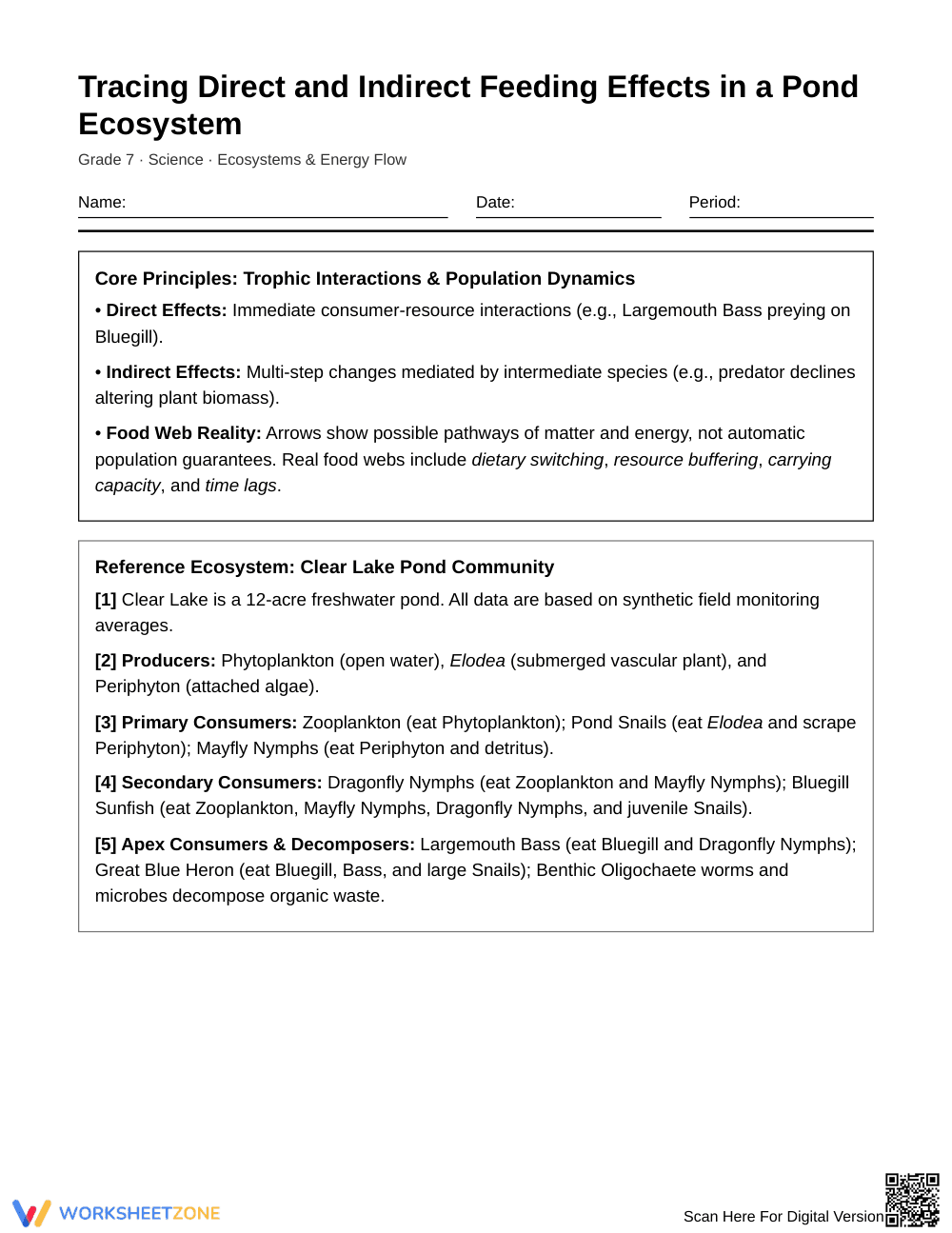
This Grade 7 science worksheet builds student competence in analyzing multi-trophic interactions across complex aquatic food webs. Middle school learners trace immediate predation changes, extended trophic cascades, and dietary buffering mechanisms across a realistic 12-acre pond ecosystem model, developing robust causal reasoning skills for environmental science units.
At a Glance
- Grade: 7 · Subject: Science
- Standard: Middle School Life Science — Predict and model how changes in populations alter energy flow and trophic dynamics
- Skill Focus: Direct and indirect feeding effects
- Format: 5 pages · 10 problems · Answer key included · PDF
- Best For: Ecosystems and food web unit mastery
- Time: 40–50 minutes
What's Inside
The 5-page printable resource provides a complete instructional sequence centered on the Clear Lake Pond Community reference text. Students explore producer-consumer relationships using a structured data profile, an analytical interaction table, 4-step causal chains, 5 realistic environmental disturbance scenarios, and 2 written synthesis explanation checks accompanied by a comprehensive 3-page answer key.
Skill Progression
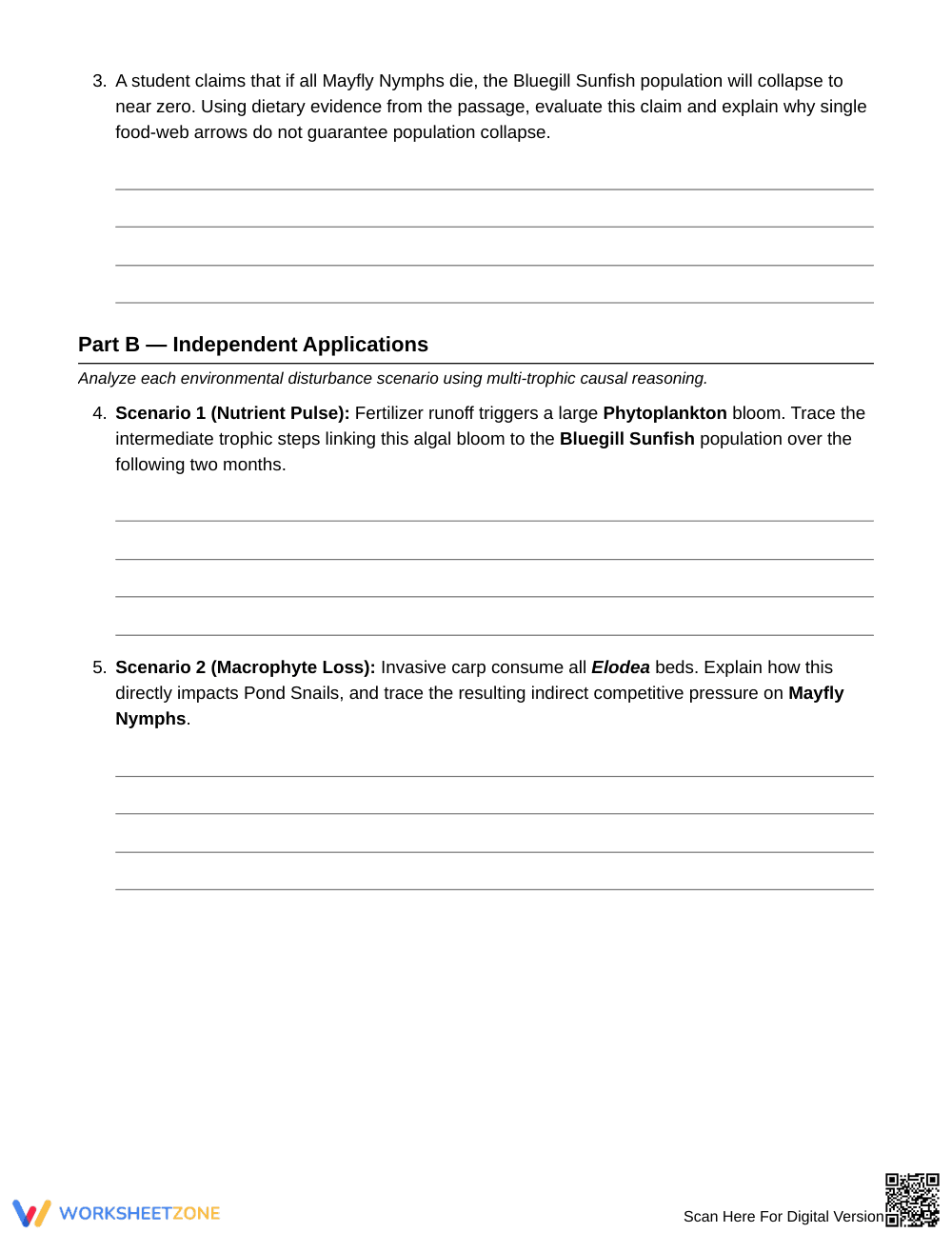
- Guided Practice (Items 1–3): Students use reference data to fill an interaction matrix, diagram a 4-step phytoplankton-to-bass chain, and evaluate a food-web collapse claim using evidence of dietary switching.
- Supported Practice (Items 4–8): Learners analyze 5 distinct disturbance scenarios (nutrient pulses, macrophyte loss, top predator harvest, littoral drought, and larvicide exposure) using multi-trophic causal reasoning.
- Independent Practice (Items 9–10): Students synthesize overarching principles of community ecology by explaining how generalist feeding provides ecological buffering and identifying biological causes of time lags and carrying capacities.
This sequence follows a gradual-release architecture, transitioning students from scaffolded table completion to independent scientific explanations of complex ecological dynamics.
Standards Alignment
This resource aligns with middle school life science standards for ecosystems, interactions, energy, and dynamics. Students construct explanations based on evidence for how resource availability and multi-species feeding relationships govern individual organism survival and broader population patterns. Both standard descriptions can be copied directly into lesson plans, IEP goals, or district curriculum mapping tools.
How to Use It
Deploy this activity during the mid-to-late phase of your energy flow unit, immediately following direct instruction on food webs and trophic cascades. During independent seatwork, monitor whether students attribute population shifts solely to isolated food-web arrows or successfully account for generalist feeding buffers in Part B. The 10 multi-part tasks require 40 to 50 minutes of instructional time.
Who It's For
Designed for Grade 7 general science, integrated life science, and introductory environmental biology classes. Visual learners and striving readers benefit from the embedded organism lists and structured table prompts. Pair this activity directly with an aquatic ecosystem food web diagram or a hands-on trophic cascade simulation.
According to research by Fisher & Frey (2014) on purposeful instructional design, structured analytical frameworks significantly enhance student ability to untangle multi-step causal mechanisms in complex biological systems. When middle school science students evaluate real-world environmental disturbances, isolated linear food chains often lead to misconceptions that any single species loss triggers total community collapse. By explicitly contrasting immediate predator-prey outcomes against indirect cascades and dietary switching buffers, this 5-page worksheet reinforces systemic ecological thinking. Students move past surface-level arrow tracking to construct evidence-based models of carrying capacity, response time lags, and community resilience across 10 targeted analytical items. The integrated 3-page answer key provides complete biological explanations and chain pathways, establishing a rigorous reference point for formative checks and progress tracking across life science energy flow units.


