




























Views
Downloads




Essential Extraneous Roots Worksheet | Grade 11 Algebra II

Paste this activity's link or code into your existing LMS (Google Classroom, Canvas, Teams, Schoology, Moodle, etc.).
Students can open and work on the activity right away, with no student login required.
You'll still be able to track student progress and results from your teacher account.
This Grade 11 Algebra II worksheet targets critical mathematical precision by helping students identify, explain, and correct algebraic errors involving absolute values and extraneous solutions. Through rigorous error analysis across radical expressions and radical equations, high school learners strengthen their conceptual mastery of the real number system and algebraic equivalence.
At a Glance
- Grade: 11 · Subject: Algebra II
- Standard:
HSA-REI.A.2— Solve radical equations and show how extraneous solutions arise- Skill Focus: Correct Lost Absolute Values and Extraneous Roots
- Format: 5 pages · 10 problems · Answer key included · PDF
- Best For: High school error analysis and targeted intervention
- Time: 45–60 minutes
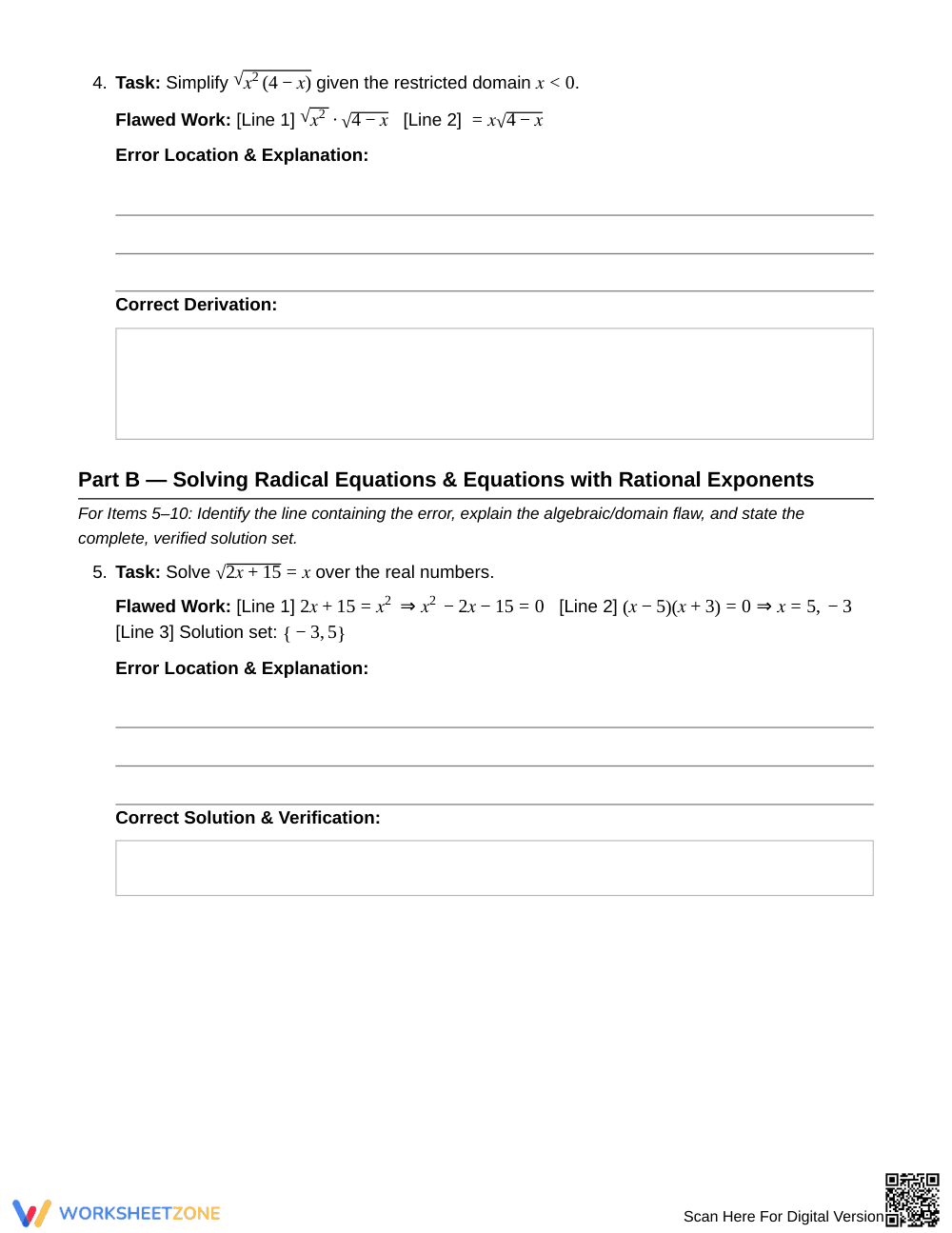
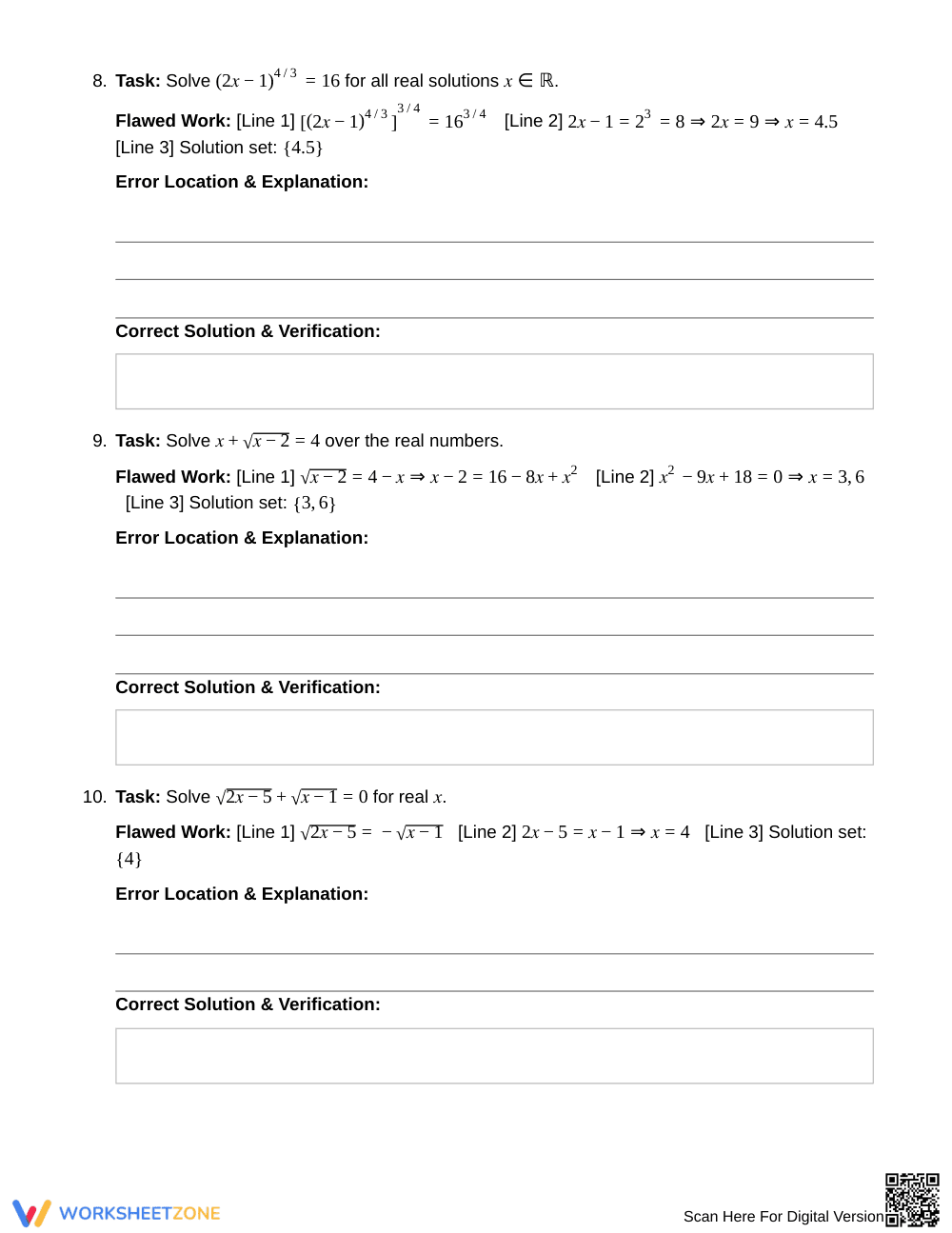
The 5-page resource features theoretical principles covering the principal root definition and even index absolute value rules, paired with a complete worked model. Students encounter 10 multi-line error analysis tasks partitioned into expression simplification and equation solving. A comprehensive 3-page answer key provides complete correct derivations, step-by-step verifications, and explicit mathematical explanations for each flawed algebraic step.
Skill Progression
- Guided practice: The worksheet opens with core algebraic conventions and a fully annotated worked example modeling how to identify domain restrictions and apply absolute value bars to even radicals.
- Supported practice: Tasks 1–4 require learners to analyze flawed simplifications of radical and rational exponent expressions, requiring written justification for invalid algebraic steps.
- Independent practice: Tasks 5–10 challenge students to solve multi-step radical equations, detect non-equivalent power operations, and verify solution sets to isolate extraneous roots.
This structured sequence utilizes an I Do, We Do, You Do gradual-release framework to move students from conceptual review to independent evaluation of complex algebraic derivations.
Standards Alignment
This resource aligns directly with HSA-REI.A.2, which requires students to solve simple rational and radical equations in one variable and give examples showing how extraneous solutions may arise. Additionally, the activities reinforce HSN-RN.A.2 by requiring students to rewrite radical expressions using rational exponent properties. Both standard codes can be copied directly into lesson plans, IEP goals, or district curriculum mapping tools.
How to Use It
Implement this worksheet after direct instruction on solving radical equations as a collaborative partner activity or targeted formative assessment. During class, monitor whether students check candidate values in the original radical equation rather than intermediate squared lines to spot misconceptions early. The 10-item set is designed for a focused 45–60 minute instructional block.
Who It's For
This practice set is built for on-grade and advanced Grade 11 Algebra II students who need rigorous practice with domain restrictions, as well as students preparing for standardized exams. Pair this worksheet directly with an anchor chart detailing principal root definitions and even-index simplification rules.
Algebraic precision with radical equations under HSA-REI.A.2 requires learners to recognize that squaring both sides of an equality introduces non-equivalent solution spaces. According to research from Fisher & Frey (2014) on error analysis and corrective feedback, evaluating flawed mathematical derivations prompts deeper metacognitive reflection than routine computation alone. When Grade 11 students analyze why an algebraic step fails, such as dropping absolute value notation during even radical extraction or accepting extraneous roots without verification, they internalize structural rules governing the real number system. This targeted 10-task worksheet builds that exact evaluative capacity by requiring students to justify errors in writing before constructing verified derivations. By directly confronting common pitfalls in radical operations, secondary mathematics learners bridge procedural execution with conceptual fluency, establishing a durable foundation for advanced pre-calculus and calculus coursework.


