




























Views
Downloads



Essential Exponential Rules Worksheet | Grade 11 Algebra II

Paste this activity's link or code into your existing LMS (Google Classroom, Canvas, Teams, Schoology, Moodle, etc.).
Students can open and work on the activity right away, with no student login required.
You'll still be able to track student progress and results from your teacher account.
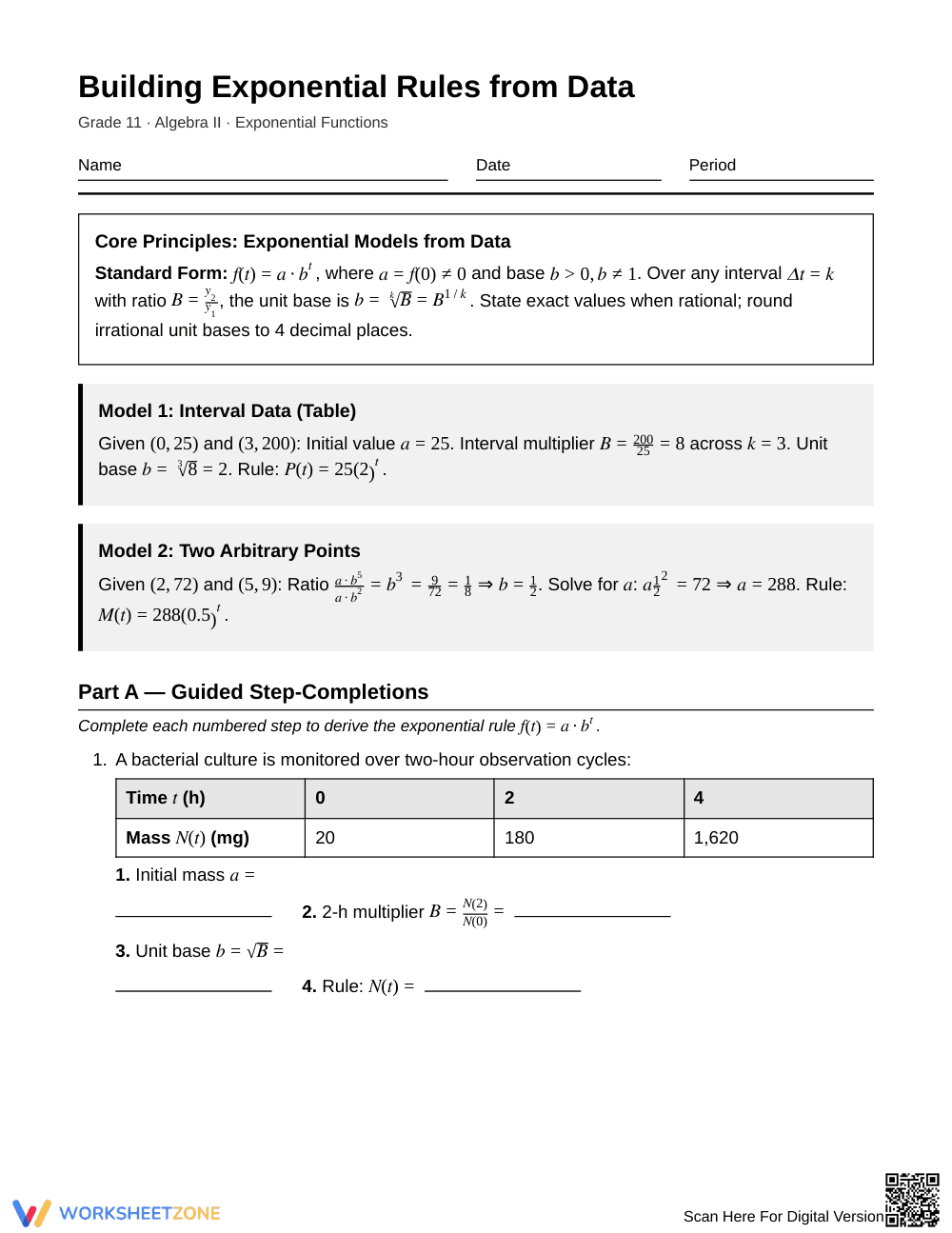
This 5-page Algebra II resource trains high school students to construct exponential functions from tables, graphs, and contextual descriptions. By identifying initial values and calculating unit bases across varying intervals, learners build functional rules and verify predictions with mathematical precision.
At a Glance
- Grade: 11 · Subject: Algebra II
- Standard:
HSF-LE.A.2— Construct exponential functions given a graph, contextual description, or table of values- Skill Focus: Build an Exponential Rule from Data
- Format: 5 pages · 12 multi-step problems · Answer key included · Printable PDF
- Best For: Core unit practice and targeted mastery review
- Time: 45–60 minutes
What's Inside
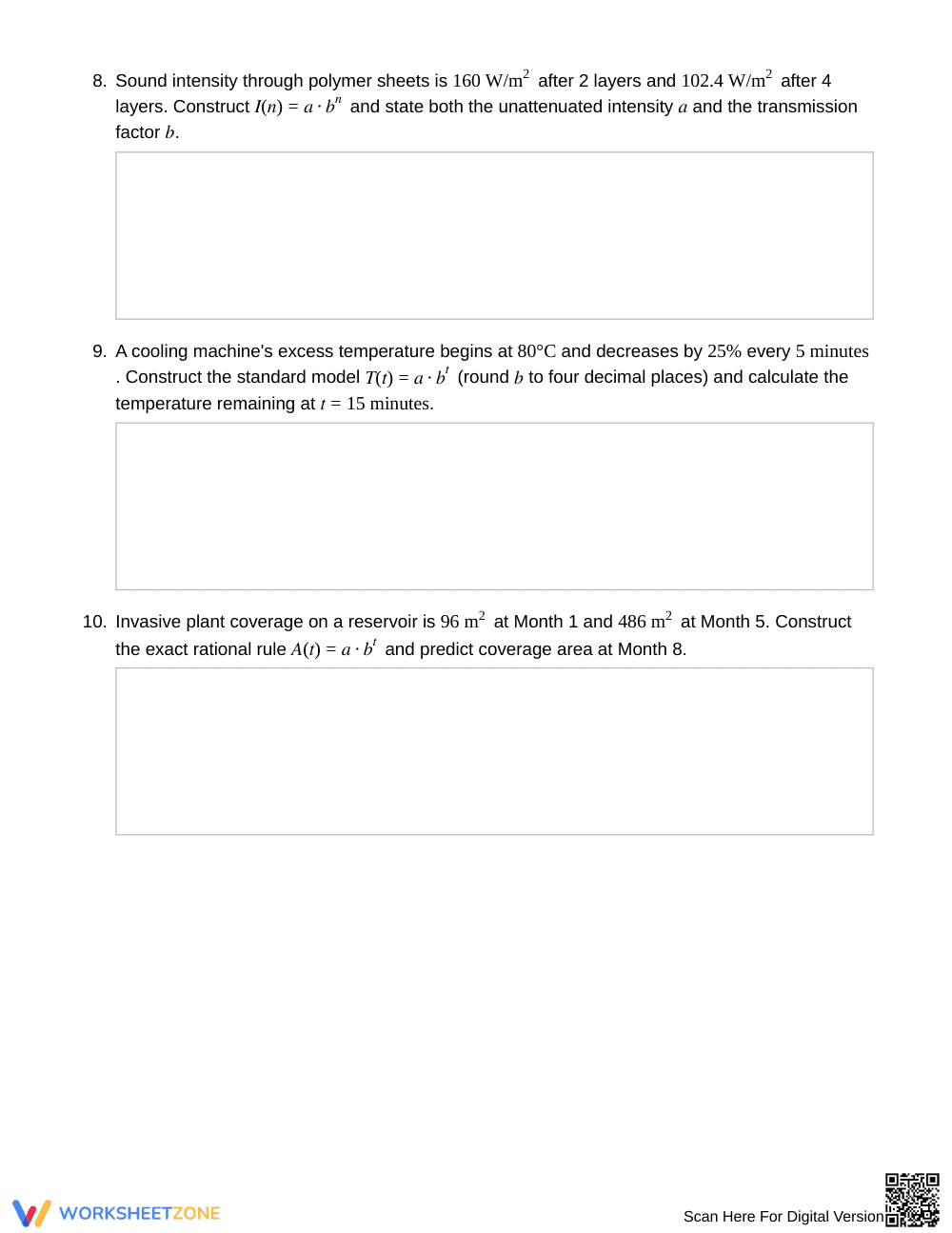
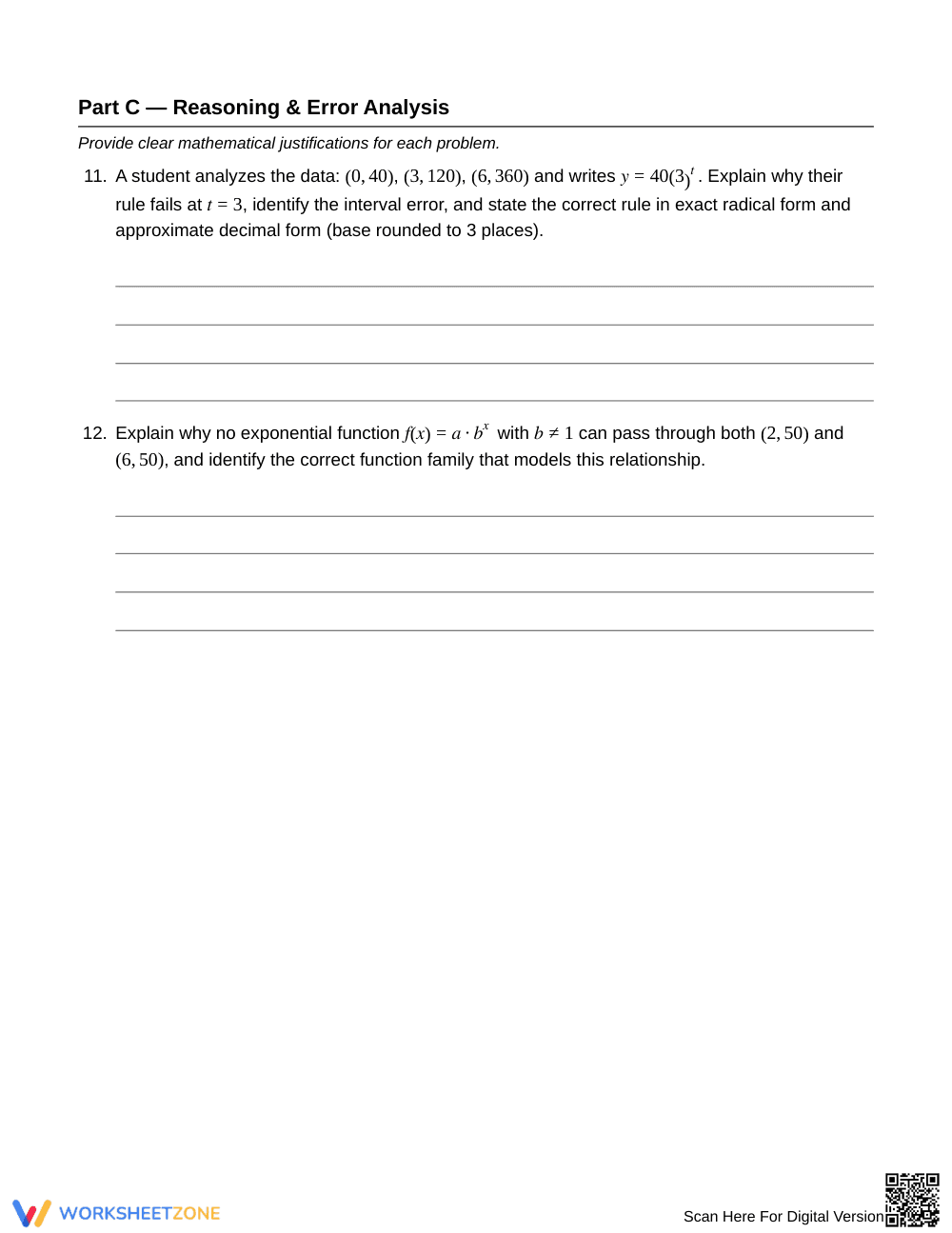
This 5-page packet opens with a reference box defining standard form, unit base formulas, and two worked examples. Twelve student exercises span input-output tables, decay curves, scientific scenarios, and coordinate pairs across three sections. A 2-page answer key provides complete algebraic steps, radical forms, and decimal approximations.
Skill Progression
- Guided practice (4 problems): Step-by-step prompts scaffold calculating interval multipliers, finding unit roots, and assembling rules.
- Supported practice (6 problems): Unprompted application tasks require constructing models from tables, graphs, and contexts.
- Independent practice (2 problems): Error analysis and proofs target interval misconceptions and theoretical function limits.
This gradual release shifts students from guided root extraction to autonomous algebraic modeling.
Standards Alignment
This resource aligns directly to HSF-LE.A.2: construct linear and exponential functions, including arithmetic and geometric sequences, given a graph, a description, or two input-output pairs. It also supports HSF-BF.A.1 by having students write functions describing relationships. Both standard codes can be copied directly into lesson plans, IEP goals, or district curriculum mapping tools.
How to Use It
Deploy this worksheet following direct instruction on exponential rates. Assign Part A during partner practice to solidify unit base calculations, using Part B for independent evaluation. Formatively observe whether students mistakenly divide by interval length rather than taking roots. Eleventh-grade classes typically finish all 12 tasks in 45 to 60 minutes.
Who It's For
This packet targets Grade 11 Algebra II and Integrated Math III students preparing for advanced Precalculus functions. Support developing learners with the initial worked models, while challenging advanced students with the final proof prompts. Pair this worksheet with an anchor chart detailing radical unit root operations.
According to Fisher & Frey (2014), academic achievement accelerates when secondary mathematics instruction provides a structured gradual release of responsibility, guiding learners from modeled problem-solving to independent algebraic formulation. This Algebra II worksheet implements that evidence-based framework to address HSF-LE.A.2, systematically training students to build an exponential rule from data tables, graphs, and authentic scientific contexts. By confronting the mathematical nuances of variable time steps, learners must compute unit growth or decay bases using radical roots rather than falling back on linear slope assumptions. The progression embeds structured scaffolds across initial guided problems before transitioning pupils toward unassisted function construction and rigorous mathematical justifications. Consequently, this resource equips educators with high-utility instructional materials that build conceptual understanding, procedural fluency, and algebraic precision. Students develop the requisite analytical modeling competencies mandated by state standards and college readiness assessments.


