




























Views
Downloads




Essential Evidence Sufficiency Worksheet | Grade 8 ELA

Paste this activity's link or code into your existing LMS (Google Classroom, Canvas, Teams, Schoology, Moodle, etc.).
Students can open and work on the activity right away, with no student login required.
You'll still be able to track student progress and results from your teacher account.
This informational text worksheet teaches eighth-grade students how to evaluate argument validity and defend sufficiency judgments across competing viewpoints. By analyzing two paired policy texts on shared school technology, learners examine whether cited data provides enough representative evidence to justify an author's broad claims or leaves critical analytical gaps.
At a Glance
- Grade: 8 · Subject: ELA
- Standard:
RI.8.8— Evaluate argument claims, assessing whether reasoning is sound and evidence is sufficient.- Skill Focus: Defending Evidence Sufficiency
- Format: 5 pages · 8 problems · Answer key included · PDF
- Best For: Argument analysis and close-reading practice
- Time: 40–50 minutes
What's Inside: The resource features two balanced non-fiction passages presenting opposing arguments regarding a shared school equipment pool. A structured critical reading framework establishes criteria for relevance, sufficiency, and soundness before students complete 8 text-dependent analysis tasks. The 5-page document includes a comprehensive 3-page answer key with exemplar sufficiency evaluations and rubric notes.
Skill Progression
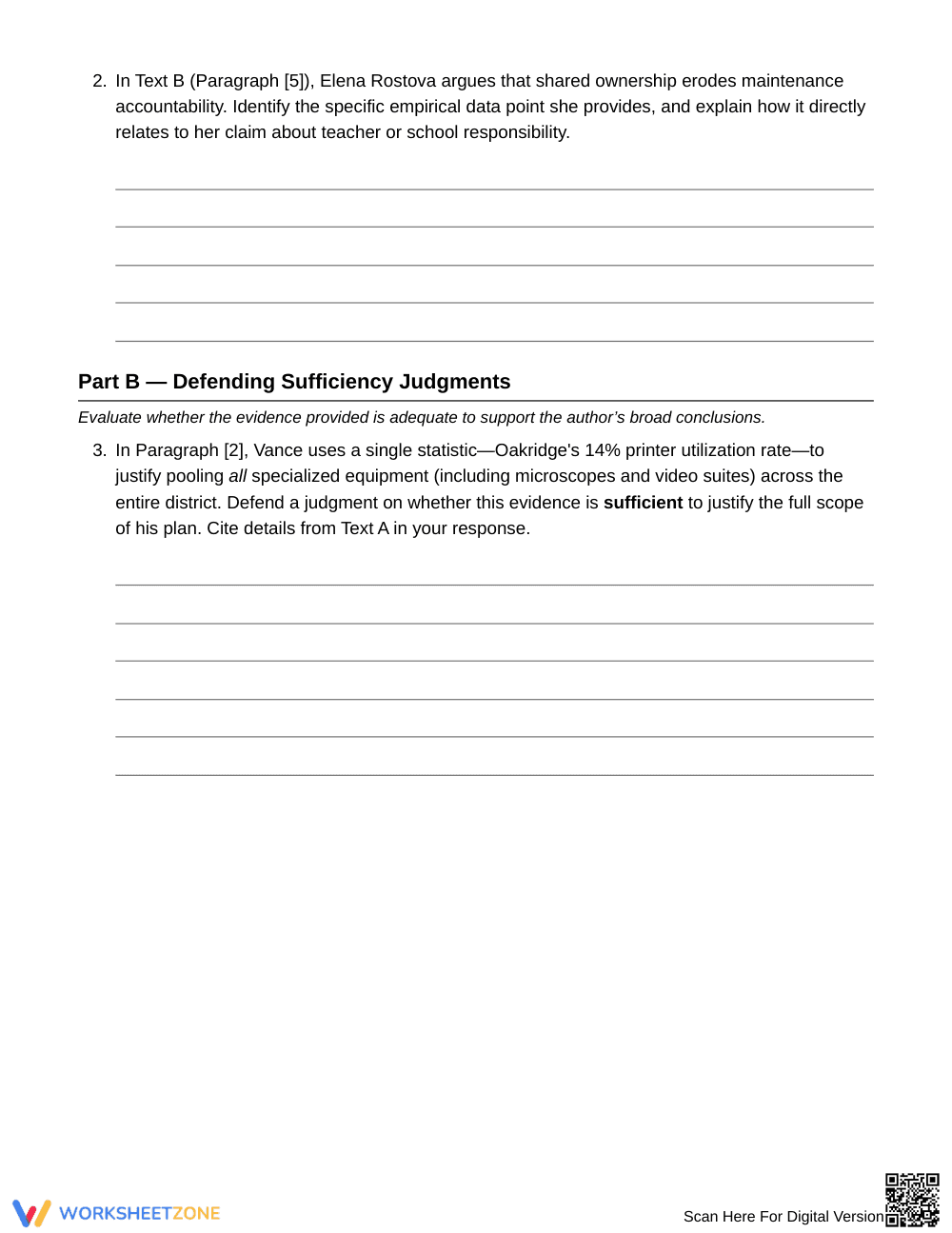
- Guided Practice (Part A, 2 tasks): Students identify directly relevant evidence supporting targeted claims and analyze how specific empirical statistics connect to author conclusions.
- Supported Practice (Part B, 4 tasks): Learners evaluate single-sample data, identify unaddressed logistical variables, and defend written judgments comparing the adequacy of competing economic claims.
- Independent Practice (Part C, 2 tasks): Students analyze counterevidence across competing viewpoints and synthesize both texts to formulate and defend an evidence-based policy recommendation.
This sequence follows a gradual-release model, moving students from basic evidence identification to nuanced, independent sufficiency critiques.
Standards Alignment
Primary standard: RI.8.8 — Delineate and evaluate the argument and specific claims in a text, assessing whether the reasoning is sound and the evidence is relevant and sufficient; recognize when irrelevant evidence is introduced. Both standard codes can be copied directly into lesson plans, IEP goals, or district curriculum mapping tools.
How to Use It
Use this activity during mid-unit instruction on argumentative analysis after teaching foundational evidence types, or assign it as a targeted formative assessment. During work time, observe whether students identify overgeneralization when authors extrapolate broad policy conclusions from a single data point. Expected completion time is 40 to 50 minutes.
Who It's For
This printable activity is designed for general education Grade 8 ELA classrooms, advanced Grade 7 readers, or high school intervention groups needing rigorous informational text practice. Sentence stems in Part A support developing writers, while Part C offers high-level analytical challenge. Pair this resource with direct instruction on logical fallacies and argument structure.
Evaluating argument sufficiency under standard RI.8.8 requires middle school students to move beyond surface-level comprehension and critically assess whether an author provides adequate empirical support for their assertions. Research by Fisher & Frey (2014) highlights that structured close reading routines and scaffolded text-dependent questioning significantly enhance adolescent literacy, analytical reasoning, and evidence evaluation skills. This Grade 8 ELA worksheet guides learners through paired expository texts to examine data relevance, isolate unaddressed logistical variables, and defend written judgments on whether presented evidence adequately substantiates broad claims. By progressing from targeted identification tasks to comprehensive policy synthesis across 8 scaffolded items, the resource establishes clear mastery criteria. This rigorous instructional sequence equips eighth graders with the essential evaluative tools required for complex secondary informational analysis.


