




























Views
Downloads




Essential Evaluating Proposals Worksheet | Grade 8 ELA

Paste this activity's link or code into your existing LMS (Google Classroom, Canvas, Teams, Schoology, Moodle, etc.).
Students can open and work on the activity right away, with no student login required.
You'll still be able to track student progress and results from your teacher account.
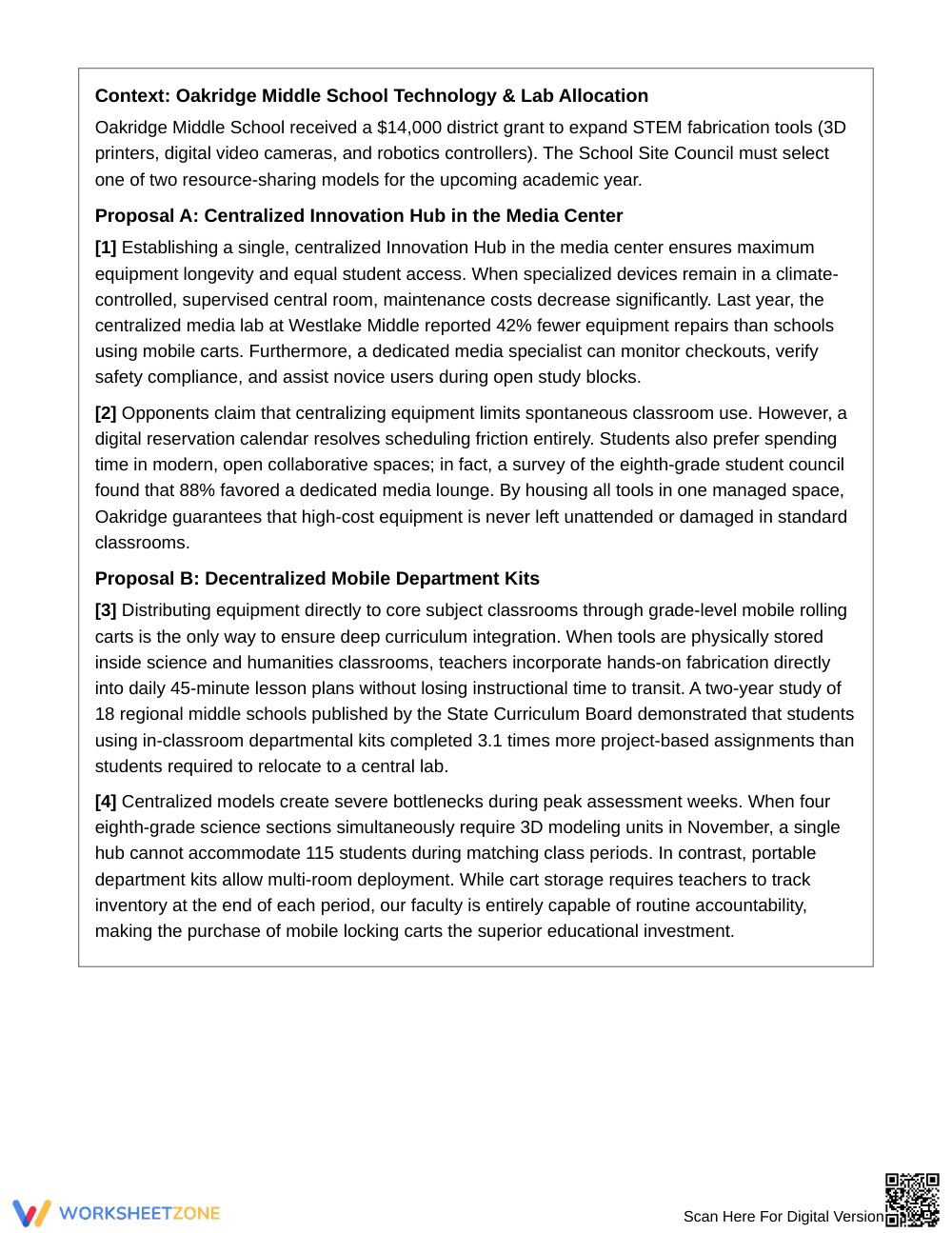
This Grade 8 reading informational text worksheet trains students to critically evaluate competing institutional proposals under real-world operational constraints. Students analyze two competing school policy proposals, distinguish sound empirical evidence from unsupported assumptions, and assess whether arguments hold up under budget, scheduling, and staffing limitations.
At a Glance
- Grade: 8 · Subject: ELA
- Standard:
RI.8.8— Delineate and evaluate arguments, assessing whether reasoning is sound and evidence is relevant- Skill Focus: Judge a Proposal’s Support Under Constraints
- Format: 5 pages · 10 problems · Answer key included · PDF
- Best For: Argumentative analysis and critical reading units
- Time: 40–50 minutes
What's Inside
This 5-page printable resource features a multi-paragraph paired-argument text centered on a middle school technology grant allocation. Across 10 rigorous tasks, students dissect claims, verify empirical statistics versus preference surveys, and identify unstated logistical assumptions. The packet includes a comprehensive 3-page answer key with exemplar text evidence and analytical explanations.
Skill Progression
- Guided Practice (Part A): 2 tasks prompting students to isolate stated institutional constraints, separating fixed scheduling limits from subjective author opinions.
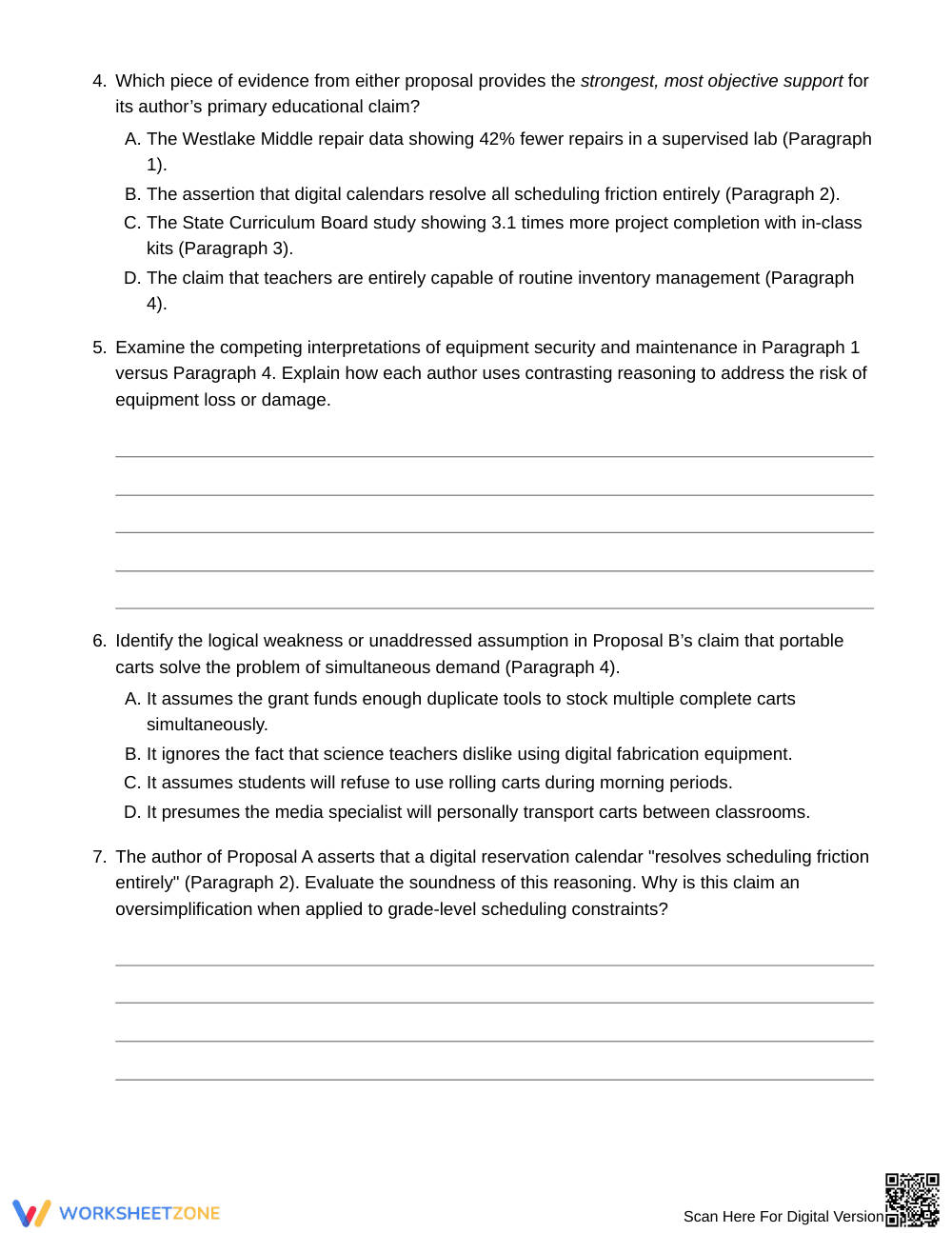
- Supported Practice (Part B): 6 analytical tasks focusing on evidence relevance, statistical validity, logical fallacies, and contrasting author reasoning.
- Independent Application (Part C): 2 open-response policy tasks where students synthesize constraints to defend an optimal proposal and design a targeted logistical compromise.
This structured sequence follows a gradual-release instructional model, moving learners from basic constraint identification to sophisticated synthesis and policy critique.
Standards Alignment
This activity directly addresses RI.8.8: "Delineate and evaluate the argument and specific claims in a text, assessing whether the reasoning is sound and the evidence is relevant and sufficient; recognize when irrelevant evidence is introduced." It also supports RI.8.1 by requiring textual evidence to justify operational decisions. Both standard codes can be copied directly into lesson plans, IEP goals, or district curriculum mapping tools.
How to Use It
Administer this worksheet after direct instruction on logical fallacies and argument evaluation. For a whole-class activity, have students complete Part A in pairs before moving to independent analysis in Parts B and C. As a formative assessment tip, check question 6 to ensure students recognize unstated resource assumptions rather than accepting claims at face value. Typical completion time is 40 to 50 minutes.
Who It's For
Designed for Grade 8 general education ELA classes, advanced Grade 7 critical thinking courses, or high school remediation. It pairs naturally with non-fiction text sets on public policy, debate units, or informational anchor charts dissecting argument structures.
According to research highlighted in Fisher & Frey (2014) on close reading and text-dependent questioning, middle school learners require intentional practice interrogating an author's evidence against external constraints to build higher-order evaluative literacy. Standard RI.8.8 demands that students not only summarize arguments, but also actively judge whether cited data truly proves a specific claim. By presenting two balanced proposals with competing data points and unaddressed assumptions, this resource moves students past passive comprehension. Learners must cross-examine empirical findings, such as maintenance records and student output metrics, against rigid operational limits like staffing hours and class period lengths. This systematic approach ensures students develop transferable analytical routines for evaluating complex persuasive and informational texts across academic disciplines.


