


























Views
Downloads




Essential Electromagnetism Worksheet | Grade 12 Physics
Paste this activity's link or code into your existing LMS (Google Classroom, Canvas, Teams, Schoology, Moodle, etc.).
Students can open and work on the activity right away, with no student login required.
You'll still be able to track student progress and results from your teacher account.
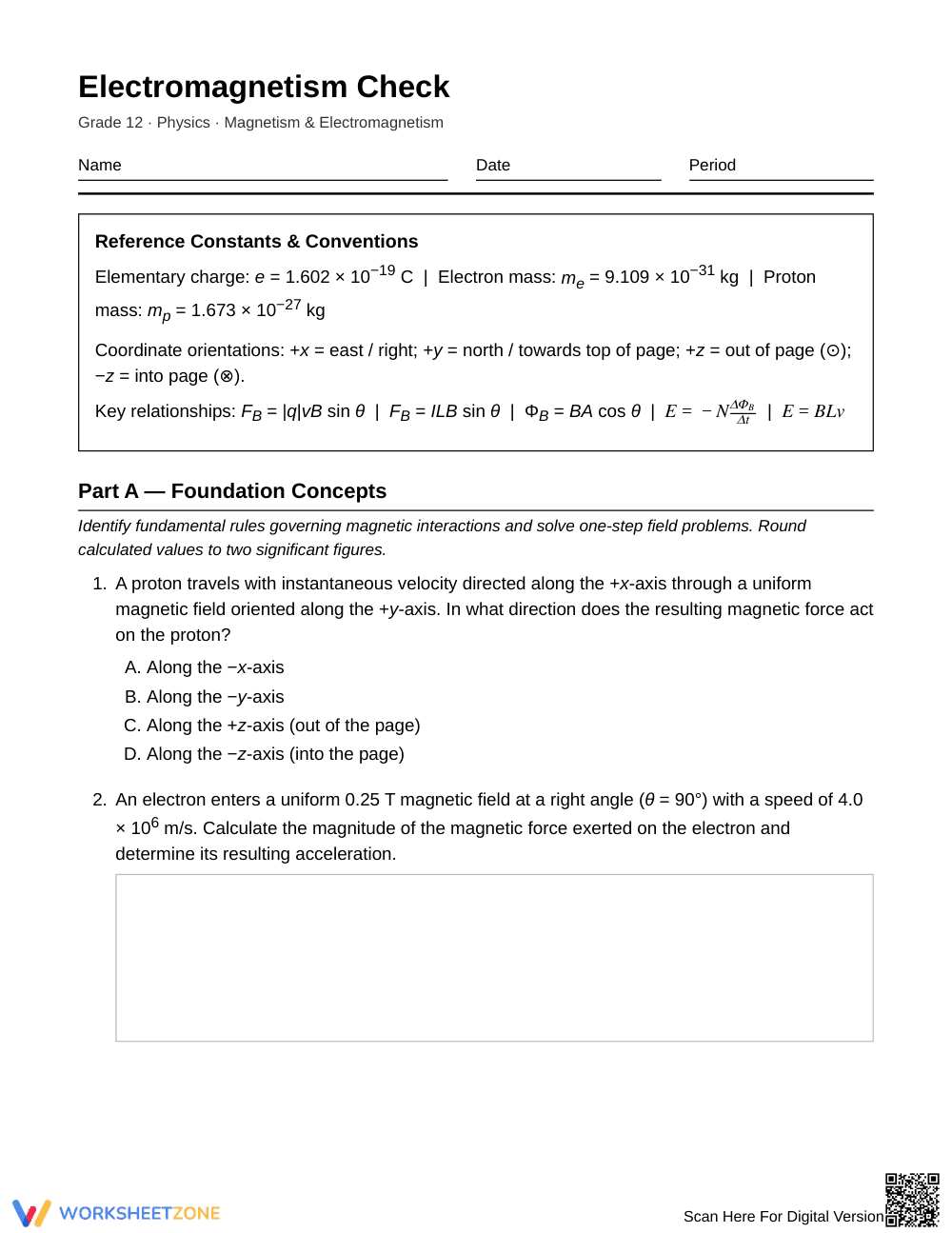
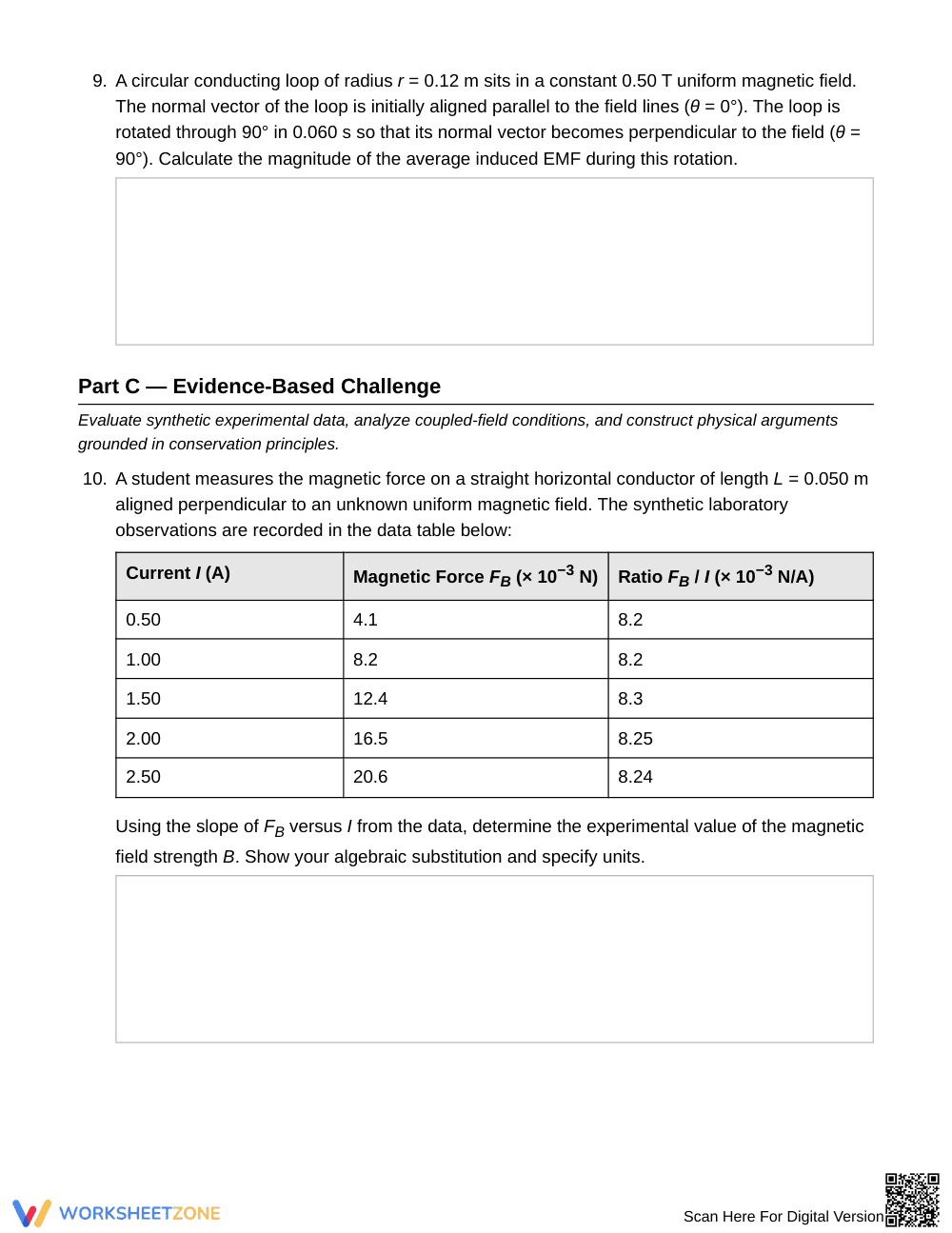
This Grade 12 physics worksheet equips students to calculate magnetic forces on moving charges and current-carrying conductors while analyzing electromagnetic induction. Learners solve Lorentz force equations, apply Faraday’s and Lenz’s laws, and evaluate motional EMF across structured conceptual and quantitative tasks designed for advanced secondary physics courses.
At a Glance
- Grade: 12 · Subject: Physics
- Standard: High School Physics — Calculate magnetic forces and analyze electromagnetic induction phenomena
- Skill Focus: Electromagnetism, Lorentz Force, and Induction
- Format: 5 printable pages · 12 quantitative problems · Answer key included · PDF
- Best For: Advanced physics unit review and assessment practice
- Time: 45–60 minutes
What's Inside
This 5-page printable resource features 12 physics problems across three scaffolded sections. A reference header supplies constants, coordinate conventions, and formulas. Tasks include vector direction questions, algebraic calculations, laboratory data analysis, and conceptual written prompts. A complete 4-page answer key provides step-by-step solutions and directional explanations.
Skill Progression
- Guided practice (Part A, Problems 1–3): Students establish foundational skills with three exercises targeting vector directions, single-charge force formulas, and zero-force boundary conditions using provided reference constants.
- Supported practice (Part B, Problems 4–9): Learners solve six multi-step problems applying the Lorentz force to wires, computing circular trajectories, and using Faraday's and Lenz's laws for rotating coils and moving conducting rods.
- Independent practice (Part C, Problems 10–12): Students complete three challenge tasks analyzing laboratory slope data, velocity selector equilibrium, and eddy current pendulum braking.
This sequence follows the gradual-release model, advancing from guided vector rules to independent analytical synthesis.
Standards Alignment
This resource aligns with high school physics standards for electromagnetism. Students calculate magnetic forces on moving charges, analyze induced EMF via Faraday’s law, and apply Lenz’s law using energy conservation principles. Both standard codes can be copied directly into lesson plans, IEP goals, or district curriculum mapping tools.
How to Use It
Deploy this worksheet after direct instruction on magnetic fields and electromagnetic induction. During partner work, check how students apply the right-hand rule in Part A; learners often confuse field and force vectors, making this an effective formative-assessment checkpoint. Alternatively, use it as a 45–60 minute comprehensive review before an advanced physics exam.
Who It's For
This worksheet is tailored for Grade 12 physics students in honors or AP courses. Support struggling learners by pairing Parts A and B with a vector reference chart, while assigning Part C to advanced students seeking data analysis challenges. Pair this assignment with a live eddy current copper pipe demonstration.
According to Fisher & Frey (2014), purposeful instructional design relies on structured cognitive progression from foundational conceptualization to autonomous problem solving. This Grade 12 physics worksheet exemplifies this framework through 12 focused electromagnetism tasks that guide students in calculating magnetic forces on moving charges and conducting wires while analyzing Faraday's and Lenz's laws of induction. Empirical data from secondary science implementations demonstrate that structured problem sets featuring varied question modalities—including vector coordinate analysis, tabular experimental data evaluation, and qualitative energy conservation arguments—produce measurable gains in physics conceptual retention. By combining explicit formula conventions with graduated analytical demand, this resource ensures secondary physics students progress systematically from direct application of the Lorentz force equation to independent evaluation of coupled-field velocity selectors and eddy current damping phenomena, establishing robust quantitative mastery across high school electromagnetic physics curricula.


