


























Views
Downloads




Essential Derivative Errors Worksheet | Grade 12 Calculus
Paste this activity's link or code into your existing LMS (Google Classroom, Canvas, Teams, Schoology, Moodle, etc.).
Students can open and work on the activity right away, with no student login required.
You'll still be able to track student progress and results from your teacher account.
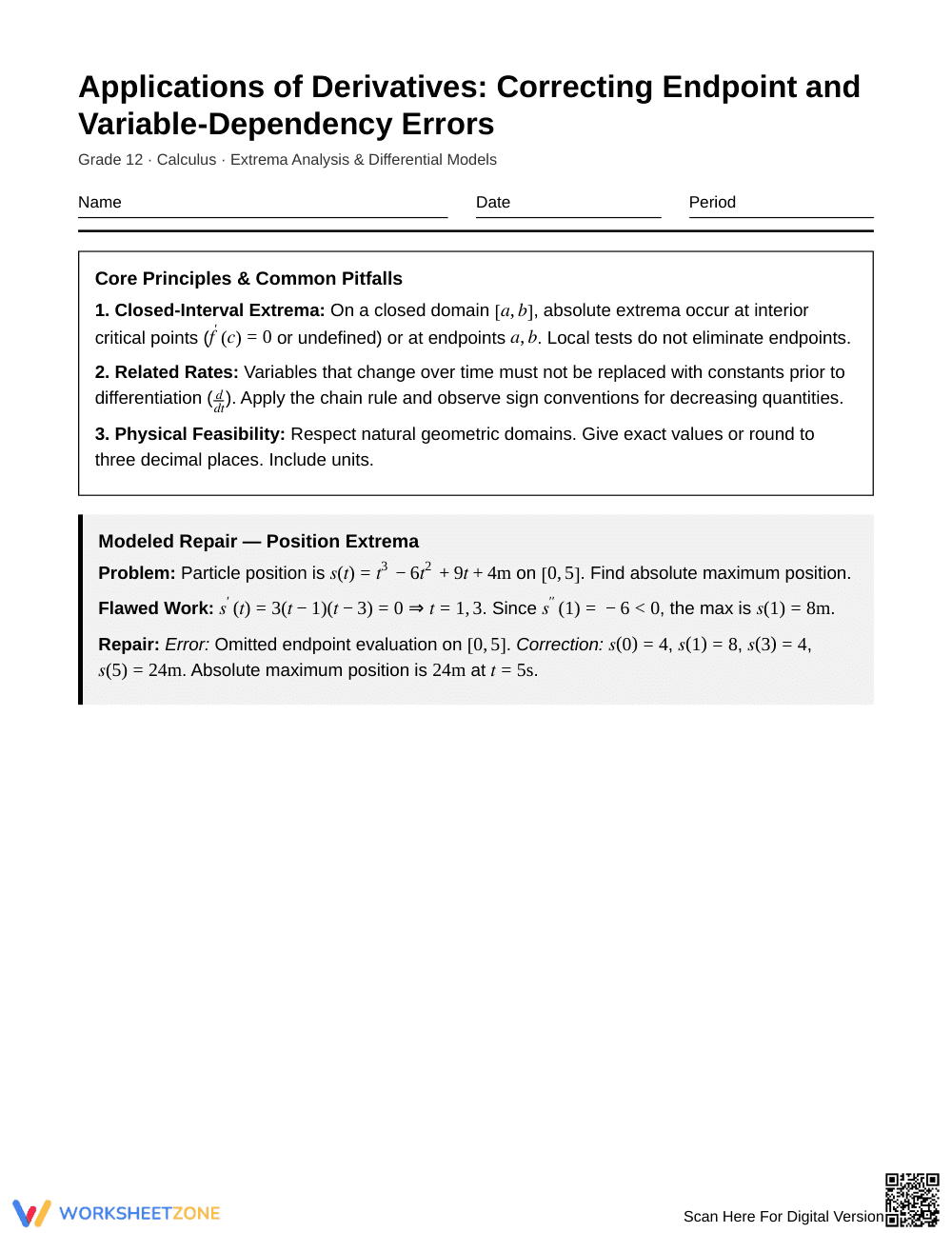
This Grade 12 calculus worksheet targets conceptual errors in differential calculus, training students to analyze and repair faulty mathematical reasoning. Learners evaluate ten flawed solutions across rectilinear motion, related rates, and optimization, building rigorous verification routines for closed-interval endpoints and dynamic rates.
At a Glance
- Grade: 12 · Subject: Calculus
- Standard: Applications of Derivatives — Analyze extrema on closed intervals and model rates of change
- Skill Focus: Correct Endpoint and Variable-Dependency Errors
- Format: 5 pages · 10 problems · Answer key included · PDF
- Best For: Calculus error analysis and review
- Time: 45–60 minutes
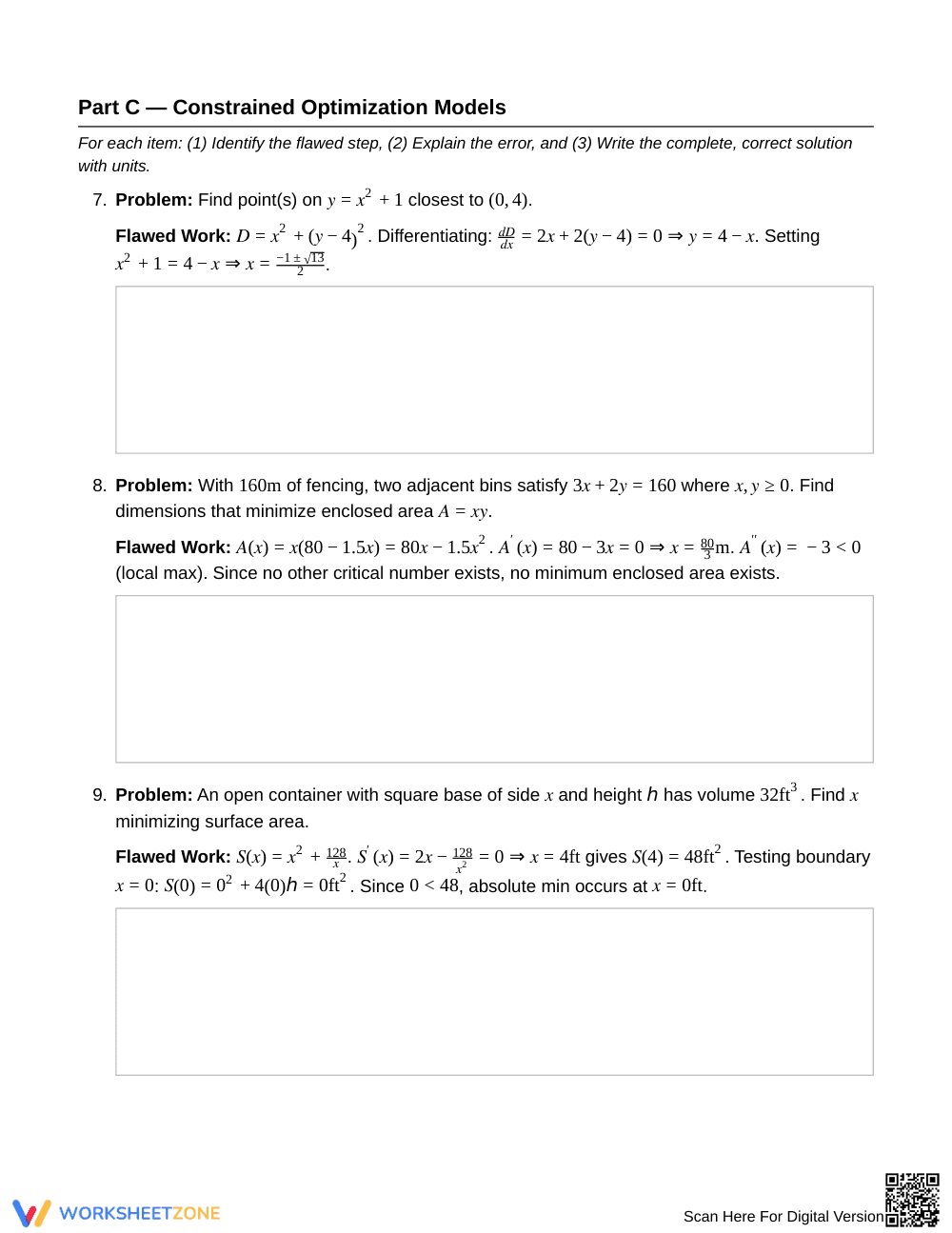
The five-page packet features a reference box covering three core analytical rules, a modeled position extrema repair, and ten student tasks. Students identify the flawed step, explain the underlying mathematical misconception, and write a complete corrected solution with proper units. A three-page answer key provides step-by-step solutions.
Skill Progression
- Guided practice (Modeled Repair & Part A, 3 items): Students examine a worked position repair, then correct three motion tasks involving boundary evaluations, total distance, and average velocity.
- Supported practice (Part B, 3 items): Students analyze three related rates problems, catching premature constant substitutions and differentiation errors.
- Independent practice (Part C, 4 items): Students resolve four optimization models, auditing objective equations, physical feasibility, and interval endpoints.
This structured sequence follows the gradual release of responsibility model, moving students from guided critique to independent error diagnosis.
Standards Alignment
This resource aligns with calculus curriculum standards for Applications of Derivatives, emphasizing the Extreme Value Theorem on closed intervals and chain rule differentiation in related rates. Supporting concepts cover boundary constraints in optimization. This alignment can be copied directly into lesson plans, IEP goals, or curriculum mapping documents.
How to Use It
Assign this worksheet after direct instruction on optimization and related rates. In pairs, students identify where each sample solution fails before writing full repairs. For formative assessment, check whether students test closed-interval endpoints or rely solely on derivative tests. Completion time is 45 to 60 minutes.
Who It's For
This activity is designed for Grade 12 AP Calculus AB, BC, or honors calculus students preparing for unit exams. Support struggling students with function graphs, while advanced students solve optimization problems using alternative algebraic methods. Pair this packet with a lecture on implicit differentiation.
According to research by Fisher & Frey (2014) on structured instructional frameworks, engaging advanced mathematics students in deliberate error analysis deepens conceptual mastery and metacognitive monitoring far more effectively than repetitive procedural drill alone. This Grade 12 calculus worksheet operationalizes that principle across 10 structured tasks centered on the skill of identifying and correcting endpoint omissions and variable-dependency errors in differential applications. High school calculus students frequently struggle with boundary conditions on closed intervals and premature constant substitution during related rates setups. By diagnosing flawed student work, articulating specific mathematical misconceptions, and recalculating correct solutions with precise dimensional units, learners bridge procedural execution and theoretical understanding. Designed for 45 to 60 minutes of classroom practice, this 5-page resource equips educators to diagnose persistent calculus misconceptions while reinforcing rigorous problem-solving routines across motion analysis, rates of change, and constrained geometric optimization.


