




























Views
Downloads




Essential Density Intervals Worksheet | Grade 8 Science

Paste this activity's link or code into your existing LMS (Google Classroom, Canvas, Teams, Schoology, Moodle, etc.).
Students can open and work on the activity right away, with no student login required.
You'll still be able to track student progress and results from your teacher account.
This physical science worksheet equips Grade 8 students to calculate density ranges with measurement uncertainty and identify unknown substances using laboratory reference tables. Learners evaluate bounding ratios, interpret buoyant float-sink behaviors across layered liquid columns, and justify material classifications through rigorous quantitative bounds.
At a Glance
- Grade: 8 · Subject: Science
- Standard: Physical Science — Determine characteristic properties and calculate density uncertainty intervals
- Skill Focus: Infer Unknown Materials from Intervals
- Format: 5 pages · 12 problems · Answer key included · PDF
- Best For: Physical science laboratory analysis practice
- Time: 45–60 minutes
What's Inside
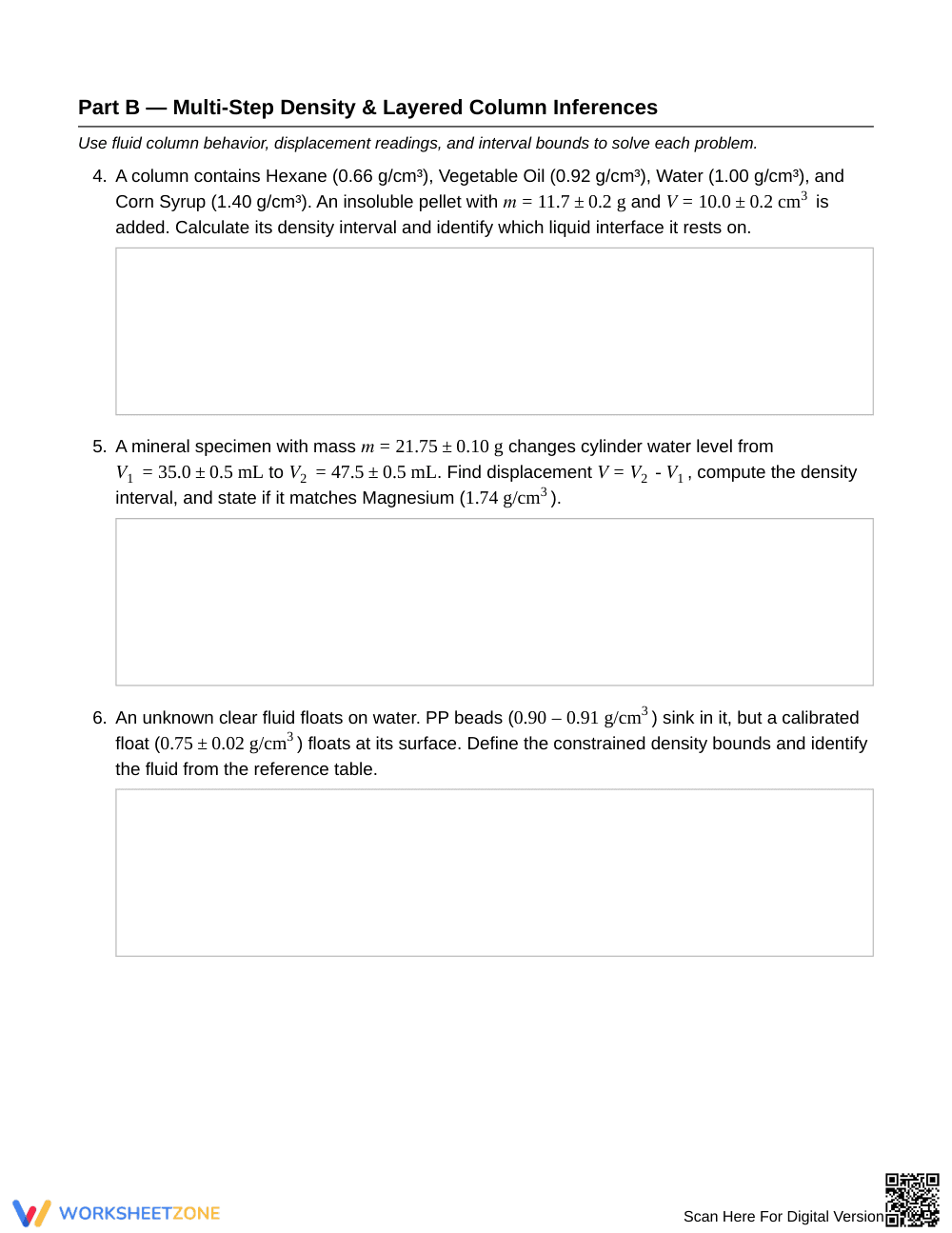
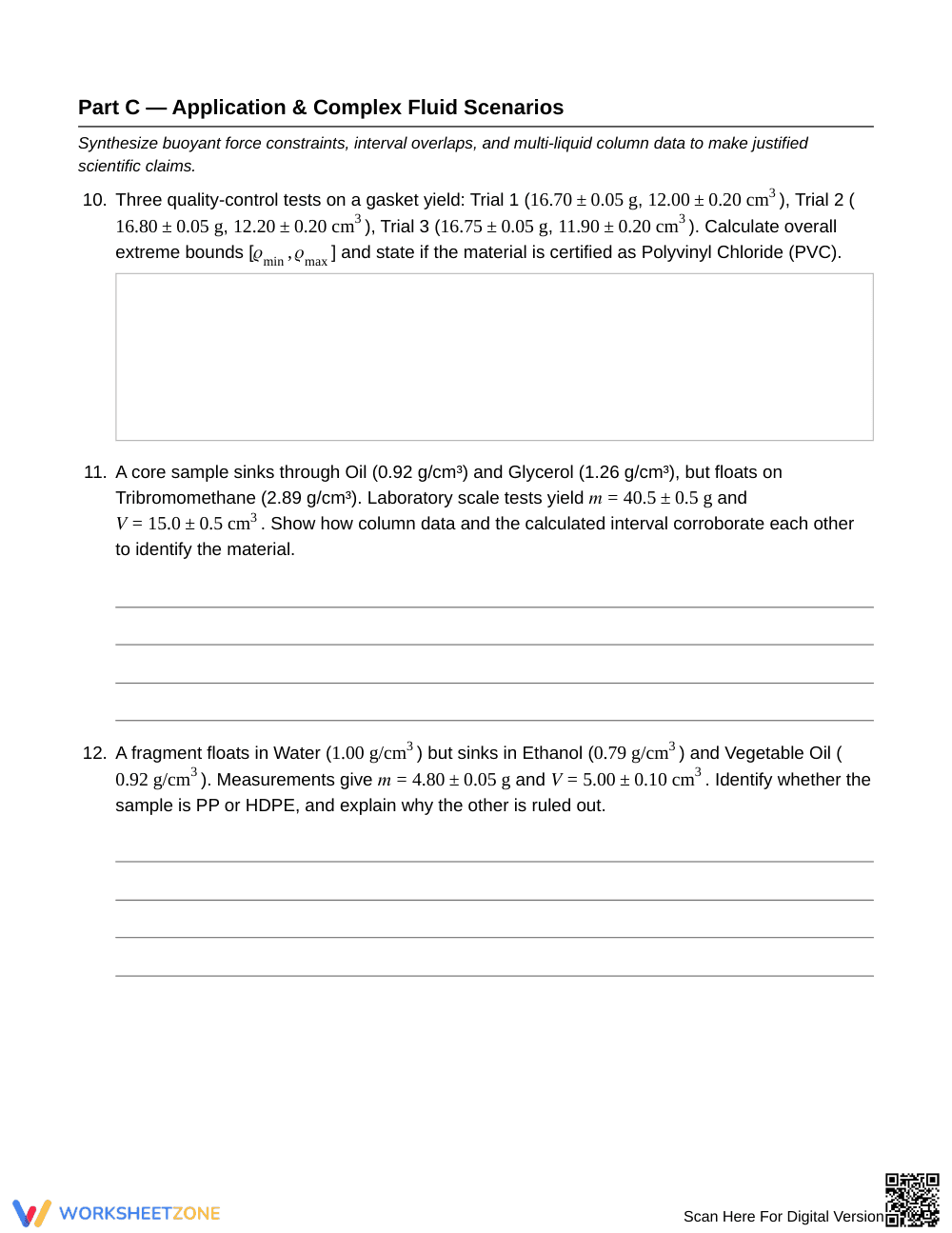
The 5-page worksheet includes a comprehensive 20 °C laboratory reference table of fluid and solid densities, key bounding formulas, 12 multi-step scientific tasks across 3 structured sections, and a complete 2-page answer key showing full algebraic solutions and material matching rationale.
Skill Progression
- Guided Practice (Part A, Problems 1–3): Direct interval calculations where students compute extreme bounds from mass and volume tolerances to match target solids.
- Supported Practice (Part B, Problems 4–9): Multi-step density tasks integrating water displacement measurements, rectangular volume bounds, and layered liquid column equilibrium.
- Independent Practice (Part C, Problems 10–12): Complex multi-liquid column synthesis and quality-control certification scenarios requiring corroborated scientific claims.
This structured progression follows the gradual release of responsibility model, ensuring students master foundational error propagation before evaluating multi-layer buoyant systems.
Standards Alignment
This resource aligns directly with middle school physical science standards requiring students to analyze and interpret data on the characteristic properties of substances before and after substances interact. Students distinguish pure substances by identifying characteristic properties like density while accounting for experimental measurement uncertainty. These learning targets can be copied directly into lesson plans, IEP goals, or district curriculum mapping tools.
How to Use It
Assign this resource directly after hands-on laboratory lessons on mass-volume measurement or fluid displacement. During seatwork, observe whether students correctly match minimum density to minimum mass divided by maximum volume rather than dividing like bounds. The resource requires 45 to 60 minutes for full completion and functions effectively as partner lab analysis or independent summative practice.
Who It's For
Designed for 8th-grade physical science and introductory physics classrooms, this worksheet supports general education and honors tracks. Pair this problem set directly with a graduated cylinder displacement lab or a density tower demonstration to anchor abstract calculations in visible phenomena.
According to research highlighted in Fisher & Frey (2014), structured problem progression scaffolds complex quantitative reasoning by explicitly bridging direct calculation and multi-step inference. When Grade 8 students calculate upper and lower density bounds using mass-to-volume ratio extremes, they develop critical analytical habits regarding experimental uncertainty. By synthesizing numerical bounds with physical observations in density columns, learners transform raw laboratory data into corroborated scientific conclusions. This 12-problem physical science resource targets material identification through rigorous boundary modeling, reinforcing evidence-based claims and measurement precision across middle school physical science curricula.


