




























Views
Downloads




Essential Curve Slicing Worksheet | Grade 12 Calculus

Paste this activity's link or code into your existing LMS (Google Classroom, Canvas, Teams, Schoology, Moodle, etc.).
Students can open and work on the activity right away, with no student login required.
You'll still be able to track student progress and results from your teacher account.
This advanced calculus resource equips students to evaluate definite integrals for the area between curves by comparing horizontal and vertical slicing methods. High school calculus learners analyze differential elements, formulate single versus multi-part integral expressions, critique common analytical errors, and determine the most efficient coordinate orientation to compute exact geometric bounded areas.
At a Glance
- Grade: 12 · Subject: Calculus
- Standard: Applications of Definite Integrals — Calculate area between intersecting continuous curves using horizontal and vertical differential slices
- Skill Focus: Compare Horizontal and Vertical Slices
- Format: 6 pages · 12 problems · Answer key included · PDF
- Best For: AP Calculus area unit exam preparation
- Time: 45–60 minutes
What's Inside
This 6-page comprehensive practice set contains 12 multi-part analytical problems organized into three rigorous sections. It provides detailed geometric figures, differential slice rule boxes, coordinate translation prompts, and error analysis tasks, supported by an exhaustive 5-page answer key showing full analytical steps and evaluations.
Skill Progression
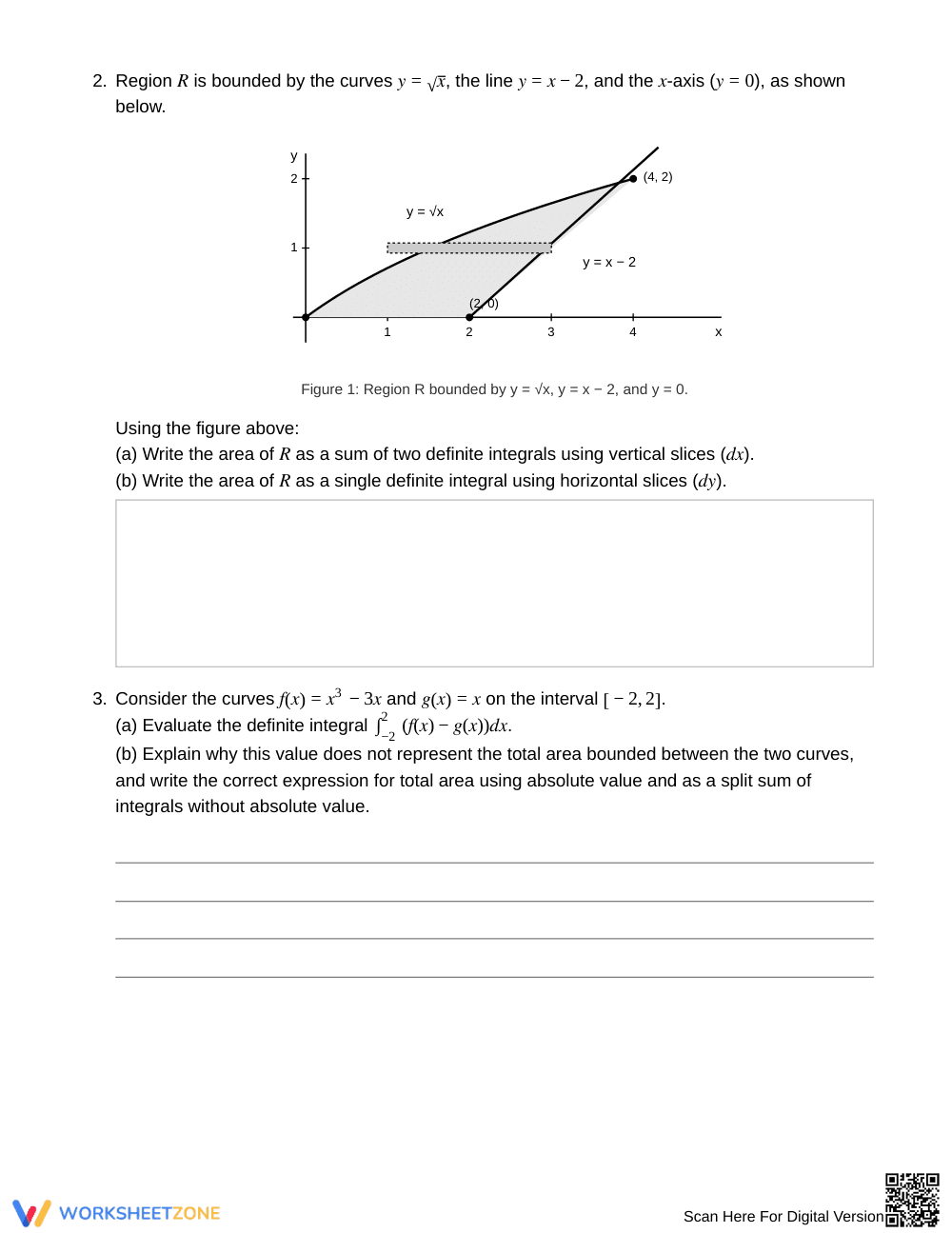
- Guided practice (Part A, Problems 1–3): Students read visual diagrams and algebraic integrals to identify differential elements ($dx$ vs. $dy$), determine boundary equations, and resolve sign discrepancies between net accumulation and total area.
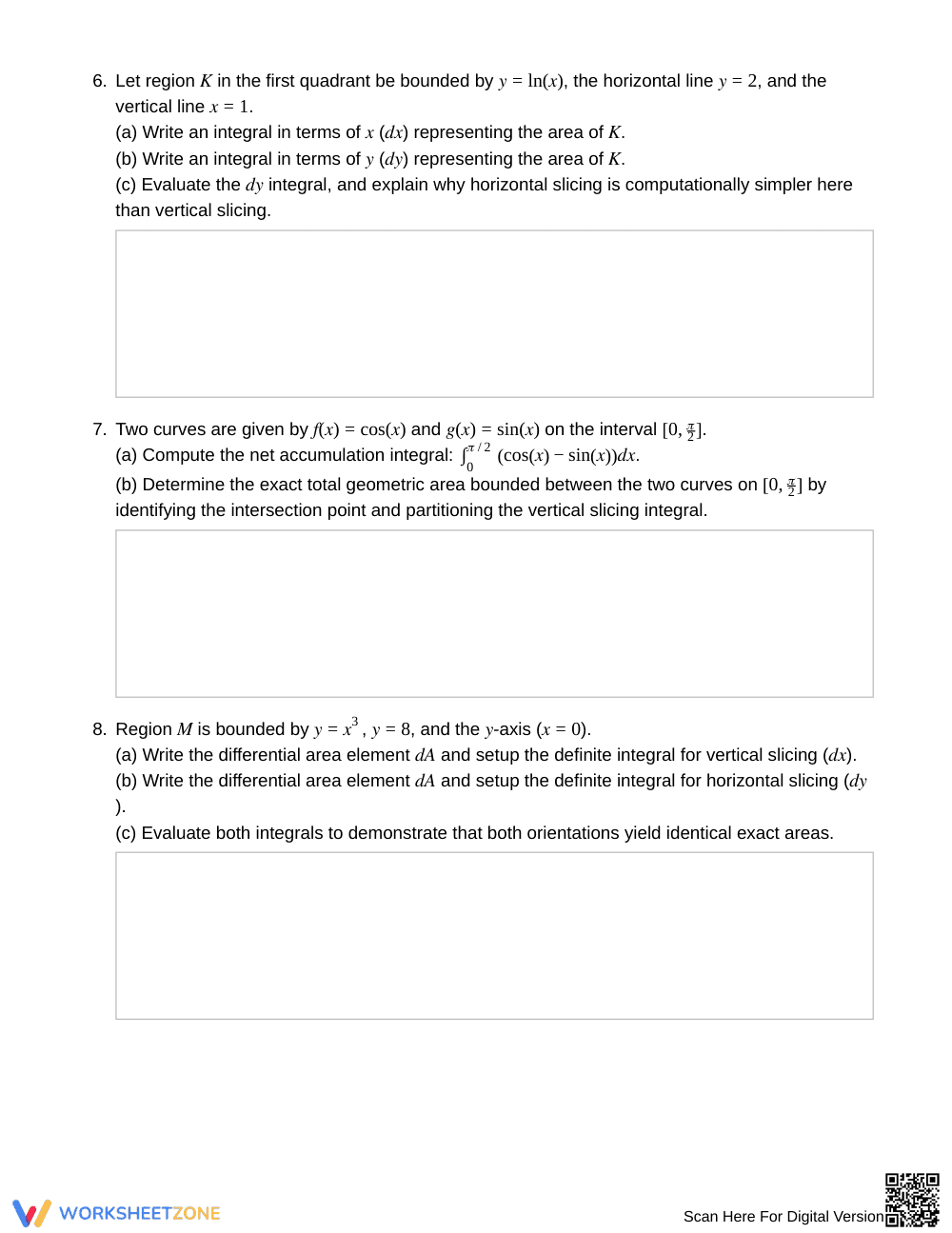
- Supported practice (Part B, Problems 4–9): Learners formulate and evaluate area integrals under both orientations, converting equations between $y=f(x)$ and $x=g(y)$ to evaluate computational efficiency.
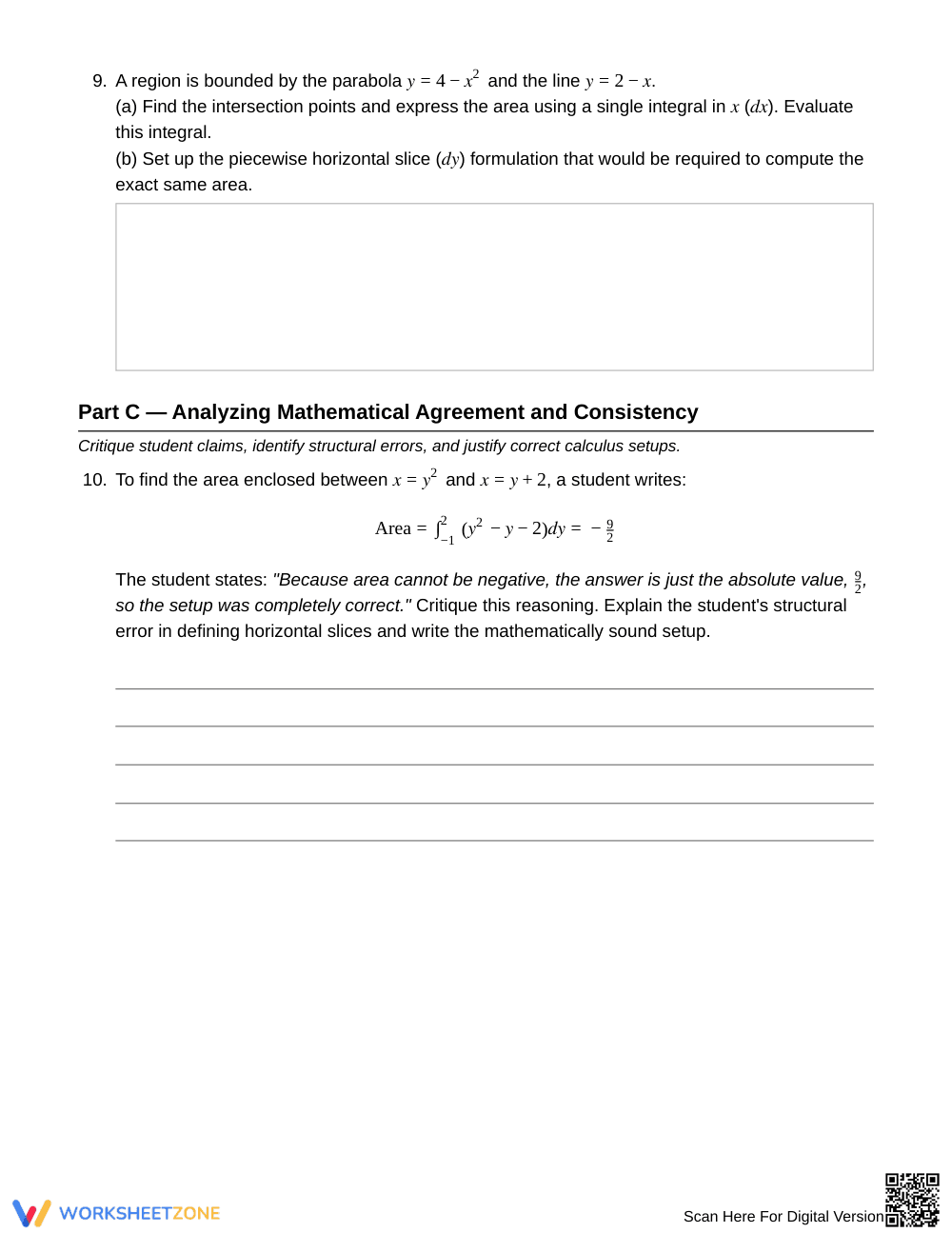
- Independent practice (Part C, Problems 10–12): Students critique flawed student reasoning, repair boundary setup errors, and differentiate between physical rate accumulation and geometric area.
This structured progression reflects the gradual release of responsibility framework, transitioning learners from foundational diagram analysis to independent calculus troubleshooting.
Standards Alignment
This resource aligns with advanced high school calculus standards covering definite integrals and geometric applications. Students partition regions into rectangular differential elements, determine points of intersection, and formulate Riemann sum limits with respect to both $x$ and $y$. Both standard codes can be copied directly into lesson plans, IEP goals, or district curriculum mapping tools.
How to Use It
Deploy this worksheet after direct instruction on area between curves as an in-depth partner synthesis activity or assessment review. Instructors should assign Parts A and B during class to actively observe whether students correctly invert functions (e.g., solving for $x$ in terms of $y$) before attempting integration. Expect student completion within 45 to 60 minutes.
Who It's For
This set is built for Grade 12 AP Calculus AB/BC or introductory college calculus students mastering integral geometry. Pair this packet directly with an interactive graphing calculator visualizer or curve-tracing whiteboard warm-up.
According to Fisher & Frey (2014), structured instructional scaffolds that require students to contrast multiple problem-solving pathways substantially deepen conceptual transfer and procedural flexibility in advanced mathematics. This calculus resource trains high school learners to inspect boundary curves, choose between horizontal and vertical slices, and verify mathematical consistency across 12 rigorous multi-part tasks. By requiring students to analyze function inversions and justify coordinate selections, the packet prevents common integration missteps before high-stakes summative evaluations. Mathematics educators can use these targeted exercises to reveal underlying student misconceptions regarding variable orientation and upper-versus-lower boundary assignments. Providing visual geometric models alongside analytical error critique reinforces algebraic fluency, computational stamina, and definite integration mastery across 6 complete pages. As students compare slicing strategies, they develop the metacognitive judgment required to solve complex geometric area problems efficiently on AP examinations and college-level calculus assessments.


