


























Views
Downloads


Essential Current & Resistance Worksheet | Grade 12 Physics
Paste this activity's link or code into your existing LMS (Google Classroom, Canvas, Teams, Schoology, Moodle, etc.).
Students can open and work on the activity right away, with no student login required.
You'll still be able to track student progress and results from your teacher account.
This Grade 12 physics worksheet helps students distinguish current, potential difference, and resistance, then apply Ohm's law to a series circuit and a parallel circuit. Students finish by judging flawed student work with physical reasoning, which builds accuracy and conceptual understanding together.
At a Glance
- Grade: 12 · Subject: Physics
- Standard: Not specified — apply Ohm's law to series and parallel circuits
- Skill Focus: Current, potential difference, and resistance
- Format: 5 pages · 12 problems · Answer key included · PDF
- Best For: Practice after circuits instruction
- Time: 25–35 minutes
What's Inside
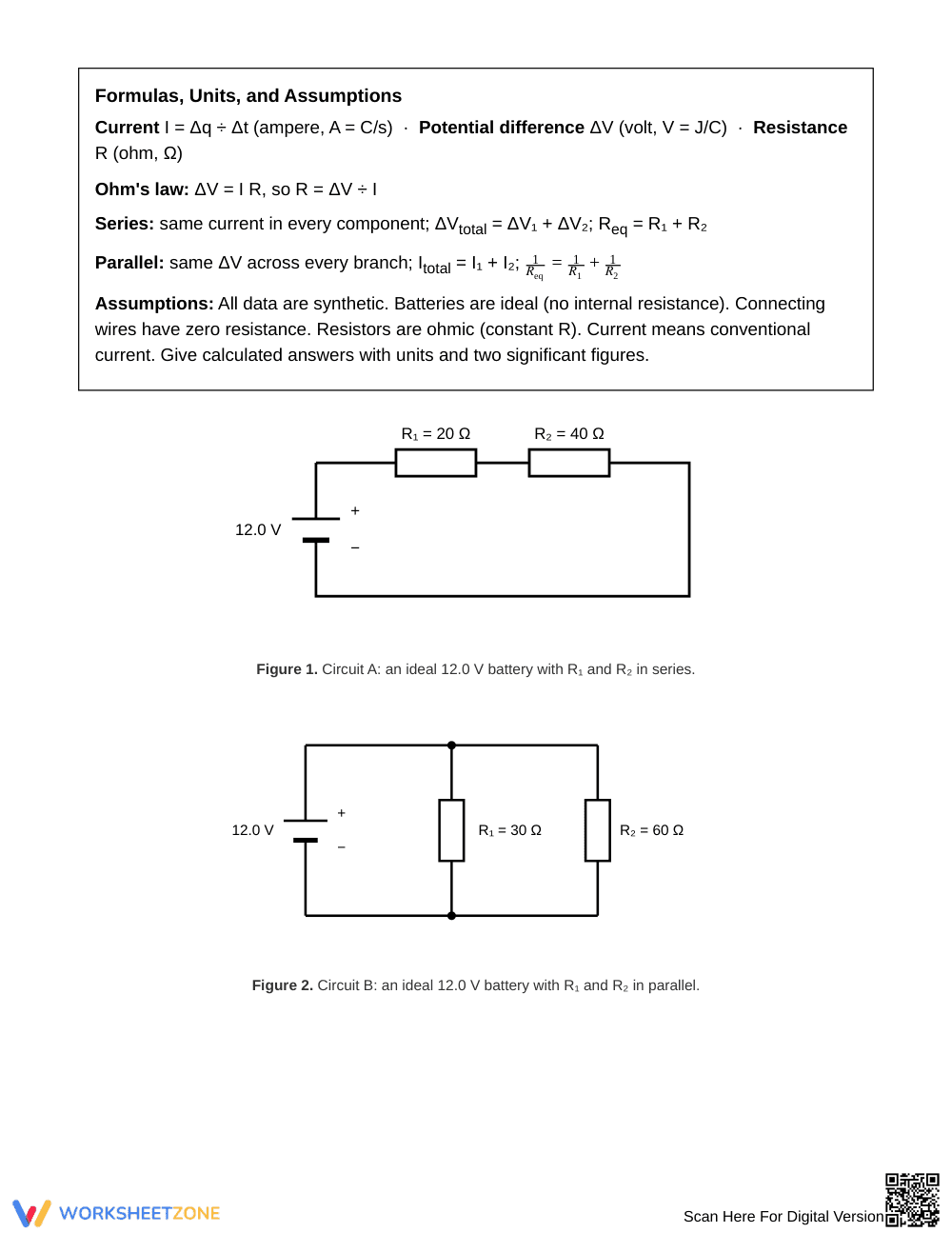
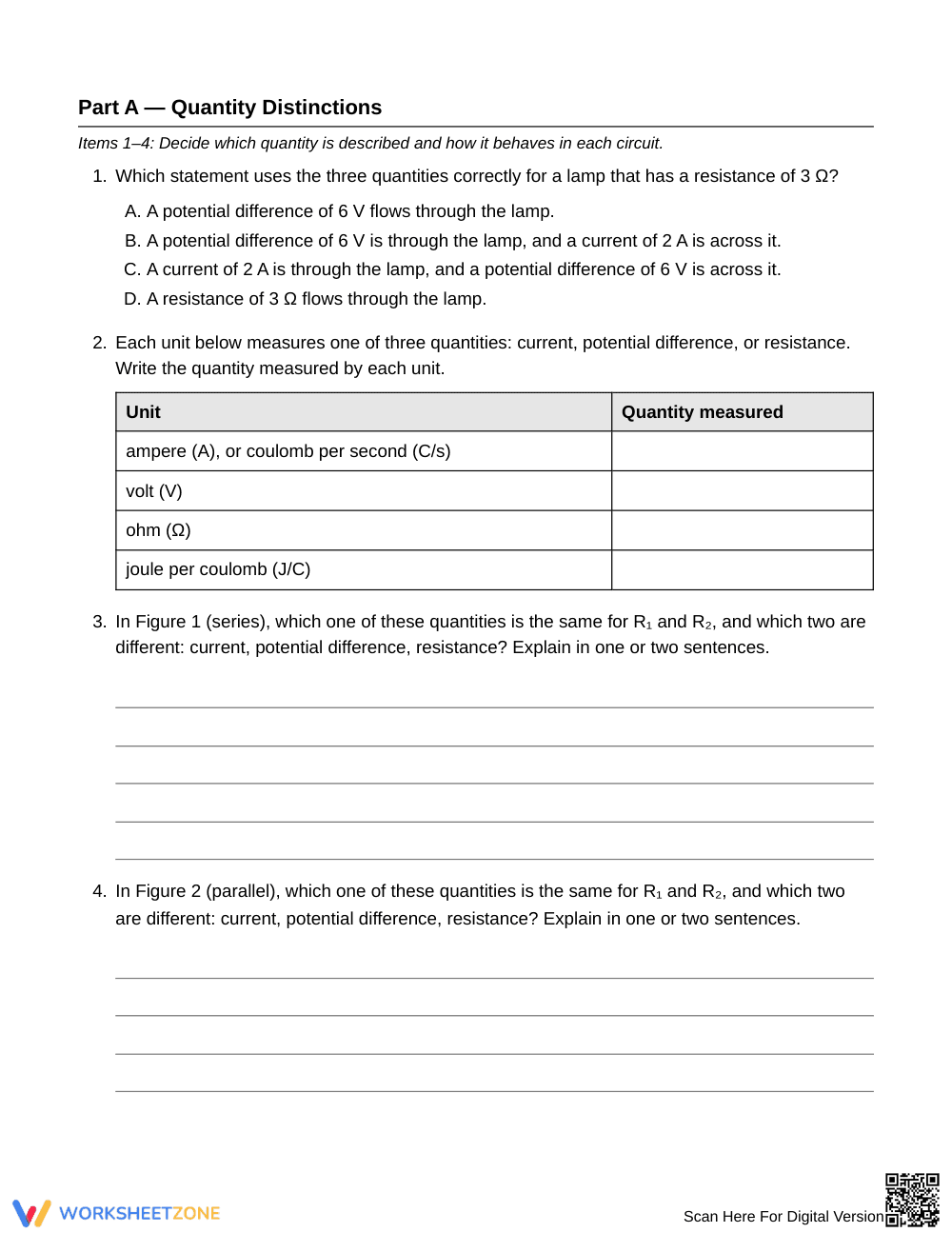
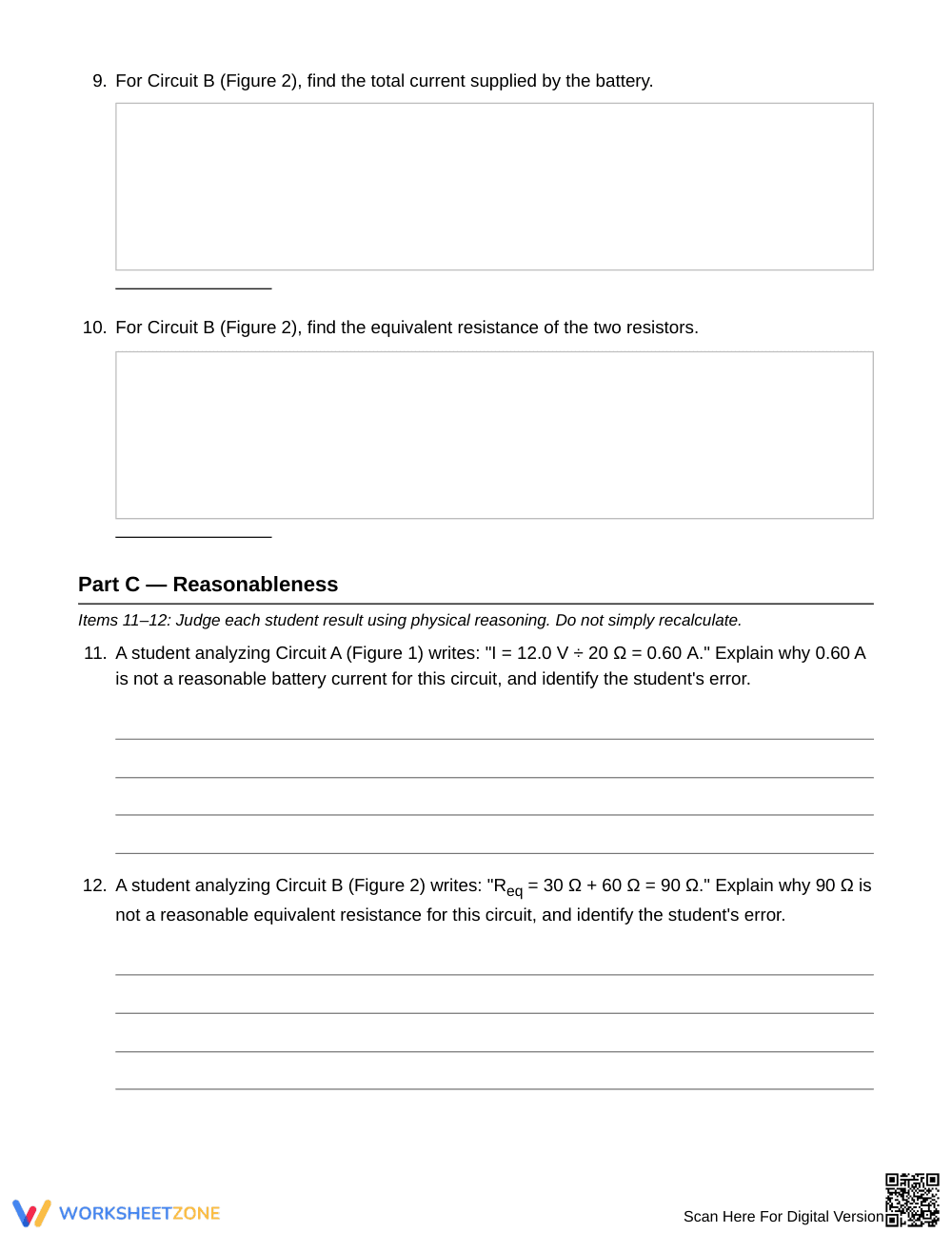
The 5-page PDF opens with a formula and assumptions box covering the definition of current, units for potential difference and resistance, Ohm's law, and the series and parallel rules. Two labeled circuit figures, each with an ideal 12.0 V battery and two resistors, support the items. Part A has 4 concept items, Part B has 6 calculations, and Part C has 2 reasonableness checks. A 2-page answer key is included.
Skill Progression
- Guided practice (Items 1–4): Students match quantities to units and decide which quantity stays the same in series and in parallel. The formula box and short explanations give high support.
- Supported practice (Items 5–10): Students calculate current, resistance, branch voltage, and equivalent resistance. They show their setup and give units with two significant figures.
- Independent practice (Items 11–12): Students critique two incorrect student results and explain the error using physical reasoning, not recalculation.
This sequence follows gradual release: I do, we do, you do.
Standards Alignment
No standard code was supplied for this worksheet, so none is listed here. The content targets the core physics idea that current, potential difference, and resistance are related by ΔV = IR, and that series and parallel circuits distribute these quantities differently. Add your state or district code when copying this worksheet into lesson plans, IEP goals, or district curriculum mapping tools.
How to Use It
- After direct instruction: Assign Parts A and B as in-class practice once students have seen Ohm's law and the series and parallel rules.
- Before a quiz: Use Part C as a short review discussion, with students comparing their explanations in pairs.
Formative-assessment tip: while students work on Items 3 and 4, listen for whether they say current flows through a component and potential difference is across it. Expect 25–35 minutes.
Who It's For
This worksheet suits Grade 12 physics students in a first circuits unit. Students who need more support can keep the formula box beside them for Part B, while stronger students can write fuller explanations in Part C. It pairs well with a series-versus-parallel anchor chart or a hands-on circuit lab.
This Grade 12 Physics worksheet, Current, Potential Difference, and Resistance, asks students to separate three easily confused circuit quantities and apply Ohm's law (ΔV = IR) in series and parallel circuits. Twelve tasks move from conceptual sorting, through six calculations with units and two significant figures, to two error-analysis items where students explain why a result is physically unreasonable. The sequence follows the gradual-release model described by Fisher & Frey (2014), in which learners move from guided support to independent application. All data are synthetic, batteries are ideal, and wires have zero resistance, so students can focus on reasoning rather than measurement noise. The PDF includes a two-page answer key and a formula box covering current, potential difference, resistance, series rules, and parallel rules. No standard code is listed in the source, so teachers can map the worksheet to their own state or district physics standards for circuits.


