


























Views
Downloads



Essential Comparing Density Worksheet | Grade 6 Science
Paste this activity's link or code into your existing LMS (Google Classroom, Canvas, Teams, Schoology, Moodle, etc.).
Students can open and work on the activity right away, with no student login required.
You'll still be able to track student progress and results from your teacher account.
This Grade 6 physical science worksheet equips students to master density as a characteristic property by calculating values, interpreting water displacement data, and comparing substances against reference tables. Across 12 structured problems, learners connect quantitative division with scientific reasoning to predict sinking, floating, and material identity.
At a Glance
- Grade: 6 · Subject: Science
- Standard: Characteristic Properties — Calculate and compare material densities to predict buoyancy and identify substances
- Skill Focus: Compare Materials Using Density
- Format: 5 pages · 12 problems · Answer key included · PDF
- Best For: Physical science practice and review
- Time: 40–50 minutes
What's Inside
This five-page resource opens with a formula header and a reference density table covering eleven materials. Students solve direct calculations, analyze water displacement data, evaluate mass-versus-density misconceptions, and calculate liquid layering. The included two-page answer key provides complete computational steps and qualitative explanations.
Skill Progression
- Guided Practice (Part A, Problems 1–3): Students compute densities from given mass and volume, identify materials using reference values, and explain internal particle packing.
- Supported Practice (Part B, Problems 4–9): Learners apply water displacement, rearrange formulas to solve for mass or volume, and refute misconceptions.
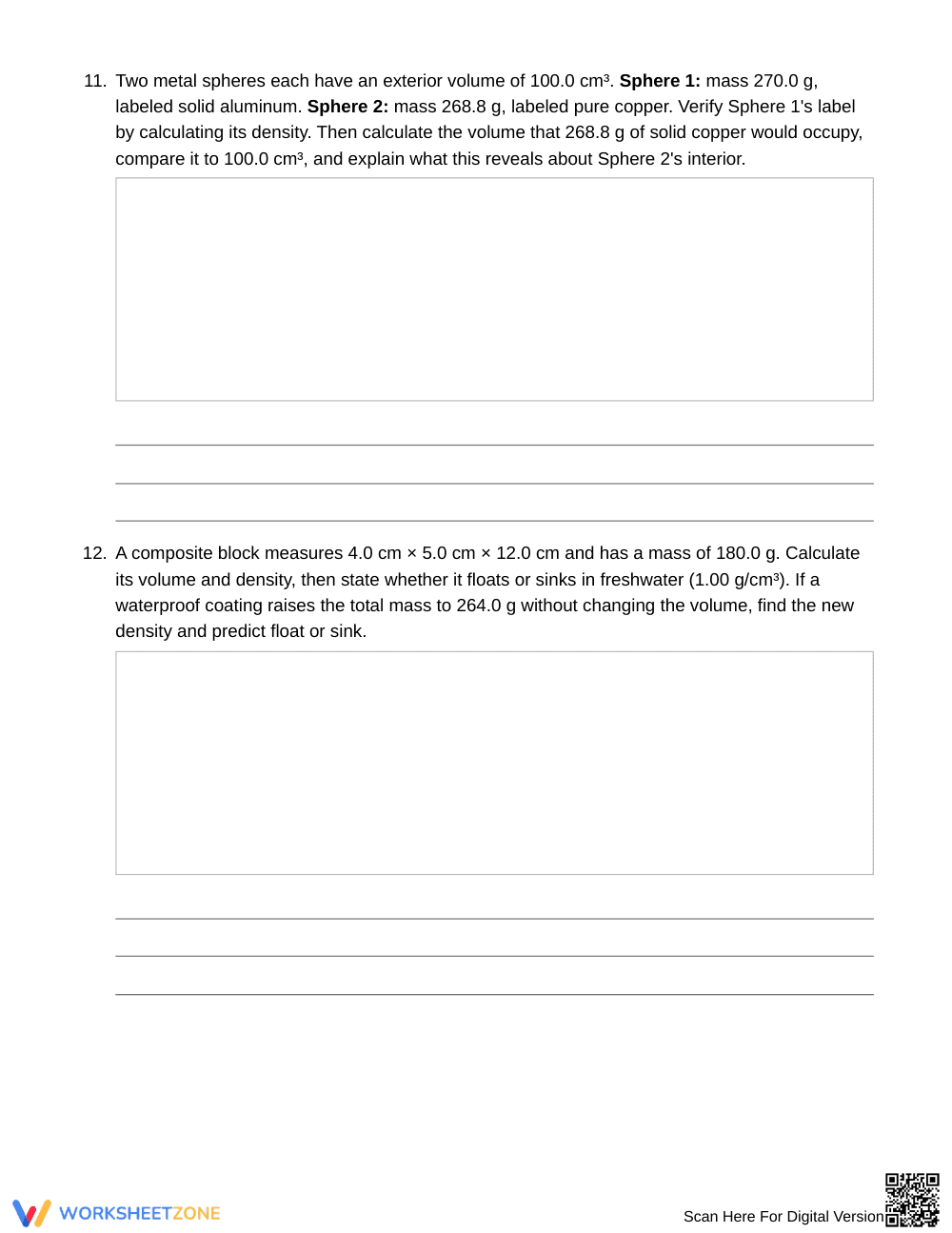
- Independent Practice (Part C, Problems 10–12): Students evaluate multi-fluid density columns, analyze hollow sphere structures, and predict composite block buoyancy.
This progression embodies gradual-release instruction, guiding students from direct computation to independent scientific evaluation.
Standards Alignment
This worksheet aligns with middle school physical science standards for characteristic properties of matter. Students prove that density is an intensive property independent of sample size. Both standard codes can be copied directly into lesson plans, IEP goals, or district curriculum mapping tools.
How to Use It
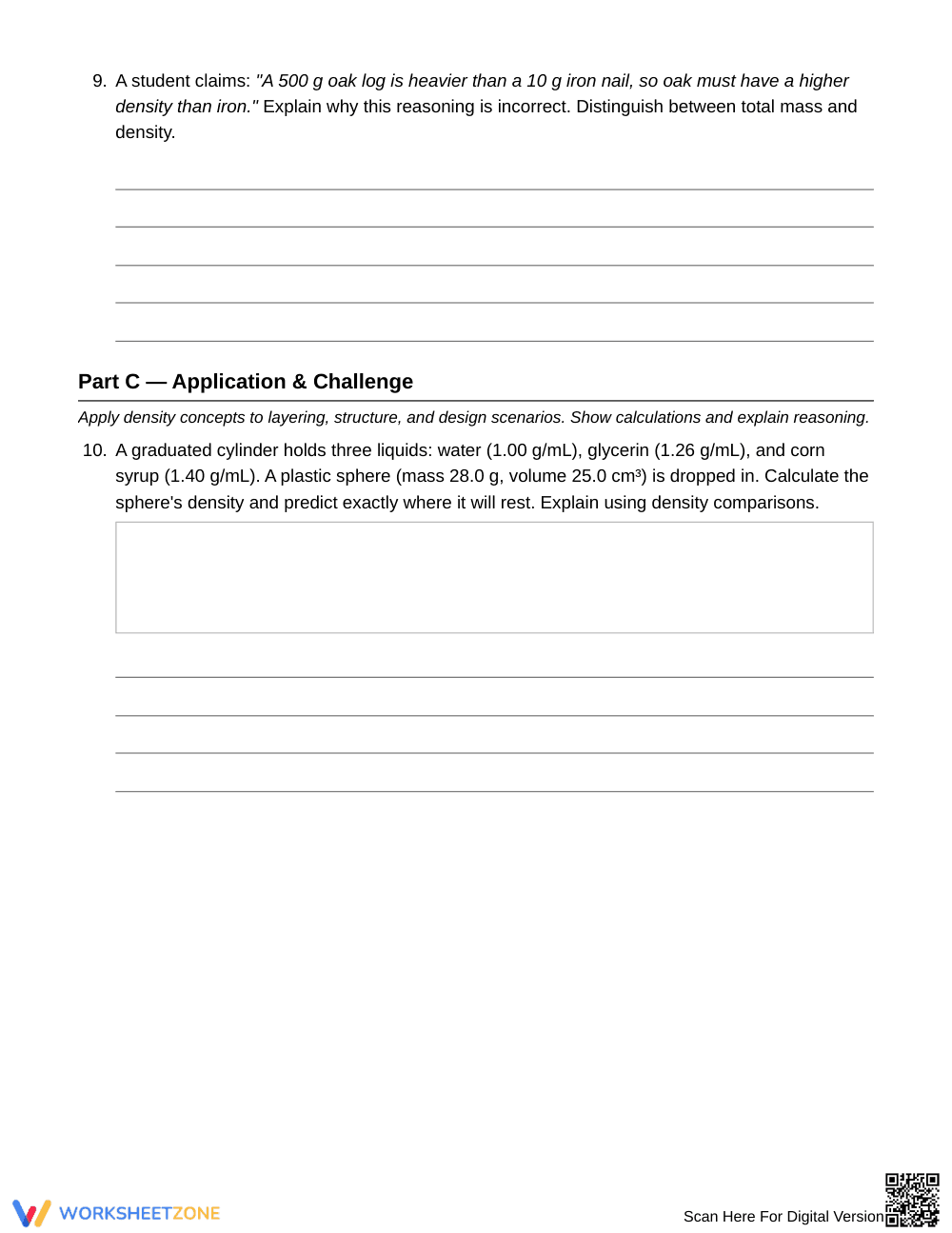
Assign this worksheet following direct instruction on the density formula or after a hands-on measurement lab. Formatively assess students on Part B, Problem 9 to verify they distinguish total mass from intrinsic density. The full problem set requires 40 to 50 minutes of instructional time.
Who It's For
Designed for Grade 6 physical science students, this resource supports both general classes and intervention groups needing structured math integration. Differentiate by utilizing the reference table for support or assigning Part C as an extension. Pair with an introductory graduated cylinder demonstration.
In middle school science education, developing proficiency in comparing materials using density requires explicit practice connecting quantitative calculations to conceptual properties of matter. According to Fisher & Frey (2014), purposeful instructional design that couples reference scaffolds with gradual cognitive demand enables students to master multi-step problem solving and transfer mathematical formulas to physical science phenomena. This Grade 6 worksheet guides students through 12 rigorous tasks, moving systematically from basic formula substitution to water displacement analysis, density column predictions, and structural investigations of composite materials. By integrating worked formula headers, empirical data interpretation, and conceptual justification, the resource reinforces the principle that density remains invariant regardless of sample volume. Teachers can implement this resource as a core skills assessment, post-lab consolidation, or targeted review to solidify student comprehension of buoyancy, characteristic properties, and material identification across diverse physical science learning environments.


