




























Views
Downloads



Essential Circuit Variables Worksheet | Grades 8–12 Science

Paste this activity's link or code into your existing LMS (Google Classroom, Canvas, Teams, Schoology, Moodle, etc.).
Students can open and work on the activity right away, with no student login required.
You'll still be able to track student progress and results from your teacher account.
This comprehensive physical science worksheet guides secondary students through experimental design, data analysis, and mathematical modeling in electric circuits. Learners evaluate controlled experiments, graph empirical relationships between voltage and current, calculate resistance values, and design a novel investigation testing how conductor geometry affects electrical flow.
At a Glance
- Grade: Grades 8–12 · Subject: Science
- Standard: Scientific Inquiry — Plan and carry out investigations to determine relationships among circuit variables
- Skill Focus: Investigation & Variables
- Format: 4 pages · 20 problems · Answer key included · PDF
- Best For: Physics inquiry and circuit lab follow-up
- Time: 45–60 minutes
What's Inside: The 4-page student handout contains 20 targeted items arranged across three core sections. Students encounter schematic diagrams, structured observation prompts, tabular voltage and current data, coordinate graphing grids, conceptual collision models, and an experimental design template. A complete 4-page teacher answer key provides full explanations, calculated resistance values, and sample experiment designs.
Skill Progression
- Guided Practice: Tasks 1–6 walk students through a concrete experimental scenario, scaffolding how to identify independent, dependent, and controlled variables while verifying correct series and parallel meter placements.
- Supported Practice: Tasks 7–14 require students to plot experimental voltage-current pairs, identify linear proportionality, compute constant resistance values using Ohm's law, and predict current outcomes at higher voltages.
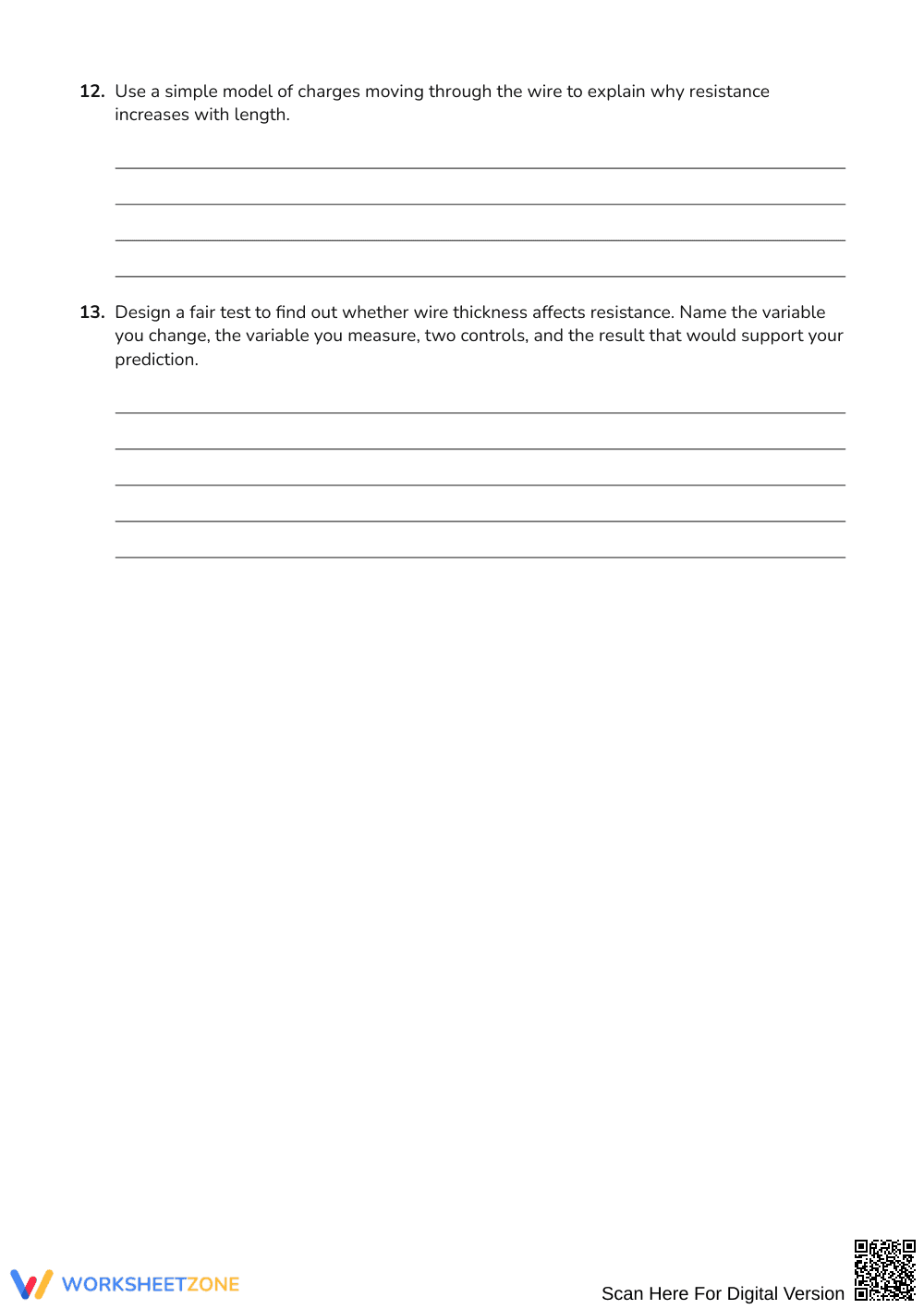
- Independent Practice: Tasks 15–20 challenge learners to extrapolate length-resistance trends, explain atomic-scale charge collisions, and author an original, controlled test isolating wire thickness.
This structured release model moves learners steadily from guided schematic analysis to autonomous experimental planning.
Standards Alignment
This resource supports middle and high school physical science performance expectations focusing on planning and conducting investigations and analyzing electrical forces. Students define system boundaries, manipulate test variables, evaluate empirical data, and generate mathematical models relating potential difference, charge flow, and material resistance. These foundational inquiry competencies can be copied directly into lesson plans, IEP goals, or district curriculum mapping tools.
How to Use It
Deploy this worksheet after direct instruction on electrical potential and resistance, or use it immediately following a wet lab to consolidate experimental thinking. During independent work, conduct quick formative checks on whether students place ammeters in series and voltmeters in parallel on circuit schematics. Students typically finish all 20 prompts within 45 to 60 minutes.
Who It's For
This resource serves general science, physical science, and introductory physics courses across grades 8 through 12. Visual learners benefit from explicit schematic diagrams and structured tables, while advanced students gain practice modeling atomic collisions. Pair this worksheet directly with a hands-on breadboard laboratory or digital circuit simulation.
Explicit instruction in variable identification and experimental design enables secondary science students to bridge empirical lab observations and abstract mathematical modeling. According to Fisher & Frey (2014), structured scaffolds within guided inquiry—transitioning from identifying controlled variables to graphing data points and designing independent tests—significantly strengthen conceptual retention and procedural fluency. This 4-page science investigation worksheet equips learners in grades 8 through 12 to isolate independent and dependent variables, verify Ohm’s law through linear slope interpretation, and construct qualitative particle collision models. By progressing systematically through tabular data analysis, quantitative ratio calculations, and an original experimental proposal for wire diameter, students build rigorous evidentiary reasoning. Science educators can deploy this twenty-task resource alongside hands-on breadboard labs or as a rigorous standalone inquiry exercise, ensuring students master the foundational mechanics governing electrical current, potential difference, and material resistance.


