




























Views
Downloads




Essential Central Idea & Summary Worksheet | Grade 7 ELA

Paste this activity's link or code into your existing LMS (Google Classroom, Canvas, Teams, Schoology, Moodle, etc.).
Students can open and work on the activity right away, with no student login required.
You'll still be able to track student progress and results from your teacher account.
This Grade 7 informational text worksheet equips students to identify multiple central ideas and craft unbiased summaries. Analyzing an original account of a student-led radio station, learners trace how ideas interact, isolate essential evidence from minor details, and eliminate subjective phrasing to master rigorous middle school reading benchmarks.
At a Glance
- Grade: 7 · Subject: ELA
- Standard:
RI.7.2— Determine two or more central ideas in text and write an objective summary- Skill Focus: Central Idea and Summary Check
- Format: 5 pages · 12 problems · Complete 3-page answer key · PDF
- Best For: Mid-unit assessment or independent skill practice
- Time: 40–50 minutes of instructional time
What's Inside
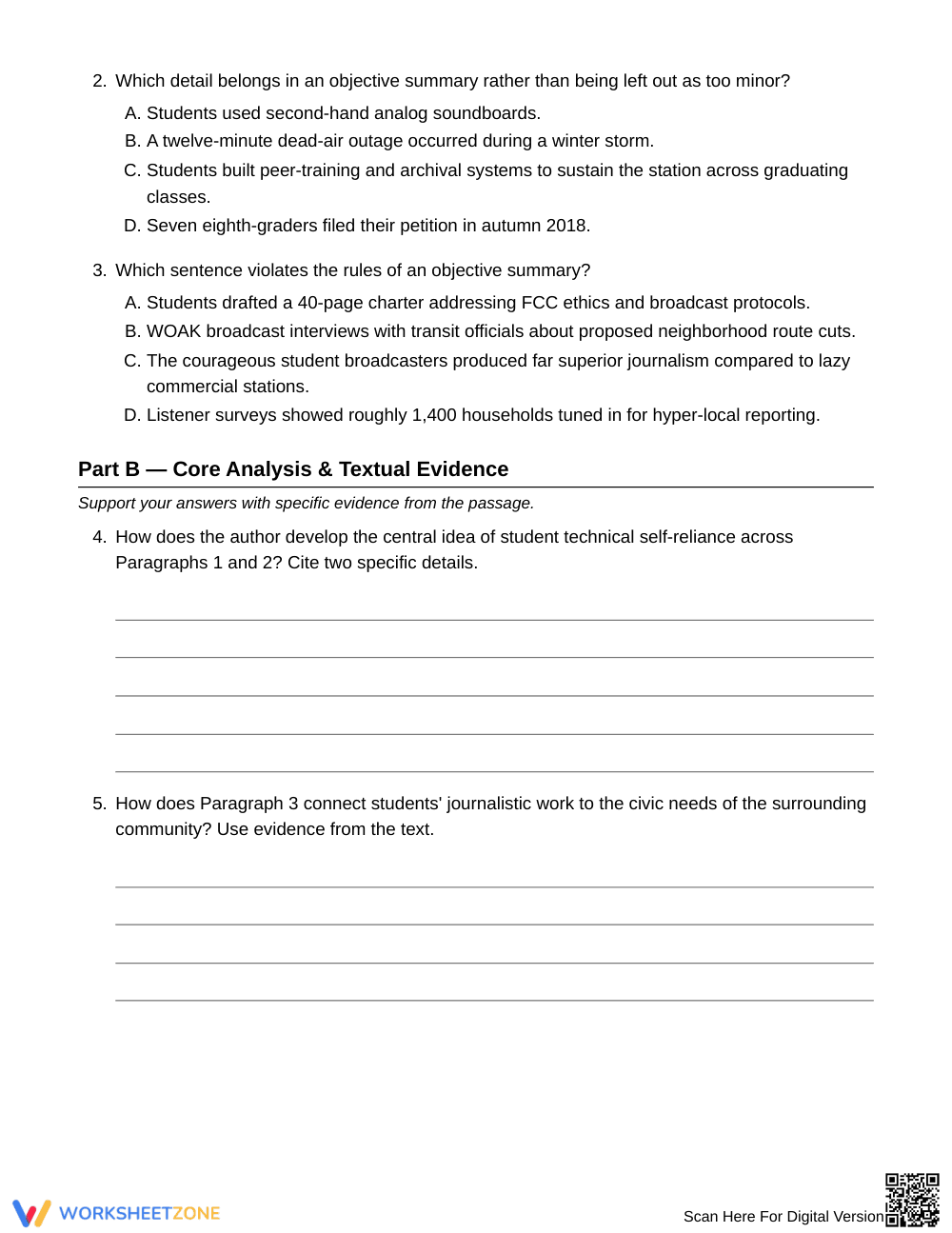
This 5-page student packet includes a rigorous non-fiction passage, 12 analytical tasks, and a detailed 3-page answer key. The assignment opens with clear conceptual definitions before presenting multiple-choice checks, evidence-based text citations, a detail-sorting chart, and two contrasting sample summaries for student critique.
Skill Progression
- Guided practice (Part A, Items 1–3): Foundational multiple-choice questions establish baseline understanding by requiring students to identify paired central ideas, weed out minor details, and spot subjective violations.
- Supported practice (Part B, Items 4–9): Scaffolded analysis prompts students to cite evidence, examine theme interactions, correct biased phrasing, and classify statements as essential or non-essential.
- Independent practice (Part C, Items 10–12): Rigorous synthesis tasks require evaluating peer summary drafts, composing an original objective summary, and explaining authorial objectivity.
This progression embodies the gradual-release framework, moving learners from guided concept recognition to autonomous summary writing.
Standards Alignment
This resource directly targets `RI.7.2`: Determine two or more central ideas in a text and analyze their development over the course of the text; provide an objective summary of the text. Supporting standard `RI.7.1` asks students to cite several pieces of textual evidence to support analysis. Both standard codes can be copied directly into lesson plans, IEP goals, or district curriculum mapping tools.
How to Use It
Deploy this activity immediately after direct instruction on summary objectivity or as a mid-unit checkpoint. During the sorting activity in Part B, observe whether students confuse minor supporting examples with overarching claims to flag needs for re-teaching. The complete task sequence takes 40 to 50 minutes to complete.
Who It's For
This worksheet serves general education seventh-graders and can be differentiated for striving readers by providing sentence starters for Part C. Pair this lesson directly with an anchor chart contrasting facts with subjective opinions.
Mastering informational text analysis under standard `RI.7.2` requires seventh-grade students to isolate multiple central ideas, trace their progression, and synthesize findings into an unbiased, objective summary. As documented by Fisher & Frey (2014), student proficiency in text-dependent summarization depends on explicit gradual-release structures that guide learners from identifying text claims to critiquing non-essential details. Without deliberate practice separating authorial claims from minor anecdotes, middle school readers consistently incorporate personal judgments or trivial facts into summaries. This 5-page curriculum-aligned instructional resource operationalizes these research insights through a 12-task progression that balances multiple-choice discrimination, textual citation, detail classification, and independent summary drafting. By scaffolding the transition from identifying bias to writing neutral restatements, this worksheet provides educators with verified evidence of student mastery while developing the critical reading and analytical writing skills mandated across secondary English language arts standards.


