




























Views
Downloads


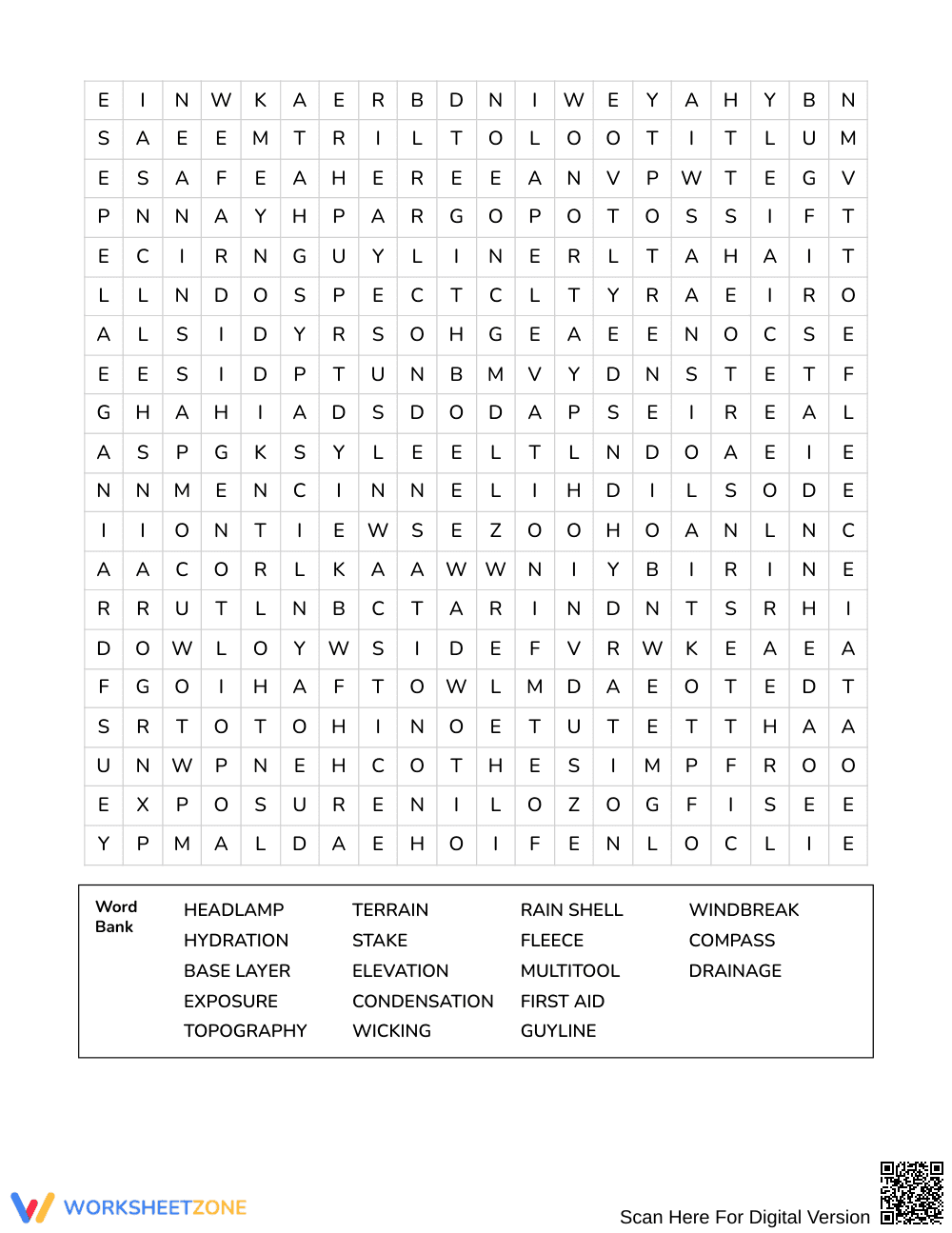

Essential Campsite Planning Word Search | Grades 7–8 ELA

Paste this activity's link or code into your existing LMS (Google Classroom, Canvas, Teams, Schoology, Moodle, etc.).
Students can open and work on the activity right away, with no student login required.
You'll still be able to track student progress and results from your teacher account.
This Grades 7–8 vocabulary word search builds essential outdoor terminology by challenging students to identify 18 terms related to planning for different campsite conditions. Students read detailed definition clues, decode key environmental and safety concepts, and locate each term within a dense letter grid to reinforce comprehension.
At a Glance
- Grade: Grades 7–8 middle school · Subject: English Language Arts (ELA) Vocabulary
- Standard: Not standards-assessed — vocabulary enrichment and context clue application
- Skill Focus: Planning for diverse outdoor terrain and campsite weather conditions
- Format: 3 printable student pages · 18 targeted vocabulary words · Full answer key included · PDF
- Best For: Cumulative review, post-reading enrichment, or early finisher activity
- Time: 20–35 minutes of focused puzzle work
What's Inside
This 3-page word search features 18 vocabulary words focused on wilderness preparedness, campsite weather risks, and protective gear. The resource provides a shuffled word bank alongside 18 complete definition clues that students review prior to searching. A full 4-page answer key provides clear visual solutions highlighting word placements across the puzzle grid.
Puzzle Mechanics and Structure
The activity is built on a challenging 20-by-20 grid designed for Grades 7–8 students. Words are hidden across all 8 compass directions: North, Northeast, East, Southeast, South, Southwest, West, and Northwest. Students use the definition clues to verify each concept before finding the hidden words, creating a focused, single-activity vocabulary search that encourages careful spatial scanning.
Standards Alignment
This resource serves as targeted vocabulary enrichment and is not aligned to a specific state or national standard. It supports cross-curricular literacy by developing domain-specific language in outdoor safety, earth science, and recreational planning, strengthening students' general reading comprehension and specialized vocabulary acquisition.
How to Use It
Deploy this word search after completing a direct instruction lesson on survival literature, outdoor safety, or informational texts about weather systems. It works effectively as an independent consolidation activity or a collaborative partner challenge. As a formative check, observe whether students read the clues first or merely scan the word list. Plan for 20 to 35 minutes of total instructional time.
Who It's For
This activity is designed for middle school students in Grades 7–8 who benefit from contextual vocabulary reinforcement. Teachers can support developing readers by having them highlight key phrases within the clues before searching. The word search pairs naturally with wilderness survival novels, expository articles on mountain ecosystems, or environmental science units.
Vocabulary enrichment activities that integrate contextual clues strengthen domain-specific word acquisition among adolescent learners. According to Fisher & Frey (2014), intentional exposure to technical terminology across diverse formats reinforces schema development and enhances long-term retention. This printable word search engages middle school students in planning for different campsite conditions by combining a comprehensive twenty-by-twenty puzzle grid with eighteen descriptive definition clues. Rather than relying on simple rote memorization, students analyze environmental factors such as elevation, drainage, exposure, and topography alongside gear requirements like guylines and moisture-wicking textiles. Pairing structural clues with multi-directional letter tracking demands active cognitive processing, bridging informal outdoor terminology with structured academic discourse. Educators can readily incorporate this independent resource to consolidate conceptual comprehension during outdoor literature units, scientific text studies, or vocabulary review sessions without demanding additional teacher preparation or setup time.


