




























Views
Downloads


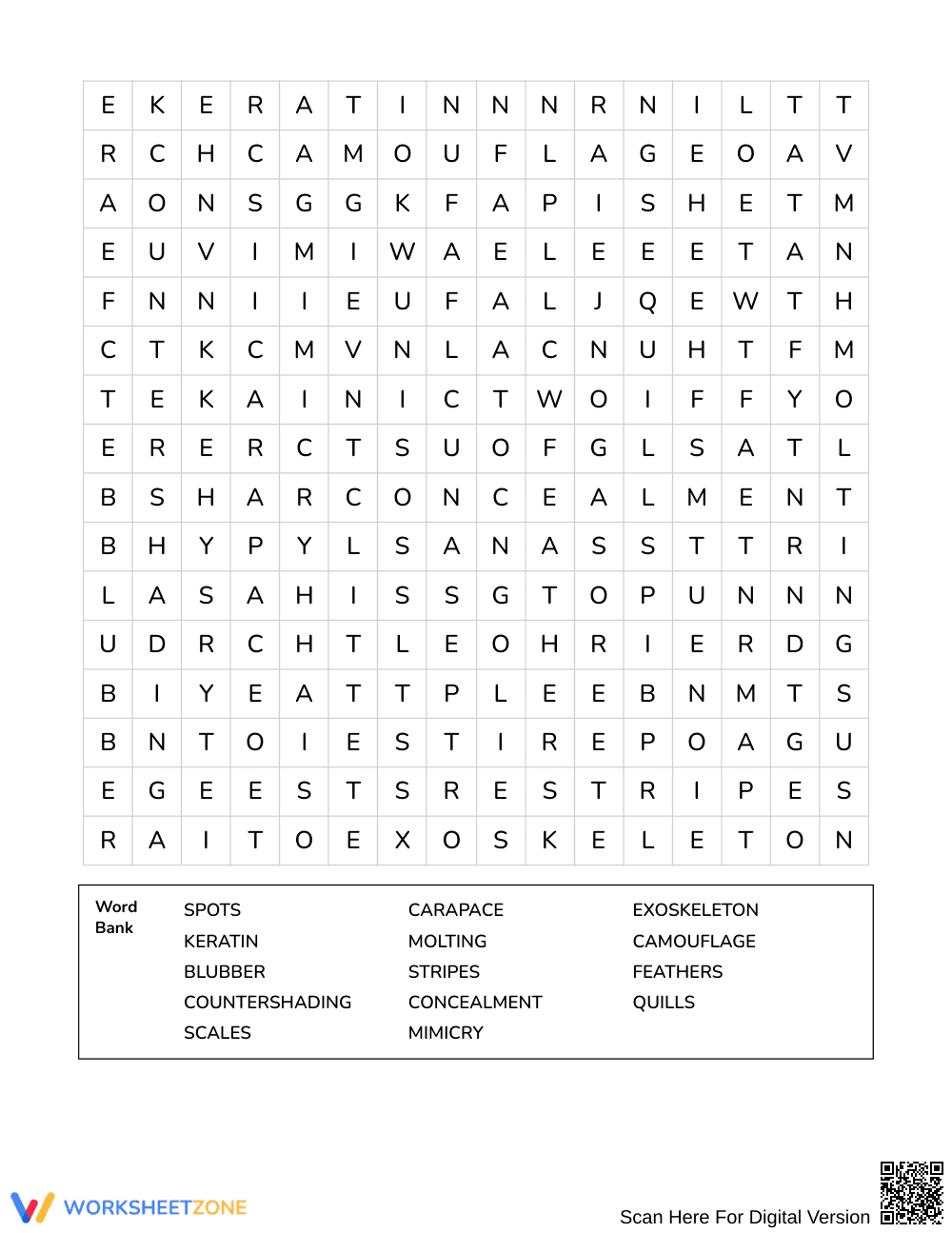

Essential Camouflage Word Search | Grades 4–5 Science

Paste this activity's link or code into your existing LMS (Google Classroom, Canvas, Teams, Schoology, Moodle, etc.).
Students can open and work on the activity right away, with no student login required.
You'll still be able to track student progress and results from your teacher account.
This science word search strengthens animal adaptation vocabulary for upper elementary students through clue-based term identification. Learners read descriptive definitions of structural defenses and body coverings, deduce the matching scientific terms, and locate them within the letter grid. The activity reinforces foundational life science terminology including protective coloration, outer coverings, and behavioral disguise mechanisms.
At a Glance
- Grade: Grades 4–5 · Subject: Life Science
- Standard: Not standards-assessed — vocabulary enrichment and animal defense concepts
- Skill Focus: Camouflage, physical adaptations, and protective body coverings
- Format: 3 pages · 14 words · Full answer key included · Printable PDF
- Best For: Life science vocabulary review, station work, and sub plans
- Time: 20–30 minutes of focused student work
What's Inside: The printable packet spans 3 pages designed for immediate classroom delivery. It features 14 science vocabulary terms focused on animal physical adaptations, paired with descriptive clue sentences rather than a simple word list. Students encounter specialized biological terms such as carapace, exoskeleton, countershading, and keratin. A complete 3-page answer key provides quick visual verification with every word highlighted in place.
Puzzle Structure and Mechanics: The activity challenges learners with a 16 by 16 letter grid where terms run in four distinct directional paths: northeast, east, southeast, and south. Rather than merely copying letters from a standard list, students read 14 contextual clues that describe biological functions—such as how blubber insulates marine mammals or how molting replaces worn outer layers. Once students identify the corresponding term, they track the hidden letters across the grid, encouraging active recall and letter-pattern scanning.
Standards Alignment: This resource serves as targeted vocabulary enrichment and is not aligned to a specific state or national standard. It supports core life science instruction by reinforcing domain-specific terms connected to animal adaptations, physical traits, and environmental survival mechanisms.
How to Use It: Deploy this word search after direct instruction on structural adaptations to cement student recall of specialized scientific definitions. It operates effectively as an independent warm-up, an engaging partner station during science rotations, or a calm sub-plan assignment. During independent work, conduct quick formative check-ins by asking students to read a clue aloud and explain why terms like countershading or mimicry protect specific animals. Expected completion time is 20 to 30 minutes.
Who It's For: This activity is built for Grades 4–5 science students exploring organism structures, survival adaptations, and ecosystem interactions. It benefits visual learners and English language learners who thrive when precise scientific terminology is anchored to clear descriptive sentences. Pair this word search with an animal adaptation reading passage, a zoo animal habitat sorting activity, or a visual anchor chart displaying animal body coverings.
Research by Fisher & Frey (2014) demonstrates that intentional domain-specific vocabulary acquisition relies on multiple meaningful encounters with technical terms in diverse classroom formats. Although not standards-assessed, this Grades 4–5 science word search targets camouflage and body coverings to help students connect 14 precise biological terms directly with their functional scientific definitions. By requiring students to interpret clue-based descriptions before locating hidden terms across a 16 by 16 puzzle grid, the resource transforms passive word finding into an active cognitive retrieval practice task. Elementary students solidify conceptual comprehension of essential animal adaptations—including mimicry, countershading, keratin, exoskeleton, and carapace—while developing visual scanning stamina in four directional paths. Embedding functional definitions alongside puzzle solving strengthens semantic networks, ensuring upper elementary learners can confidently recognize, define, and apply critical life science terminology throughout subsequent ecological investigations.


