


























Views
Downloads
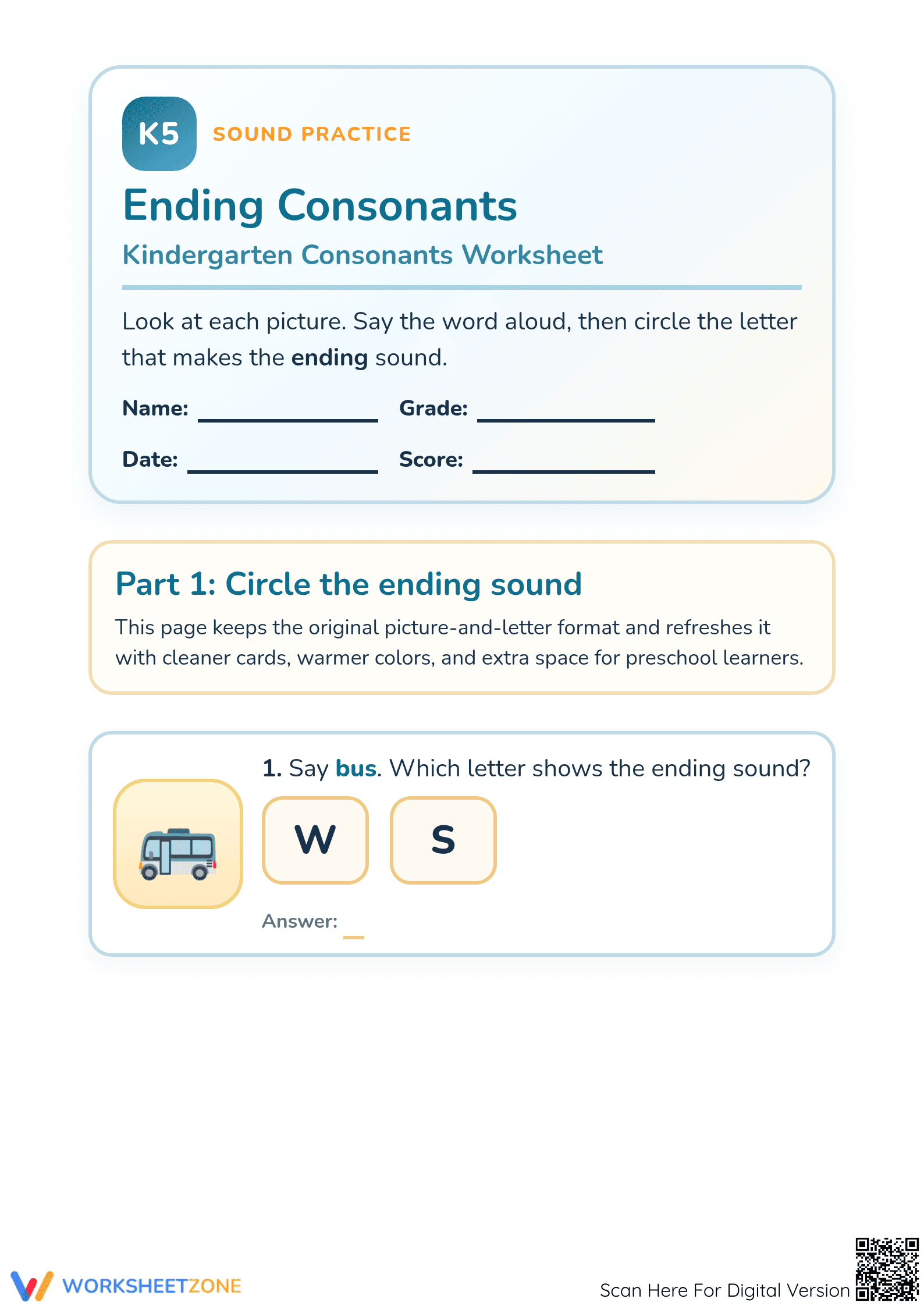


Ending Consonants Worksheet | Essential Preschool ELA
Paste this activity's link or code into your existing LMS (Google Classroom, Canvas, Teams, Schoology, Moodle, etc.).
Students can open and work on the activity right away, with no student login required.
You'll still be able to track student progress and results from your teacher account.
This Preschool ending consonants worksheet helps early learners master phonemic awareness by identifying final sounds in common words. Students practice vocalizing words and selecting the correct terminal letter, building a strong foundation for reading readiness. By focusing on auditory discrimination, this resource ensures children can isolate sounds effectively.
At a Glance
- Grade: Preschool · Subject: ELA
- Standard:
CCSS.ELA-LITERACY.RF.K.2.D— Isolate and pronounce final sounds in CVC words- Skill Focus: Ending consonant identification
- Format: 4 pages · 10 problems · Answer key included · PDF
- Best For: Literacy centers and phonics small groups
- Time: 15–20 minutes
What's Inside
This comprehensive four-page PDF contains ten structured phonics tasks. Each task features a clear, colorful illustration (such as a bus, yarn, or pencil) alongside two letter choices. The layout provides ample white space for young learners, and a full answer key is included for quick verification by teachers or parents.
Zero-Prep Workflow
- Print: Select the "Print" command on your device; 4 sheets are ready in seconds (1 minute).
- Distribute: Hand out worksheets to students for individual or small-group work (30 seconds).
- Review: Use the provided answer key or teacher tip to check for phonemic accuracy (2 minutes).
This resource requires zero assembly or teacher preparation, making it an ideal emergency sub plan or "fast finisher" activity for the literacy block.
Standards Alignment
This worksheet is strictly aligned to CCSS.ELA-LITERACY.RF.K.2.D, which requires students to isolate and pronounce the final sounds in three-phoneme words. By targeting ending consonants in words like "hen" and "sun," it supports the development of phonological awareness. This standard code can be copied directly into lesson plans, IEP goals, or district curriculum mapping tools.
How to Use It
Use this worksheet during a direct instruction phonics lesson as a guided practice activity. Ask students to say the word "bus" together, clapping for the final "s" sound before circling the letter. It also serves as a perfect formative assessment tool; observe if students struggle to distinguish between similar ending sounds to identify candidates for targeted intervention.
Who It's For
Designed for Preschool and early Kindergarten students, this resource is perfect for learners developing basic phonetic decoding skills. It is highly effective for English Language Learners (ELL) who need visual support to connect spoken sounds to printed letters. Pair it with a CVC word list or an alphabet anchor chart for maximum instructional impact.
According to the RAND AIRS 2024 report on foundational literacy, phonemic isolation of ending consonants is a critical precursor to successful decoding and spelling. Identifying terminal phonemes in CVC words like "bell" and "cup" allows students to map sounds to graphemes with higher accuracy. This Grade Preschool worksheet directly addresses standard CCSS.ELA-LITERACY.RF.K.2.D by providing ten high-quality visual prompts that require active pronunciation and selection. Research from Fisher & Frey (2014) emphasizes that such repetitive, scaffolded practice is essential for moving sounds from short-term auditory processing to long-term phonological memory. Teachers can utilize this 4-page resource as a reliable indicator of student progress toward early reading milestones, ensuring that every child masters the difficult task of hearing and identifying the "hidden" sounds at the end of common words.


