


























Views
Downloads
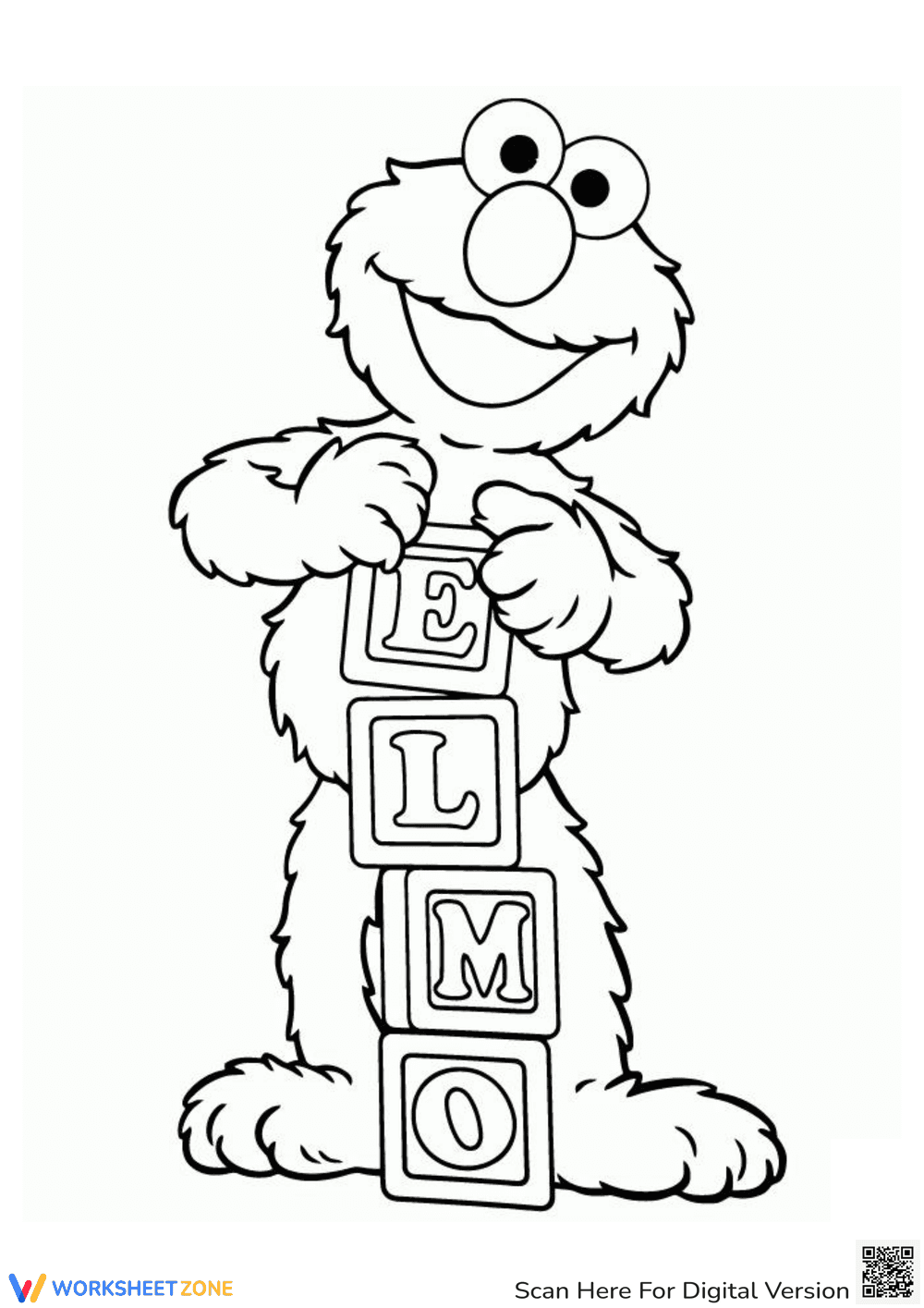

Printable Elmo Coloring Page | Grade K English
Paste this activity's link or code into your existing LMS (Google Classroom, Canvas, Teams, Schoology, Moodle, etc.).
Students can open and work on the activity right away, with no student login required.
You'll still be able to track student progress and results from your teacher account.
This engaging Kindergarten coloring worksheet helps young learners practice fine motor control and early letter recognition. Students color a familiar character holding blocks that spell a name, reinforcing print awareness while building the hand strength required for future writing tasks. It provides a creative outlet that supports foundational literacy skills.
At a Glance
- Grade: K · Subject: English
- Standard:
CCSS.ELA-LITERACY.RF.K.1.D— Recognize and name uppercase letters- Skill Focus: Fine motor skills and letter recognition
- Format: 1 page · 1 task · No answer key · PDF
- Best For: Morning work or centers
- Time: 10–15 minutes
This single-page resource features a large, clear line drawing of a popular children's television character holding four stacked alphabet blocks. The blocks clearly display the uppercase letters E, L, M, and O. The bold outlines are specifically designed for early learners who are just beginning to practice staying within the lines. Because it is an open-ended creative task, no answer key is required.
This resource is designed for immediate classroom implementation with a zero-prep workflow:
- Print (1 minute): Generate the PDF and print copies. The line art is highly ink-efficient.
- Distribute (1 minute): Hand out pages with crayons. No special teacher setup is needed.
- Review (0 minutes): Students work independently while teachers observe grip and letter identification.
Total preparation time is under two minutes, making this an excellent option for sub plans.
This activity aligns with CCSS.ELA-LITERACY.RF.K.1.D: Recognize and name all upper- and lowercase letters of the alphabet. As students color the blocks, teachers can prompt them to identify each specific letter. It also supports general fine motor development necessary for early writing. Both standard codes can be copied directly into lesson plans, IEP goals, or district curriculum mapping tools.
Teachers can utilize this coloring page during morning arrival to establish a calm environment while students settle in. It also serves as an independent literacy center activity where students practice naming the letters on the blocks before coloring. While students work, teachers can conduct quick formative assessments by asking children to point to the letter "M" or "E." Expected completion time ranges from 10 to 15 minutes.
This worksheet is primarily designed for Kindergarten and early first-grade students developing basic print awareness and fine motor control. It naturally accommodates varying ability levels; students needing more support can focus simply on coloring, while advanced learners can be challenged to trace the letters or write their own names on the back of the page. It pairs perfectly with a direct instruction lesson on the alphabet or a read-aloud session featuring character-driven stories.
Integrating creative tasks like coloring with foundational literacy instruction provides dual benefits for early childhood development. According to EdReports 2024, activities that combine fine motor practice with explicit letter exposure help solidify print concepts in young learners. When students interact with CCSS.ELA-LITERACY.RF.K.1.D to recognize and name uppercase letters within a low-stakes, enjoyable context, they build positive associations with early reading and writing. The physical act of gripping a crayon and navigating the boundaries of the character and the alphabet blocks strengthens the specific hand muscles required for future handwriting proficiency. By embedding letter recognition into a familiar and engaging visual format, educators can effectively support cognitive and physical milestones simultaneously, ensuring that foundational skills are developed in a developmentally appropriate and highly accessible manner for all young students.


