


























Views
Downloads


Complete Multi-Step Elevation Word Problems Worksheet
Paste this activity's link or code into your existing LMS (Google Classroom, Canvas, Teams, Schoology, Moodle, etc.).
Students can open and work on the activity right away, with no student login required.
You'll still be able to track student progress and results from your teacher account.
This comprehensive worksheet focuses on solving multi-step word problems involving elevation and sea level. Students will visualize vertical distance through diagrams and apply operations to calculate heights and depths. By bridging abstract concepts with real-world scenarios, learners build a robust foundation for algebraic thinking and mathematical modeling.
At a Glance
- Grade: 4 · Subject: Math
- Standard:
4.OA.A.3— Solve multi-step word problems using four operations with whole numbers and integers- Skill Focus: Elevation and sea level word problems
- Format: 4 pages · 12 problems · Answer key included · PDF
- Best For: Multi-step operation practice and integer introduction
- Time: 30–45 minutes
What's Inside
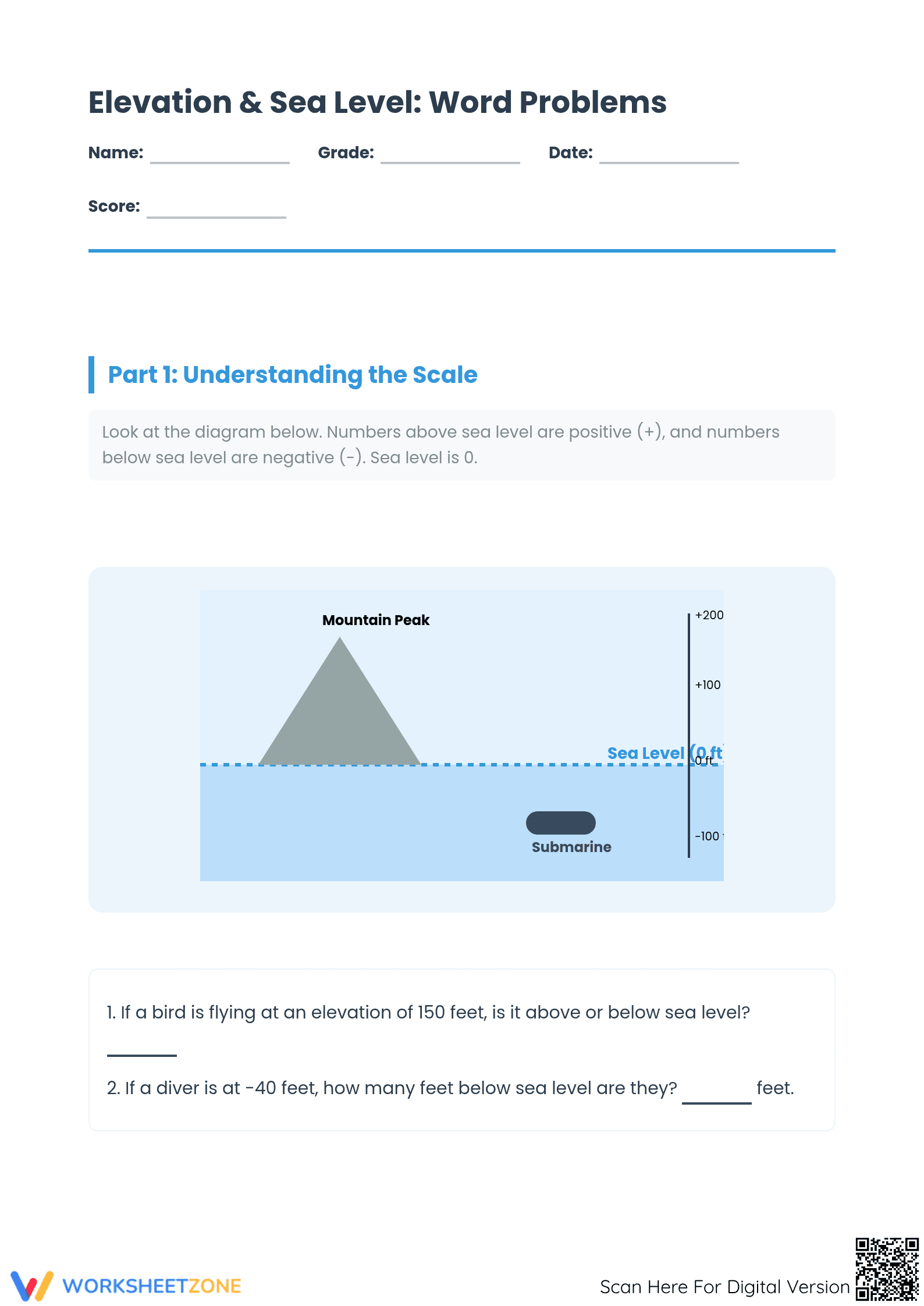
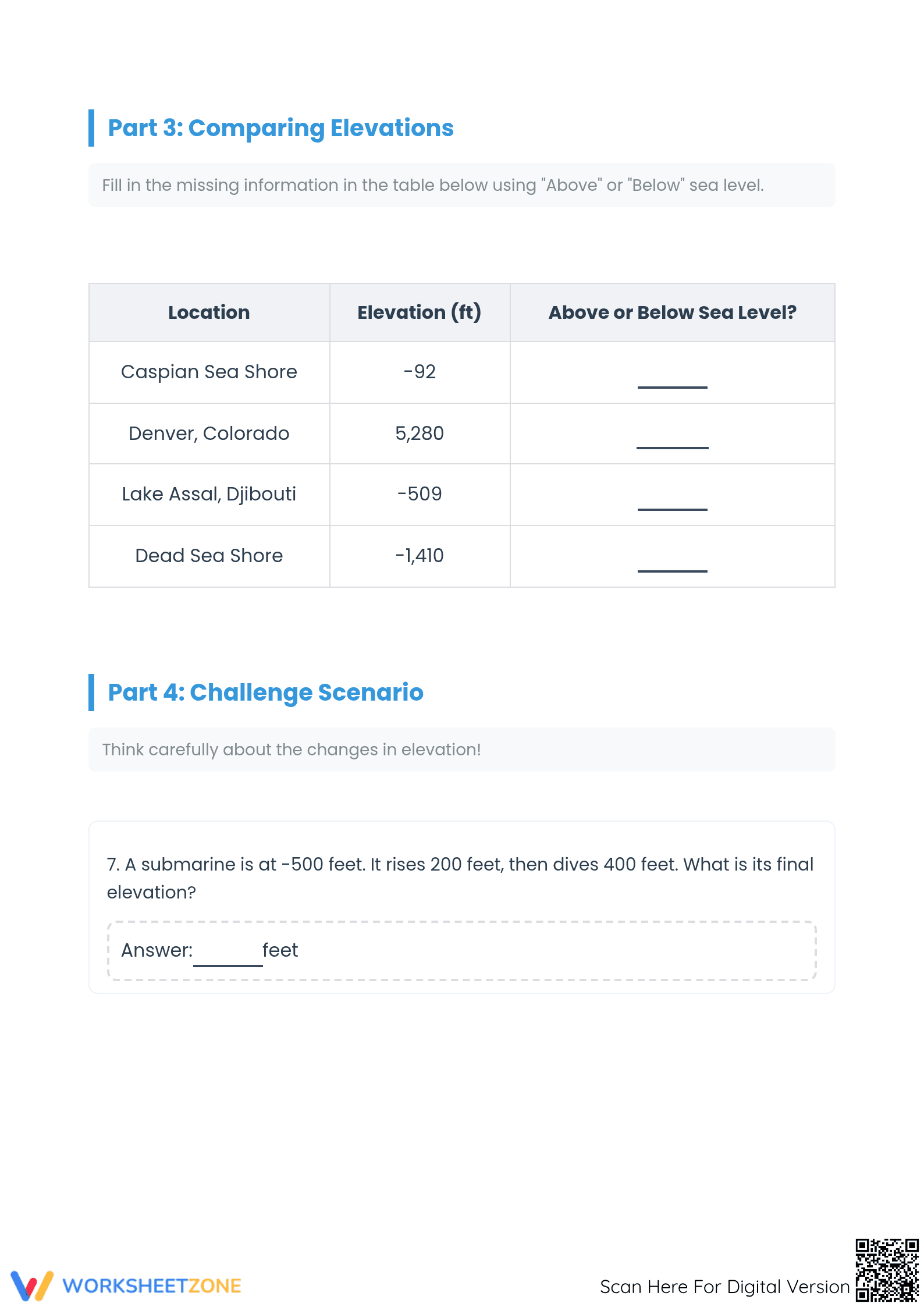
Across four detailed pages, this resource provides a structured journey through elevation concepts. It begins with a visual scale diagram that clearly identifies sea level as zero, mountain peaks as positive, and submarines as negative. The worksheet includes eight complex word problems and a four-entry comparison table. A full answer key is provided to ensure quick grading and immediate student feedback.
Skill Progression
- Guided Practice: Students interpret a labeled diagram to answer "above or below" questions, establishing a mental model of the vertical number line.
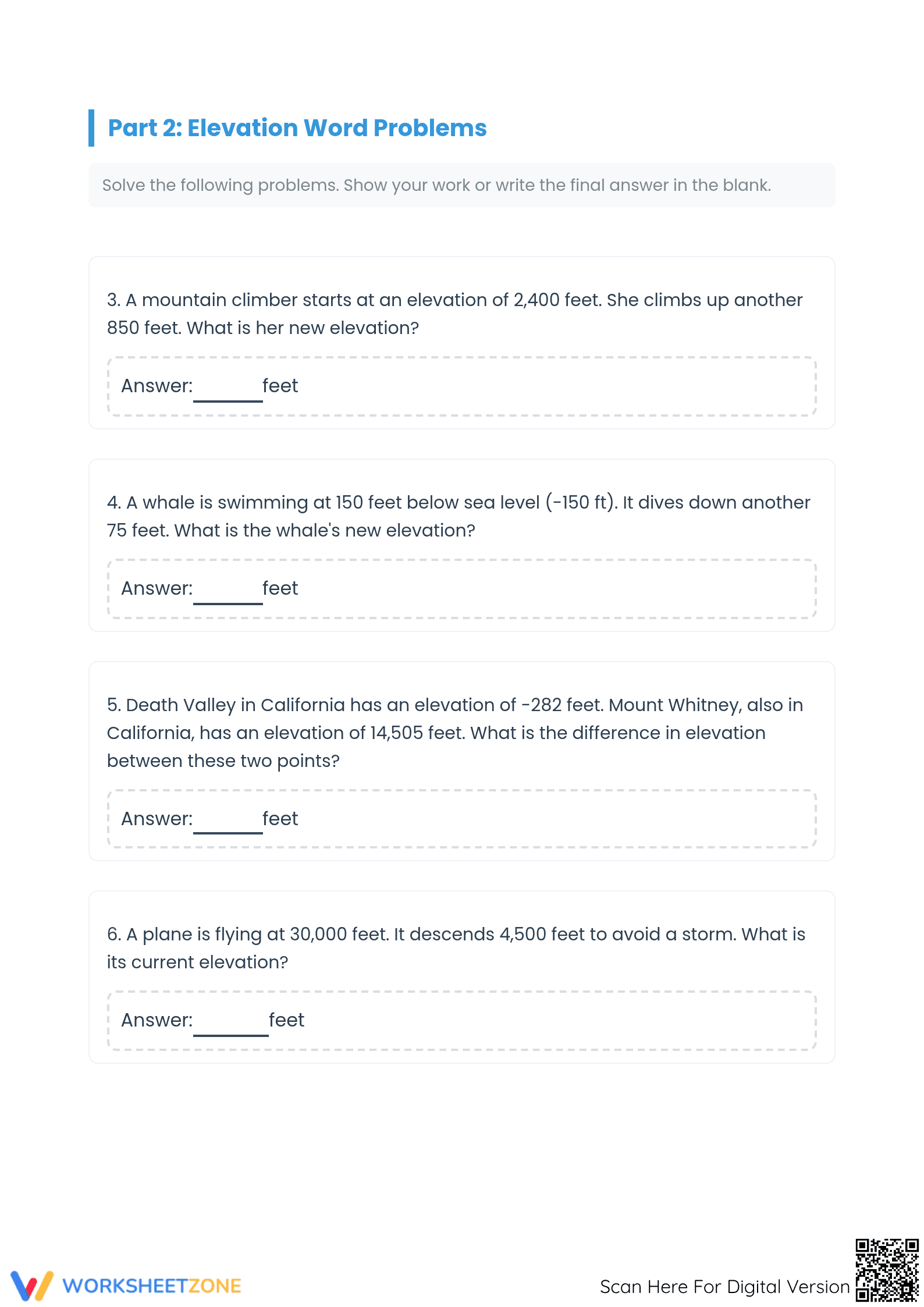
- Supported Practice: Mid-level tasks require two-step operations, such as calculating a whale's new depth or finding elevation differences.
- Independent Practice: Challenge scenarios push students to track multiple changes in position and calculate total travel distance without visual aids.
This gradual-release approach ensures students move from identifying numbers to solving complex problems.
Standards Alignment
The primary focus of this worksheet is standard 4.OA.A.3, which requires students to solve multistep word problems posed with whole numbers and having whole-number answers using the four operations. While the content introduces the concept of negative values (sea level as zero), it maintains a focus on the logic and multi-step structure required by the Grade 4 framework. Both standard codes can be copied directly into lesson plans, IEP goals, or district curriculum mapping tools.
How to Use It
Use this worksheet as a summative assessment after a unit on multi-step problems to see how students transfer skills to a new context. Alternatively, it works effectively as a collaborative small-group activity where students must explain their logic before performing calculations. For a formative check, observe students during Part 1 to ensure they understand sea level as the zero point. Completion time is roughly 40 minutes.
Who It's For
This resource is designed for Grade 4 students who are ready to move beyond simple addition and subtraction into complex scenarios. It is particularly useful for students who benefit from visual scaffolds, as the initial diagram provides a reference point. It pairs naturally with a lesson on number lines or a science unit on geographical features like oceans and mountains.
Effective mathematics instruction requires students to engage with real-world contexts that demand higher-order thinking. According to the RAND AIRS 2024 report, contextualizing multi-step problems within familiar physical scenarios—such as elevation—significantly improves student engagement and retention of operation logic. This Grade 4 worksheet leverages standard 4.OA.A.3 to challenge students to apply the four operations across multiple steps, moving beyond rote calculation. By integrating a visual vertical number line (plain-English skill: using positive and negative values to model distance), the resource helps students bridge the gap between basic arithmetic and middle-school integer concepts. The inclusion of challenge scenarios ensures that students are not merely performing operations but are thinking critically about the relationships between different quantities. This approach aligns with best practices for mathematical modeling and prepares students for more advanced algebraic reasoning in future grades.


