


























Views
Plays

Essential Elements & Symbols Worksheet | Grades 4-6
Paste this activity's link or code into your existing LMS (Google Classroom, Canvas, Teams, Schoology, Moodle, etc.).
Students can open and work on the activity right away, with no student login required.
You'll still be able to track student progress and results from your teacher account.
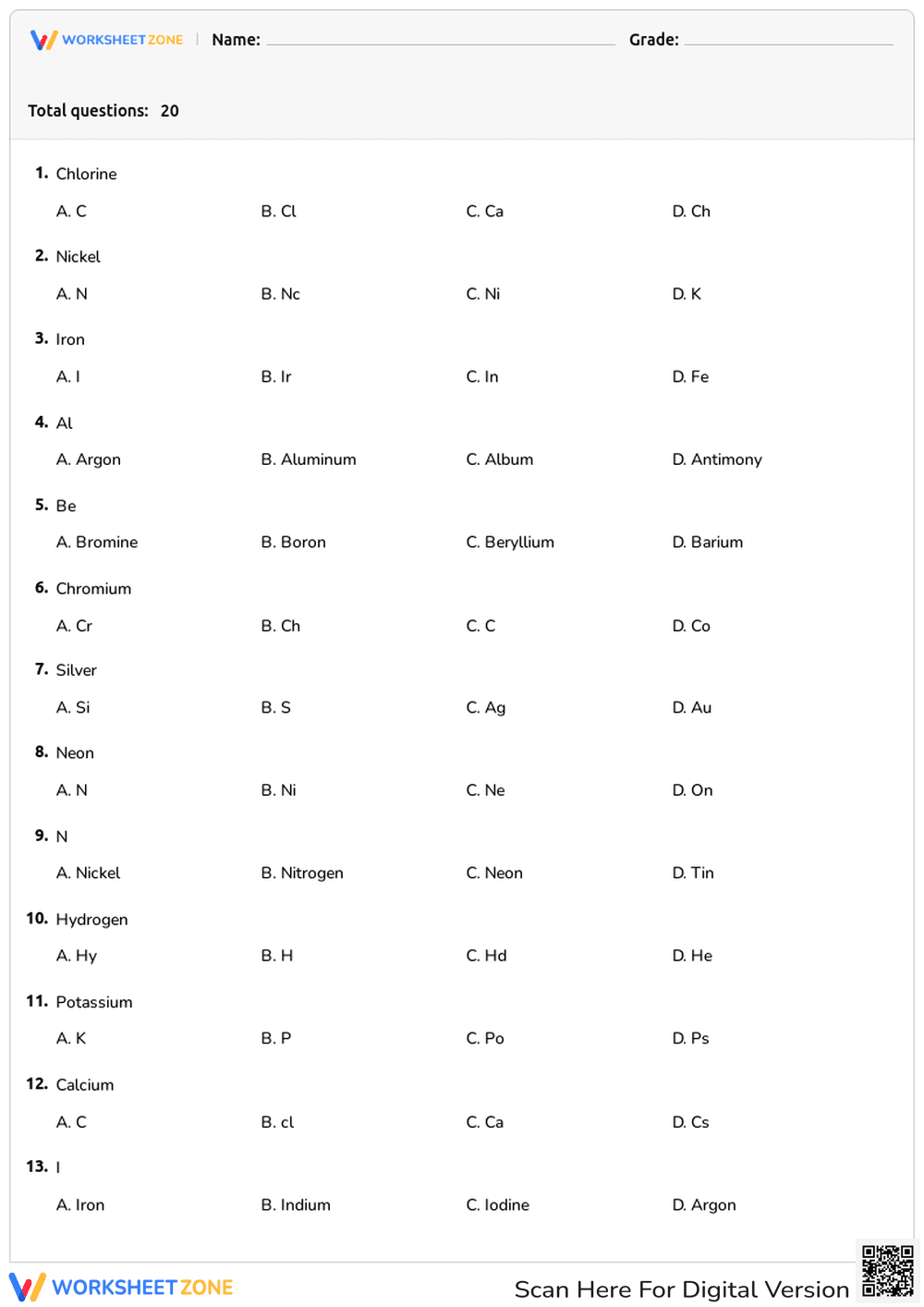
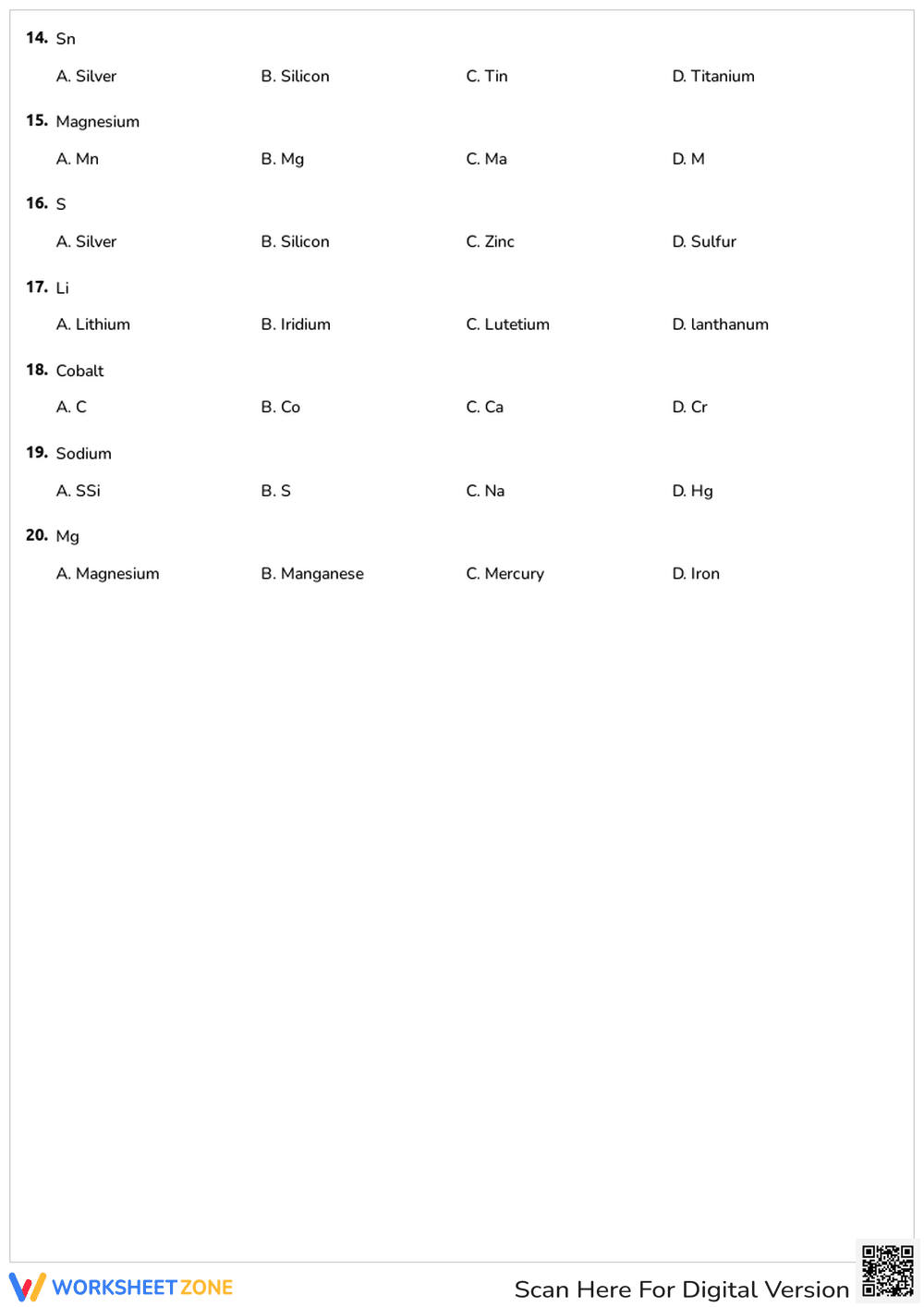
This Grade 5 science worksheet helps students master the identification of chemical elements and their symbols through 20 targeted multiple-choice questions. By practicing the translation between names like Potassium and symbols like K, students build the foundational vocabulary required for physical science mastery. This resource ensures learners can accurately recognize common elements found in the periodic table.
At a Glance
- Grade: 5 · Subject: Science
- Standard:
5-PS1-1— Identify elements and describe matter as being made of particles- Skill Focus: Chemical element identification
- Format: 2 pages · 20 problems · Answer key included · PDF
- Best For: Quick assessment or science center activity
- Time: 15–20 minutes
The worksheet consists of two pages containing 20 multiple-choice questions. Each question presents either an element name (e.g., Nickel, Chromium) or a symbol (e.g., Sn, Li) and asks the student to select the correct match from four options. The layout is clean and distraction-free, featuring a clear header for student names and grades. A comprehensive answer key is included for rapid grading.
Step 1: Print the two-page PDF (30 seconds). Step 2: Distribute to students as a warm-up or exit ticket (1 minute). Step 3: Review the 20 multiple-choice answers using the provided key (5 minutes). Total teacher prep time is under 2 minutes, making this an ideal sub plan or last-minute review for any chemistry unit.
This resource is primary aligned to 5-PS1-1: "Develop a model to describe that matter is made of particles too small to be seen." Identifying specific elements is a critical supporting skill for this standard. Both standard codes can be copied directly into lesson plans, IEP goals, or district curriculum mapping tools.
Use this worksheet during the "Explain" phase of a 5E lesson cycle to verify student internalization of element symbols. It functions effectively as a timed challenge to increase fluency. Teachers should observe if students confuse symbols like Magnesium (Mg) and Manganese (Mn). Completion typically takes 15 to 20 minutes.
This resource is designed for upper elementary and middle school students in grades 4 through 6. It is particularly useful for English Language Learners who need repetitive practice with scientific nomenclature. Pair this worksheet with a printed periodic table or a classroom anchor chart to provide additional support for students who are just beginning their chemistry unit.
This Elements & Symbols worksheet provides targeted practice for students mastering the periodic table's foundational nomenclature. By requiring students to translate between full element names and their corresponding one- or two-letter symbols, the resource reinforces the symbolic language of chemistry. According to EdReports 2024, high-quality science materials must bridge the gap between abstract concepts and concrete identification tasks to build long-term retention. This worksheet addresses 20 distinct elements, including common metals like Iron (Fe) and Silver (Ag), as well as gases like Neon (Ne) and Nitrogen (N). The multiple-choice format reduces cognitive load while ensuring students focus on the specific orthographic differences between similar symbols, such as Calcium (Ca) and Chlorine (Cl). Aligned with the 5-PS1-1 standard, this resource supports the development of a particle-based model of matter. It serves as a reliable tool for formative assessment, ensuring students possess the prerequisite vocabulary necessary for more complex chemical equations and molecular modeling in later middle school grades.


