


























Views
Plays


El equilibrio químico Worksheet | Grade 10-12 Essential
Paste this activity's link or code into your existing LMS (Google Classroom, Canvas, Teams, Schoology, Moodle, etc.).
Students can open and work on the activity right away, with no student login required.
You'll still be able to track student progress and results from your teacher account.
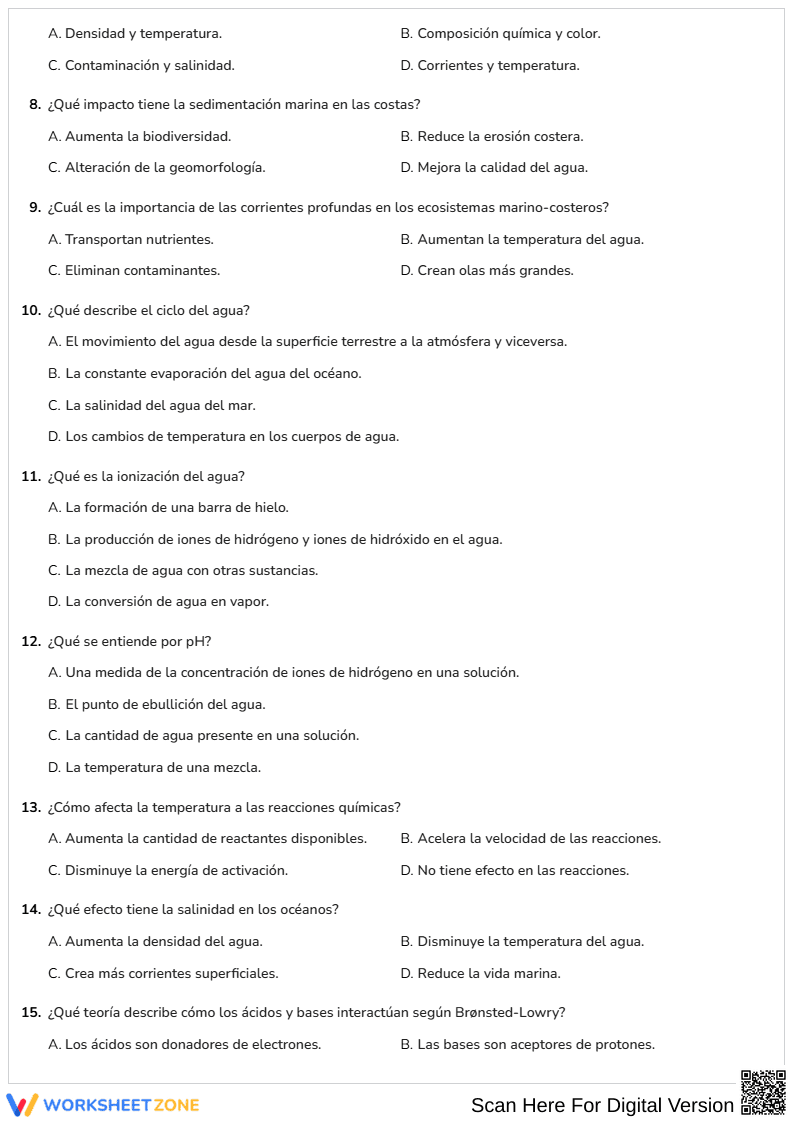
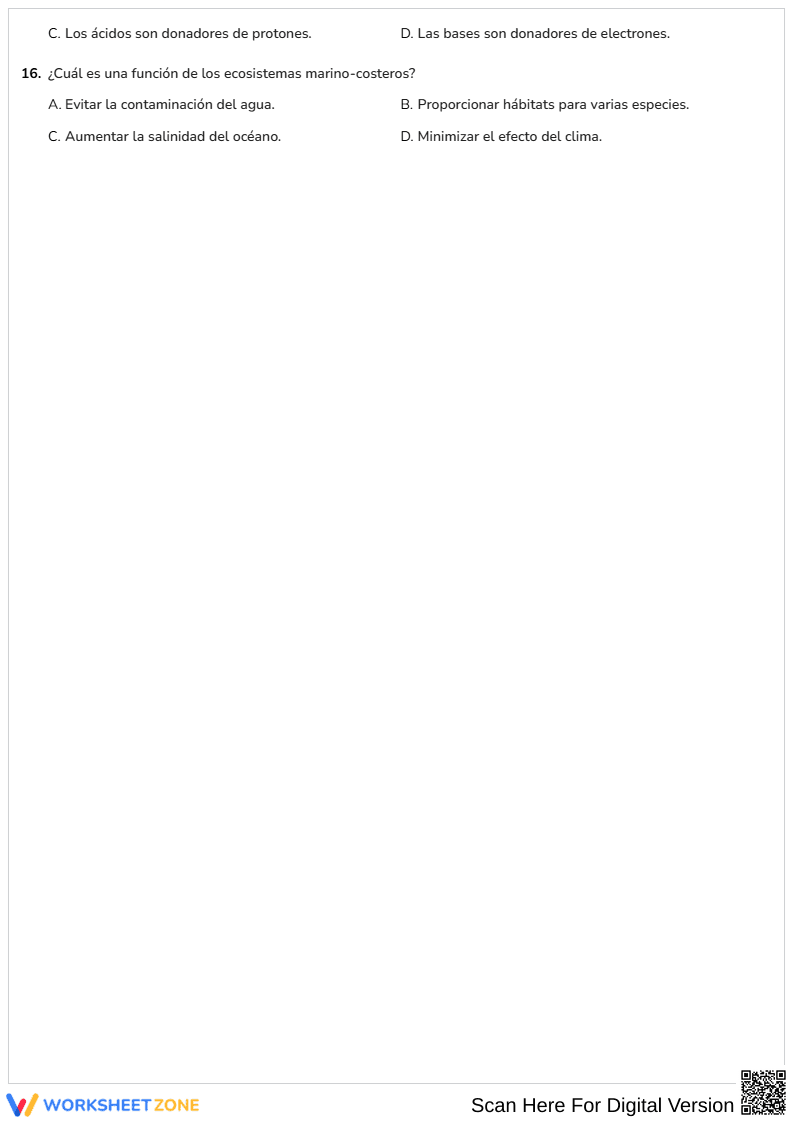
This high school chemistry worksheet provides a comprehensive assessment of chemical equilibrium and its applications in environmental contexts. Students evaluate 16 multiple-choice questions to demonstrate mastery of reaction dynamics and marine chemistry. It serves as an effective tool for measuring student understanding of how systems respond to external stressors.
At a Glance
- Grade: 10-12 · Subject: Science
- Standard:
HS-PS1-6— Refine chemical system designs by specifying changes to produce more products at equilibrium- Skill Focus: Chemical Equilibrium & Marine Systems
- Format: 3 pages · 16 problems · Answer key included · PDF
- Best For: Formative assessment or emergency sub plans
- Time: 25–35 minutes
What's Inside: This 3-page PDF contains 16 carefully crafted multiple-choice questions. The assessment covers fundamental concepts such as Le Châtelier's principle, pH scales, and acid-base theories including Arrhenius and Brønsted-Lowry. Additionally, it bridges chemistry with environmental science by exploring the chemical properties of marine-coastal ecosystems, including salinity, sedimentation, and the water cycle.
Zero-Prep Workflow: This resource is designed for immediate classroom implementation with a total teacher prep time of under 2 minutes. First, print the 3-page document for your class size. Second, distribute the worksheets as a quiet individual assessment or a collaborative partner activity. Finally, review the answers using the included key to provide instant feedback on student misconceptions regarding reaction rates and equilibrium constants.
Standards Alignment: The primary focus is `HS-PS1-6`, requiring students to refine chemical system designs by specifying changes to produce more products at equilibrium. It also touches upon `HS-ESS2-5` regarding water properties. Both standard codes can be copied directly into lesson plans, IEP goals, or district curriculum mapping tools.
How to Use It: Use this as a mid-unit formative assessment during a module on reaction dynamics. It is effective after instruction on Le Châtelier's principle to verify if students can predict system shifts. Teachers should observe responses to questions 6-9 to gauge application of chemistry to environmental issues. Expected completion is 30 minutes.
Who It's For: This resource is tailored for high school students in Chemistry, Honors Chemistry, or Environmental Science courses. It provides necessary scaffolding through clear, concise language and a structured multiple-choice format. It pairs naturally with an anchor chart on acid-base theories or a laboratory investigation into equilibrium shifts.
According to the RAND AIRS 2024 report, high-quality instructional materials that integrate cross-cutting concepts—such as linking chemical equilibrium to environmental science—significantly improve student retention of complex scientific phenomena. This worksheet addresses the need for rigorous, standards-aligned practice that challenges students to apply the HS-PS1-6 standard beyond theoretical laboratory settings. By evaluating 16 distinct scenarios involving pH, ionization, and ecosystem health, learners develop the cognitive flexibility required for advanced scientific inquiry. Research from Fisher & Frey (2014) emphasizes that structured independent practice is a critical component of the gradual release of responsibility model, ensuring that students move from guided instruction to mastery. This resource provides that essential bridge, offering a clear metric for teacher evaluation of student progress in high school science curricula.


