


























Views
Downloads

Grade 3 Spelling — Printable No-Prep Worksheet
Paste this activity's link or code into your existing LMS (Google Classroom, Canvas, Teams, Schoology, Moodle, etc.).
Students can open and work on the activity right away, with no student login required.
You'll still be able to track student progress and results from your teacher account.
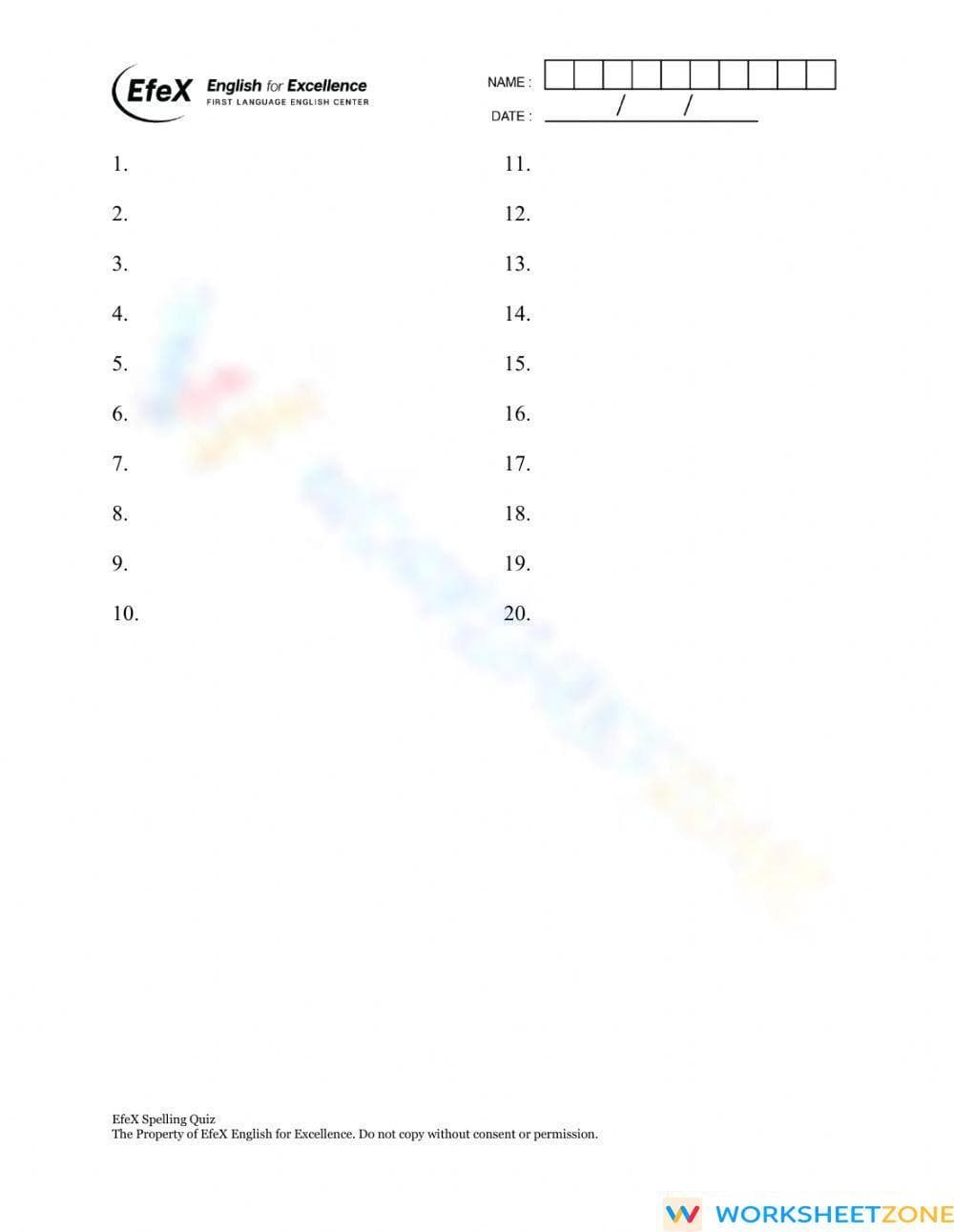
This printable spelling quiz worksheet provides a clear and organized format for assessing Grade 3 students on any 20-word spelling list. Designed for immediate classroom use, it helps teachers efficiently evaluate students' command of spelling conventions with a simple, no-fuss layout that focuses entirely on the assessment task.
At a Glance
- Grade: 3 · Subject: ELA
- Standard:
CCSS.ELA-LITERACY.L.3.2— Demonstrate command of standard English spelling conventions.- Skill Focus: Spelling Assessment
- Format: 1 page · 20 problems · Answer key not included · PDF
- Best For: Weekly spelling tests, pre-assessments, or dictation practice.
- Time: 10–15 minutes
What's Inside
This single-page PDF features a clean, professional layout, including numbered lines for 20 spelling words, student name, and date fields. Its minimalist design removes distractions, making it ideal for formal spelling assessments. As a generic template, it requires the teacher to provide the word list; no answer key is included.
A Zero-Prep Workflow
This worksheet allows teachers to reclaim valuable instructional time with maximum efficiency:
- Print (under 1 minute): Simply print one copy for each student. The black-and-white design is ink-friendly.
- Distribute (under 1 minute): Hand out the sheets. The format is intuitive for young learners.
- Review (under 1 minute): Collect and review the completed quizzes to assess student progress. No extra setup is required.
With total teacher prep time under two minutes, this resource is perfect for busy classrooms and an excellent, reliable tool to leave for a substitute teacher.
Standards Alignment
This worksheet directly supports Common Core standard CCSS.ELA-LITERACY.L.3.2, which requires students to "Demonstrate command of standard English spelling conventions." Focusing on the spelling component (L.3.2.f), it serves as a practical tool for data gathering on this foundational language skill. Standard codes can be copied directly into lesson plans or curriculum mapping tools.
How to Use It
This versatile template integrates into weekly routines as a Friday spelling test, administered after a week of instruction and practice. For formative assessment, use it as a Monday pre-test to gauge student knowledge. As students write, observe for common errors to inform instruction. The quiz typically takes 10 to 15 minutes.
Who It's For
This resource is designed for Grade 3 ELA classrooms but adapts for Grades 2 through 5 by adjusting word list difficulty. It's essential for teachers using structured spelling programs. For support, consider a word bank or pairing it with a classroom anchor chart.
Regular, low-stakes spelling assessment is crucial for effective literacy instruction, providing data on orthographic mapping. This worksheet aligns with CCSS.ELA-LITERACY.L.3.2, emphasizing spelling convention application. It allows educators to identify error patterns, adjust teaching, and track progress, making spelling practice a diagnostic tool for strengthening foundational language skills. Research by Fisher & Frey (2014) highlights the importance of regular checks for understanding in the gradual release of responsibility model, noting that structured assessments provide the necessary feedback loop for student mastery. By providing a clear, distraction-free environment for students to demonstrate their knowledge of Grade 3 spelling conventions, this resource ensures that the focus remains on the specific cognitive task of word construction. The use of a standardized 20-word format facilitates consistent data collection over time, allowing teachers to monitor longitudinal growth in phonics and spelling proficiency throughout the academic year. This evidence-based approach to spelling instruction transforms a simple quiz into a powerful engine for literacy development.


