


























Views
Downloads


Easter Island Printable Worksheet | Grade 4 ELA
Paste this activity's link or code into your existing LMS (Google Classroom, Canvas, Teams, Schoology, Moodle, etc.).
Students can open and work on the activity right away, with no student login required.
You'll still be able to track student progress and results from your teacher account.
This Grade 4 nonfiction reading comprehension worksheet builds students' ability to quote accurately from an informational text and explain what the text says explicitly, using Easter Island as the engaging anchor topic. Students read a structured passage about one of the Pacific's most mysterious landmarks and answer 10 targeted questions that require direct textual evidence.
At a Glance
- Grade: 4 · Subject: English Language Arts (ELA) — Reading
- Standard:
CCSS.ELA-LITERACY.RI.4.1— Refer to details and examples when explaining what a text says- Skill Focus: Citing textual evidence from nonfiction informational text
- Format: 2 pages · 10 problems · Answer key included · PDF
- Best For: Independent practice after close-reading lesson
- Time: 20–30 minutes
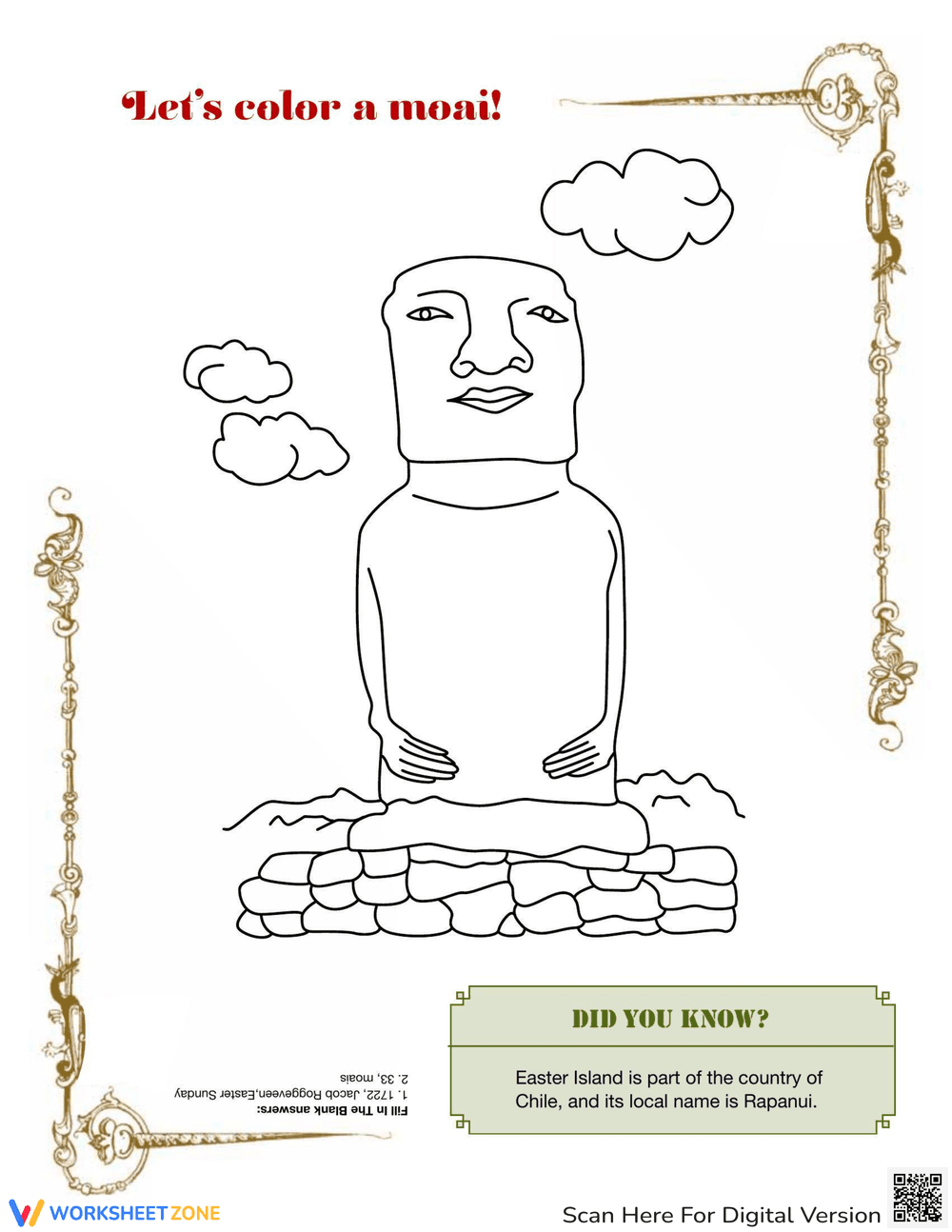
The worksheet contains a nonfiction reading passage about Easter Island — its location in the South Pacific, its famous stone statues (moai), and the cultural history of the Rapa Nui people. Task types include fill-in-the-blank sentence completion, short-answer comprehension questions, and a brief written response requiring students to cite specific details from the text. The answer key provides model responses for each item, supporting quick teacher review.
- Guided practice: 3 fill-in-the-blank items use sentence frames that direct students to the relevant paragraph, reducing cognitive load while building the habit of returning to the text.
- Supported practice: 4 short-answer questions ask students to locate explicit details and restate them in their own words, with line references provided as scaffolds.
- Independent practice: 3 open-response items require students to select and explain textual evidence without scaffolding, applying the full RI.4.1 skill independently.
This gradual-release structure mirrors the I Do, We Do, You Do model: students move from heavily supported retrieval to fully independent evidence-based writing across the 10 tasks.
CCSS.ELA-LITERACY.RI.4.1 — Refer to details and examples in a text and explain what the text says explicitly and what is drawn from inference. Supporting standard CCSS.ELA-LITERACY.RI.4.3 is addressed naturally as students explain relationships between the island's geography and its cultural significance. Both standard codes can be copied directly into lesson plans, IEP goals, or district curriculum mapping tools.
Use this worksheet after direct instruction on close reading and evidence-citing strategies. Assign as a 25-minute independent work block or as a paired reading activity. Formative-assessment tip: scan the open-response items first — students who paraphrase without quoting the text signal a gap in RI.4.1 precision that warrants a quick re-teach. As a before-assessment warm-up, the fill-in-the-blank section alone takes roughly 8 minutes and previews key vocabulary from the passage.
Best suited for Grade 4 students working at or approaching grade level in informational reading. The built-in scaffold progression makes it accessible for students needing additional support without requiring a separate version. Pairs naturally with a text-evidence anchor chart or a teacher-led think-aloud using the same passage before independent work begins.
This worksheet targets CCSS.ELA-LITERACY.RI.4.1, requiring Grade 4 students to refer to details and examples in a text when explaining explicit and inferential meaning. Easter Island's rich nonfiction context gives students a high-interest entry point into evidence-based reading. According to NAEP 2024 data, fewer than 35% of Grade 4 students perform at or above proficient in reading, underscoring the need for structured, standard-aligned practice. Fisher and Frey (2014) identify gradual-release scaffolding as a key driver of reading comprehension gains, a structure this worksheet applies across its 10 tasks. The two-page format keeps cognitive load manageable while delivering complete skill coverage from supported retrieval to independent written response.


