


























Views
Downloads
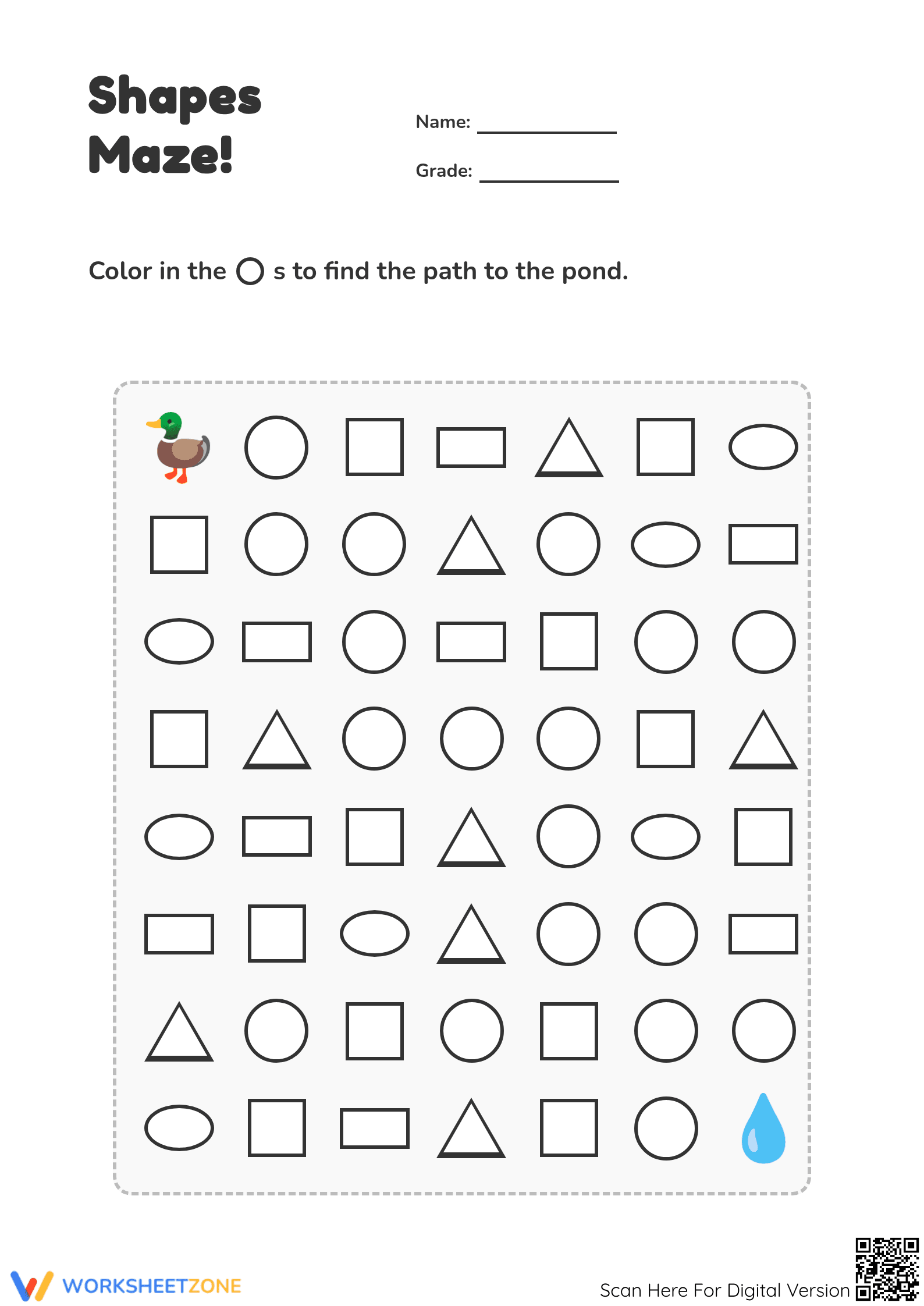

Printable Duck Maze: Circle Recognition for Kindergarten
Paste this activity's link or code into your existing LMS (Google Classroom, Canvas, Teams, Schoology, Moodle, etc.).
Students can open and work on the activity right away, with no student login required.
You'll still be able to track student progress and results from your teacher account.
This Kindergarten circle recognition worksheet helps students identify 2D shapes through an engaging maze activity. By coloring only the circles, learners differentiate between triangles, squares, rectangles, and ovals to lead a duck home. This printable resource ensures students master shape identification while developing fine motor skills and spatial reasoning in an intuitive, visual format.
At a Glance
- Grade: Kindergarten · Subject: Geometry
- Standard:
K.G.A.2— Correctly name shapes regardless of their orientations or overall size- Skill Focus: Circle recognition and 2D shape differentiation
- Format: 1 page · 1 maze task · Answer key included · PDF
- Best For: Early finishers and geometry center activities
- Time: 10–15 minutes
This single-page PDF features a large shape grid containing various geometric figures. Students are tasked with identifying and coloring every circle to reveal a path from the duck to the pond. The layout includes clear visual cues, a dedicated name and grade section, and a full-page answer key to facilitate quick checking or student self-correction during independent work.
Zero-Prep Workflow
The zero-prep workflow for this maze is designed for maximum efficiency in busy classrooms. Teachers can simply print the single-page document (30 seconds), distribute it to the class with a quick verbal instruction (1 minute), and review the final paths using the provided answer key (30 seconds). This under-two-minute setup makes it an ideal resource for unexpected sub plans or transition periods.
Standards Alignment
The primary standard addressed is `K.G.A.2`: "Correctly name shapes regardless of their orientations or overall size." Students must visually process several different 2D shapes—including squares, rectangles, triangles, and ovals—to isolate the circles. This standard code can be copied directly into lesson plans, IEP goals, or district curriculum mapping tools to document alignment with geometry benchmarks.
How to Use It
Use this worksheet as a formative assessment after introducing the circle shape in a whole-group lesson. Observe whether students can distinguish circles from ovals, as this is a common misconception for early learners. Alternatively, place it in a math center as an independent practice activity. The expected completion time is 10 to 15 minutes, depending on the student's fine motor proficiency.
Who It's For
This resource is designed for Preschool and Kindergarten students who are beginning to categorize 2D shapes. It provides essential scaffolding for students who need visual repetition. It pairs naturally with an anchor chart showing shape properties or a hands-on "shape hunt" around the classroom, providing a concrete way to transition from three-dimensional objects to two-dimensional representations.
According to a RAND AIRS 2024 analysis of early childhood education resources, engaging tasks like mazes significantly improve student retention of geometric concepts by providing a clear, goal-oriented objective. The use of K.G.A.2 alignment ensures that students are not just coloring but are actively engaging in the cognitive process of shape discrimination. This worksheet focuses on the plain-English skill of correctly naming shapes regardless of orientation, a foundational milestone in Kindergarten geometry. Research from Fisher & Frey (2014) suggests that such focused, independent practice reinforces the gradual release of responsibility, moving students from teacher-led identification to autonomous mastery. By isolating the circle within a field of distractors, the activity strengthens visual-spatial processing and ensures that the core geometric vocabulary is internalized before moving on to complex shape attributes or three-dimensional figures.


