




























Views
Downloads
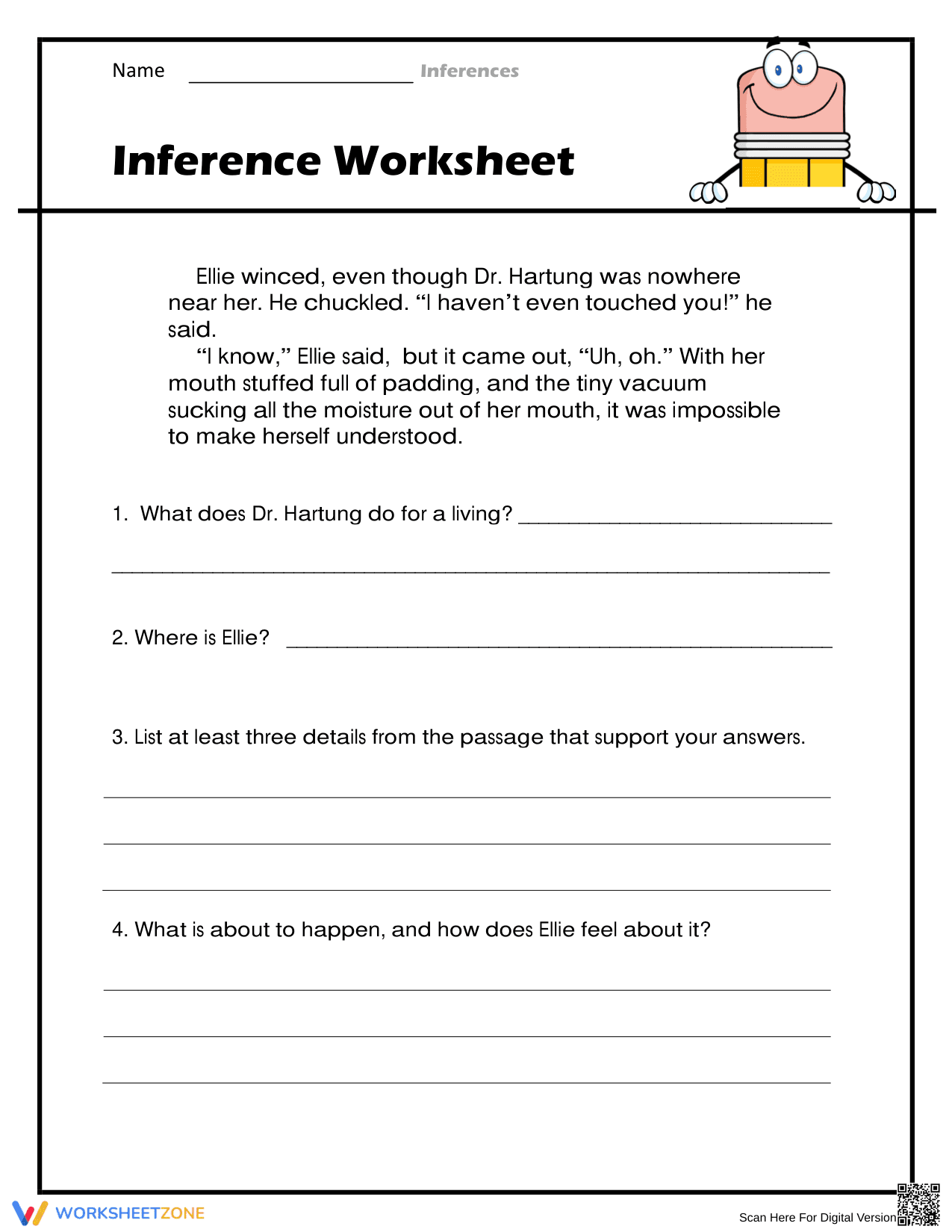

Grade 4 Making Inferences — Printable No-Prep Worksheet

Paste this activity's link or code into your existing LMS (Google Classroom, Canvas, Teams, Schoology, Moodle, etc.).
Students can open and work on the activity right away, with no student login required.
You'll still be able to track student progress and results from your teacher account.
This Grade 4 making inferences worksheet strengthens students' ability to draw logical conclusions from literary texts. By analyzing a short narrative about Dr. Hartung and Ellie, students use textual evidence to determine setting, character occupations, and emotional shifts. This activity ensures students move beyond surface-level reading to achieve deep comprehension and critical analysis of implied information.
At a Glance
- Grade: 4 · Subject: ELA
- Standard:
CCSS.ELA-LITERACY.RL.4.1— Quote accurately from a text and draw logical inferences from literature- Skill Focus: Making Inferences
- Format: 1 page · 4 problems · Answer key included · PDF
- Best For: Independent practice and quick formative assessment
- Time: 15–20 minutes
What's inside this resource is a focused one-page reading comprehension tool. It features a concise, high-interest passage followed by four structured inference-based questions. The layout includes a dedicated evidence-gathering task (Question 3) where students must list three specific details to support their conclusions. A full answer key is provided to facilitate rapid grading and immediate student feedback.
The zero-prep workflow for this worksheet is designed for efficiency. First, print the single PDF page (30 seconds). Second, distribute to students for an independent warm-up or bell-ringer activity (1 minute). Third, review the answers as a group using the included key (5 minutes). Total teacher preparation time is under two minutes, making it ideal for substitute plans or unexpected schedule shifts.
This worksheet is primarily aligned with CCSS.ELA-LITERACY.RL.4.1, which requires students to refer to details and examples in a text when explaining what the text says explicitly and when drawing inferences. By requiring students to provide three supporting details, the resource also touches upon RL.4.3 by analyzing character interactions. Both standard codes can be copied directly into lesson plans, IEP goals, or district curriculum mapping tools.
Use this worksheet during the "You Do" phase of a gradual release lesson on implicit meaning. It serves as an excellent formative assessment tool; teachers should observe whether students can identify the "dentist" setting without the word being explicitly stated. Another use case is a small-group intervention for students who struggle to move beyond literal comprehension. Completion typically takes 15 to 20 minutes.
This resource is for Grade 4 students, though it is highly effective for Grade 3 enrichment or Grade 5 review. It is particularly beneficial for English Language Learners who need practice with context clues and idiom-heavy narratives. Pair this worksheet with a character trait anchor chart or a short video clip on non-verbal cues to reinforce the concept of "reading between the lines."
According to the RAND AIRS 2024 report, the ability to synthesize implicit textual details is a foundational predictor of long-term literacy success and standardized test performance. This worksheet targets the CCSS.ELA-LITERACY.RL.4.1 standard by forcing students to bridge the gap between what is written and what is understood. By focusing on the "Dr. Hartung and Ellie" narrative, the activity engages students in a realistic scenario where they must interpret sensory details—like padding and vacuums—to infer a dental office setting. Research from Fisher & Frey (2014) emphasizes that "close reading" requires students to return to the text repeatedly, a behavior incentivized by the evidence-listing requirement in this resource. Teachers who implement these structured inference tasks see a marked improvement in student ability to defend their reasoning with specific textual citations. This 1-page tool provides the rigorous, standards-aligned practice necessary for achieving mastery in reading literature.


