


























Views
Downloads




Printable Dot Plot Dice Roll Worksheet | Grade 6 Math
Paste this activity's link or code into your existing LMS (Google Classroom, Canvas, Teams, Schoology, Moodle, etc.).
Students can open and work on the activity right away, with no student login required.
You'll still be able to track student progress and results from your teacher account.
Master the fundamentals of data visualization with this dot plot experiment. Students engage in hands-on data collection by rolling dice, building plots, and calculating measures of center. This activity transforms abstract probability into a concrete classroom experience that builds lasting conceptual understanding.
At a Glance
- Grade: 6 · Subject: Math
- Standard:
CCSS.MATH.CONTENT.6.SP.B.4— Display numerical data in dot plots and summarize data sets using statistical measures.- Skill Focus: Dot plots, frequency, and probability
- Format: 4 pages · 10 problems · Answer key included · PDF
- Best For: Individual practice or collaborative lab activity
- Time: 30–45 minutes
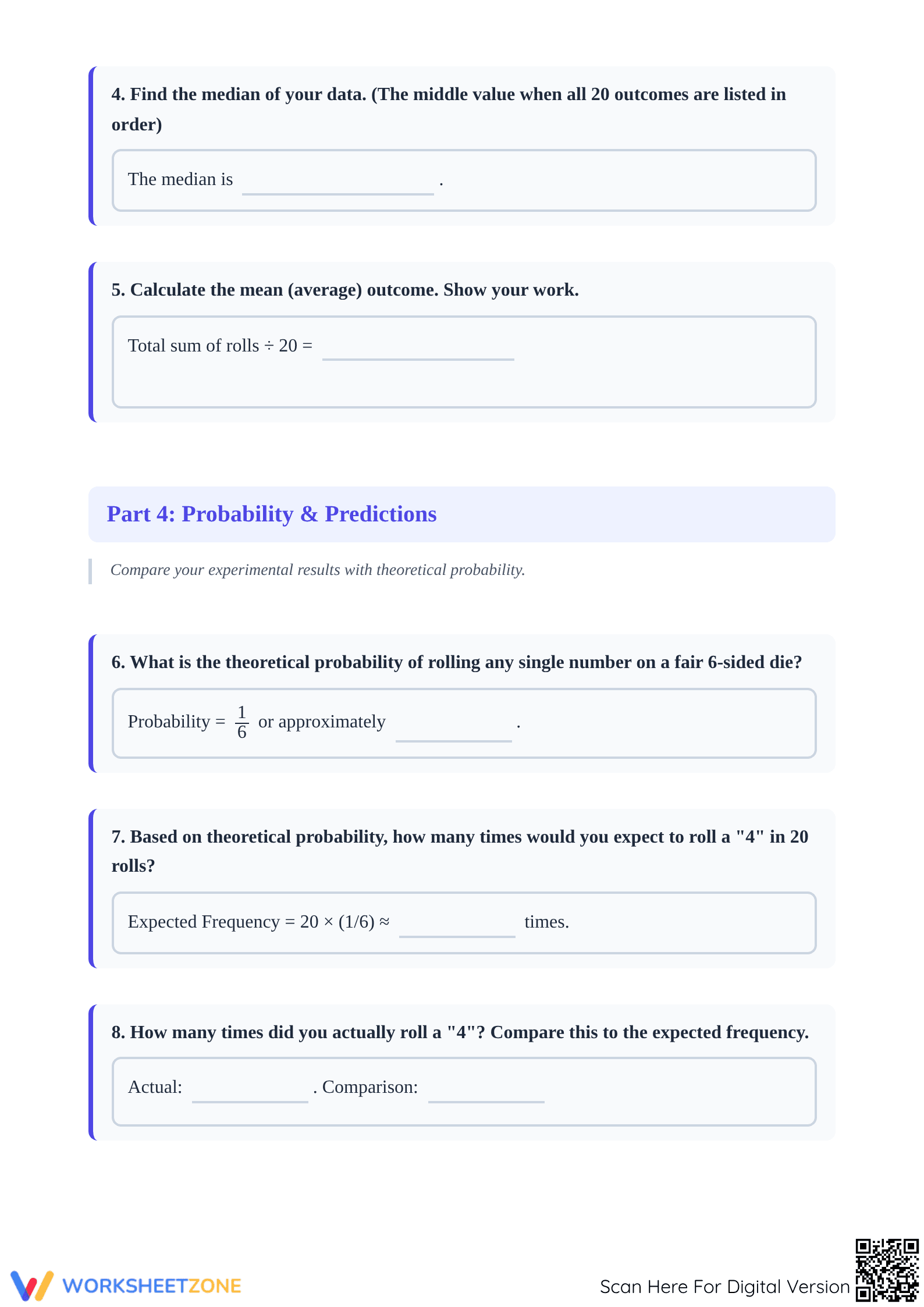
Inside this 4-page PDF is a structured sequence designed for data literacy. The packet includes a frequency table for dice rolls, a pre-labeled axis for dot plot construction, and statistical analysis questions. Students calculate mean, median, and mode while comparing experimental data to theoretical expectations in a real-world context.
- Guided Data Collection: Students roll a 6-sided die 20 times, recording outcomes in a frequency table to build essential data management skills.
- Supported Visualization: Learners translate tallies into a formal dot plot, reinforcing the link between frequency and visual representation on a number line.
- Independent Analysis: Students calculate mean, median, mode, and range, moving from basic plotting to advanced interpretation and prediction.
This scaffolded approach follows an effective instructional framework to support learners of all abilities as they master data science basics.
This resource aligns to CCSS.MATH.CONTENT.6.SP.B.4 for displaying numerical data on dot plots. It also supports 7.SP.C.6 by introducing experimental probability through repeated trials. Both standard codes can be copied directly into lesson plans, IEP goals, or district curriculum mapping tools.
Use this worksheet as a hands-on lab during your statistics unit. It is highly effective after direct instruction on measures of center. Observe if students correctly calculate the median from their 20-roll data set. Completion typically takes 40 minutes and requires only a standard die.
This resource is ideal for Grade 6 students and Grade 7 review. It serves general education, small groups, and homeschooling environments. Pair this with a standard die and an instructional passage on probability for a complete lesson cycle that engages students through active participation.
This Grade 6 Dot Plot Dice Roll experiment provides a high-leverage opportunity for students to engage in authentic data collection and statistical analysis. By rolling a 6-sided die 20 times, learners transition from raw data points to sophisticated visualizations, directly addressing the requirements of CCSS.MATH.CONTENT.6.SP.B.4. The integration of theoretical probability with experimental results allows students to bridge the gap between abstract concepts and observable outcomes. Research by Fisher & Frey (2014) highlights that such guided investigations enhance conceptual understanding through the gradual release of responsibility model, moving from structured tallying to independent analysis of measures of center like mean and median. This 4-page resource ensures that students not only master the mechanics of plotting dots but also develop the critical thinking skills necessary to predict future outcomes based on established data patterns. It serves as an essential tool for evidence-based math instruction and mastery.


