


























Views
Downloads

Essential Dolphins Crossword | Grade 4-6 ELA Worksheet
Paste this activity's link or code into your existing LMS (Google Classroom, Canvas, Teams, Schoology, Moodle, etc.).
Students can open and work on the activity right away, with no student login required.
You'll still be able to track student progress and results from your teacher account.
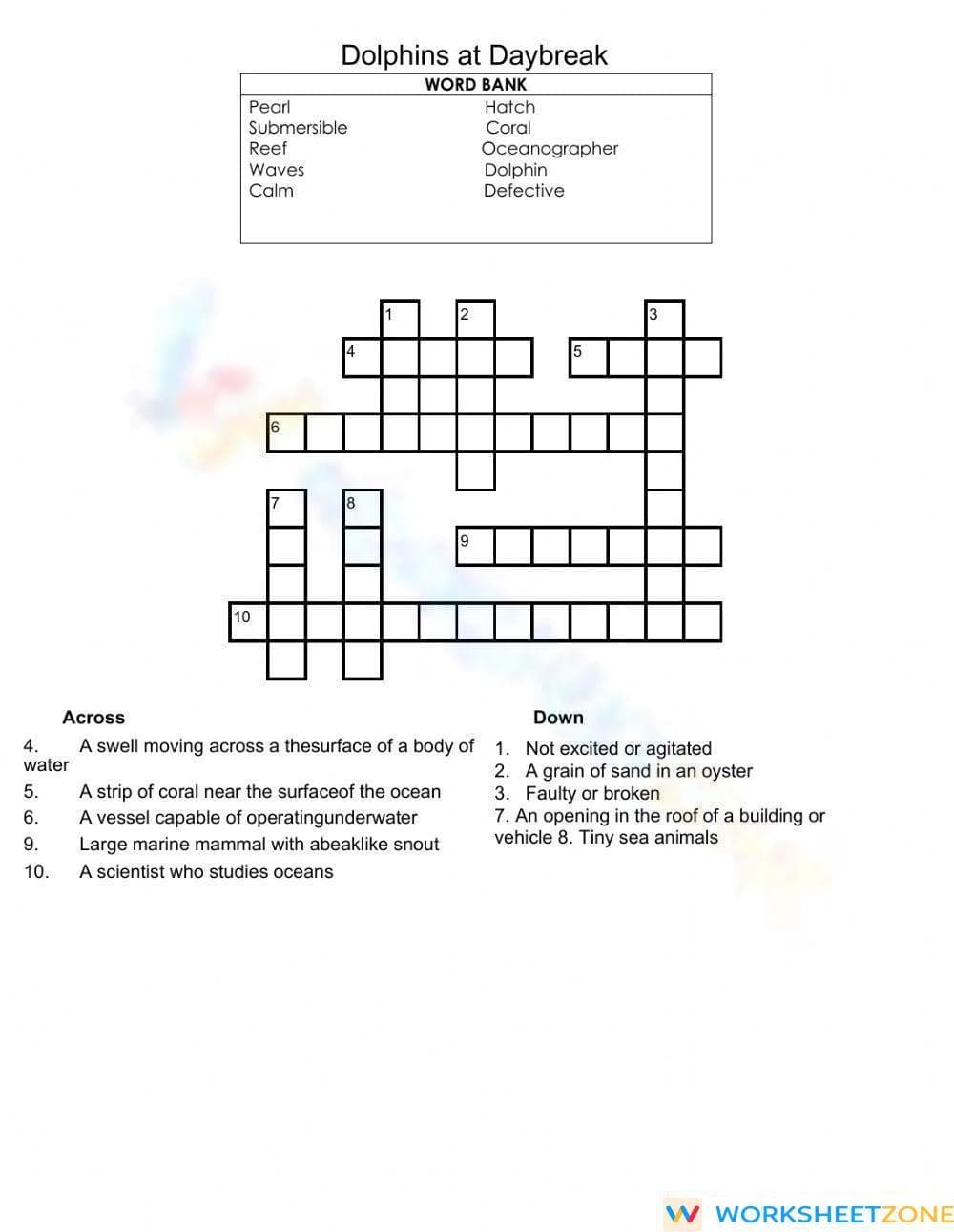
This Grade 4-6 Dolphins Crossword worksheet provides students with ten structured vocabulary clues to strengthen their understanding of marine life and oceanographic terms. By connecting definitions with terminology like oceanographer and submersible, learners build language skills. The activity serves as a complete, ready-to-use resource for enhancing domain-specific literacy in any science or ELA unit.
At a Glance
- Grade: 4-6 · Subject: English Language Arts
- Standard:
CCSS.ELA-LITERACY.L.4.6— Use grade-appropriate academic and domain-specific words and phrases accurately- Skill Focus: Ocean Vocabulary
- Format: 1 page · 10 problems · Answer key included · PDF
- Best For: Quick vocabulary review or sub plans
- Time: 15–20 minutes
What's Inside
One single-page crossword puzzle featuring ten clues divided into across and down categories. The layout includes a clear word bank to support spelling and recognition. The task covers scientific terms, nautical vocabulary, and descriptive adjectives. A comprehensive answer key is included for immediate feedback, and the high-contrast PDF format ensures clean printing for every student in the classroom.
Zero-Prep Workflow
- Print (1 minute): Download the PDF and send the page to your printer.
- Distribute (30 seconds): Hand out the worksheets as students arrive.
- Review (30 seconds): Use the provided answer key for a quick class check.
Total teacher prep time is under two minutes, making it ideal for emergency sub plans or last-minute morning work.
Standards Alignment
This worksheet is primarily aligned to `CCSS.ELA-LITERACY.L.4.6`, which requires students to "acquire and use accurately grade-appropriate general academic and domain-specific words and phrases." It also supports reading comprehension by reinforcing vocabulary encountered in informational texts about the ocean. Both standard codes can be copied directly into lesson plans, IEP goals, or district curriculum mapping tools.
How to Use It
This crossword is best used as a vocabulary reinforcement after a lesson on marine biology or as a reading companion. For a formative assessment, observe if students cross off words in the bank as they go, which reveals their level of vocabulary confidence. Expected completion time is 15-20 minutes.
Who It's For
This resource is designed for students in grades 4 through 7 developing technical vocabulary. It is especially effective for English Language Learners who benefit from the word bank scaffold. The worksheet pairs naturally with the Magic Tree House book "Dolphins at Daybreak" or any introductory oceanography unit.
Recent data from RAND AIRS 2024 suggests that integrating structured vocabulary tasks like crossword puzzles significantly improves retention of domain-specific terminology in middle-grade learners. This worksheet is specifically designed to meet the requirements of CCSS.ELA-LITERACY.L.4.6, focusing on the acquisition of academic words such as oceanographer and submersible. By providing a word bank, the resource scaffolds the learning process, ensuring that students focus on semantic connections between definitions and terms rather than struggling with spelling. Research from Fisher & Frey (2014) emphasizes that "gradual release of responsibility" is effectively supported when students apply new vocabulary in independent, low-stakes formats. This 10-task puzzle facilitates that application, building the linguistic foundation necessary for more complex science and ELA texts. Educators can confidently utilize this tool to bridge the gap between initial word exposure and functional literacy in marine biology topics.


